
CBP seeks walk-through biometric facial comparison at 38 airport terminals
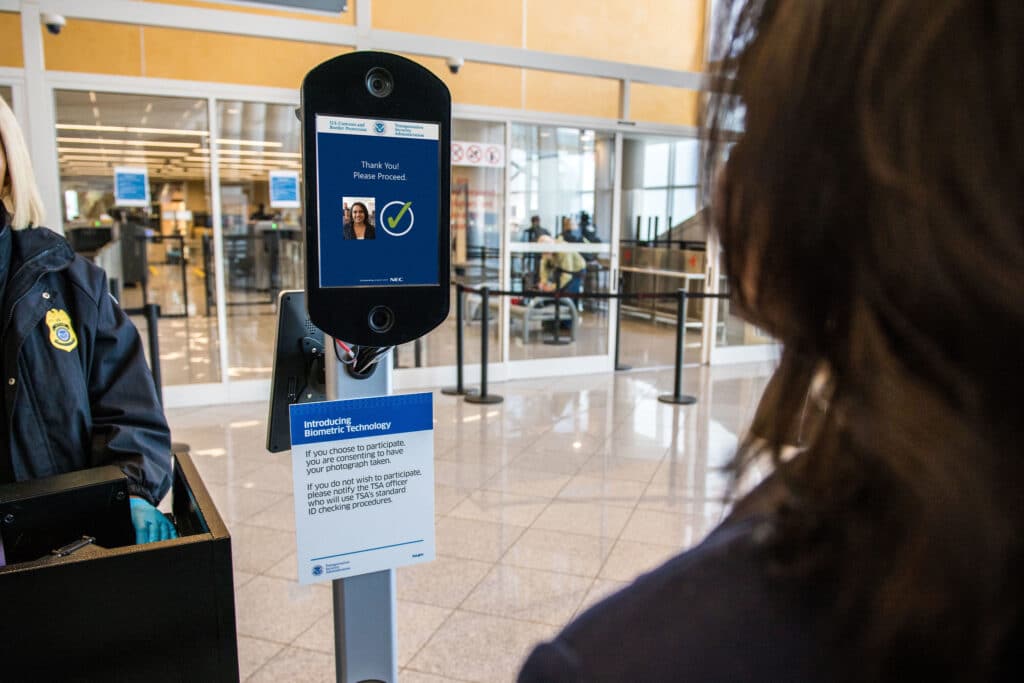
U.S. Customs and Border Protection (CBP) is seeking a biometric capture system that can photograph Global Entry travelers while they continue walking through airport arrival lanes, moving the trusted traveler program toward continuous-flow facial comparison without requiring travelers to stop at a kiosk or portal when no additional inspection is needed.
The agency’s new Global Entry Airport Modernization solicitation calls for biometric facial comparison systems at 38 international airport terminals with what CBP describes as the highest Global Entry “saturation.”
The project would move Global Entry beyond the current touchless portal model, in which travelers approach a facial comparison device, align their face with an on-screen silhouette, and have a photograph captured.
CBP’s current instructions tell travelers to approach the portal, position their face, and wait for processing to finish.
The new system would capture facial images as travelers move through a designated capture zone.
CBP says its objective is continuous processing without requiring travelers to stop unless additional inspection is needed, while improving throughput and reducing officer interaction with low-risk travelers. The contractor would provide a biometric walk-through capture lane.
CBP specifies a self-supporting archway or similar structure equipped with cameras and, where needed, integrated lighting.
Travelers must be able to walk through it, and the equipment must be flexible enough for different capture areas, airport layouts, and lighting conditions.
The structure also must conceal electrical and data wiring, withstand wear and possible tampering, be movable when inspection areas are reconfigured, and protect biometric and personally identifiable information.
The contractor’s system would capture facial images and transmit them to CBP. Biometric matching, traveler verification and identity adjudication would remain functions of CBP’s Traveler Verification Service (TVS) or a successor government system.
TVS performs the biometric matching, comparing a live photograph against a temporary gallery of source images associated with arriving or departing travelers and returning a match result within seconds. The new deployment is specifically intended for arriving Global Entry air travelers. The architecture is already central to CBP’s broader biometric travel system.
The agency says it has implemented biometric facial comparison for entry processing at all international airports and, as of its most recently published figures, has used the technology to process more than 807 million travelers.
Global Entry itself has been moving away from fingerprints, passport scans, and paper receipts for years.
When CBP introduced facial biometric Global Entry kiosks throughout Los Angeles International Airport in 2020, it said the new equipment reduced average processing time for preapproved travelers by nearly 90 percent, from about 45 seconds to less than six seconds.
The continuous-flow procurement takes that progression further by making facial capture and biometric matching part of a traveler’s movement through the inspection area rather than a separate stop at a device.
CBP is setting relatively high-performance requirements. The system must operate 99 percent of the time without failure or downtime and successfully capture photographs of at least 99 percent of Global Entry passengers.
No more than five percent of passengers can produce a “no facial match” result. At least 98 percent of passenger photographs must receive an acceptable TVS image-quality rating, and each installed system must process up to 3,500 passengers a day.
Officers would receive traveler processing status in real time.
The system must also identify and route passengers who require additional processing, so the continuous-flow model separates travelers who can be cleared biometrically from those who need additional attention.
The procurement covers 38 terminal-level installations at 30 distinct airports, not 38 separate airports.
They include John F. Kennedy International Airport, Boston Logan, San Francisco International Airport, Dallas/Fort Worth, Seattle-Tacoma, Philadelphia International, Newark Liberty, Miami International, Hartsfield-Jackson Atlanta, Washington Dulles, Los Angeles International, Chicago O’Hare, and other major Global Entry gateways.
Several airports would receive systems in multiple terminals, including JFK, Miami, Newark, Los Angeles, and San Francisco.
The list also includes CBP preclearance operations at Toronto Pearson International Airport, where installations are planned for terminals 1 and 3, and Vancouver International Airport.
CBP wants installation work to begin no later than 30 days after award, and the winning vendor must complete two installations a week. The solicitation contemplates a firm-fixed-price contract running from September 30, 2026, through September 29, 2027.
The documents do not disclose an estimated contract value. Vendors are being asked to price software, maintenance, and installation for each of the 38 deployments.
CBP plans to make the award on a best-value basis rather than simply choosing the lowest-priced offer. CBP will consider technical approach, delivery capability, and past performance along with price.
Companies seeking to compete must notify CBP by September 17 to participate in oral presentations expected September 21 and 22.
Vendors will have up to 30 minutes to address their technical approach, delivery plan, and up to three relevant past projects. Price quotes are due before the start of each company’s scheduled presentation.
The statement of work also contains a broad set of AI conditions that extend beyond the operational specifications for facial capture.
Any AI product or solution used under the contract must employ risk-management safeguards, including practices consistent with the National Institute of Standards and Technology’s AI Risk Management Framework.
Contractors must also address privacy, civil rights and civil liberties, data security, transparency, accountability, fairness, accuracy, and foreseeable risks.
The provisions require documentation of the origin, quality, and suitability of data used to train AI models, including measures to manage bias and prevent unintended disclosure of sensitive information.
A separate portion of the solicitation’s Statement of Work sets conditions for large language models (LLMs), including requirements for model, system, or data cards, safety controls, disclosure of AI training or development conducted outside the U.S., and descriptions of content moderation and output controls.
The documents do not, however, require an LLM as part of the Global Entry facial comparison system or establish that CBP intends to deploy one.
Related Posts
-
 March 25, 2026
-
 November 28, 2025
-
 February 5, 2026
-
 December 9, 2025
-
 December 17, 2025
-
 September 15, 2025
Article Topics
airport biometrics | biometric matching | CBP | face biometrics | Traveler Verification Service | trusted traveller

Comments