
London expands LFR despite weak results from rail trial
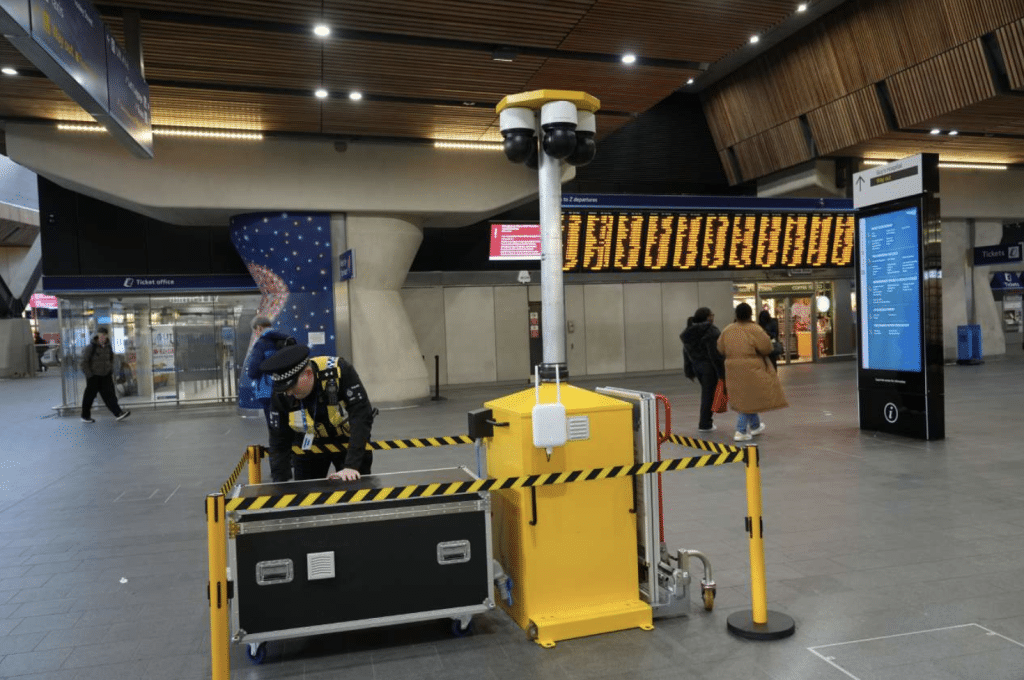
A six-month live facial recognition trial at London railway stations cost more than £320,000 (US$423,000) and nearly 100 hours of police time while producing no arrests directly from LFR alerts, according to information obtained by Liberty Investigates.
Between February and July, British Transport Police scanned more than 500,000 faces across 18 deployments at some of London’s busiest railway stations. The facial recognition system generated one watchlist alert, which proved to be a false match.
Underground trials
In August, the BTP extended its LFR trial into London Underground stations, with the first beginning August 11 at Victoria Underground station, before rotating at Underground and Network Rail stations as the trial goes on. The trial extension will proceed to November.
“This trial is an important step in understanding how this technology can be used on the London Underground in a targeted, proportionate way with strict safeguards in place,” said Siwan Hayward, director of security, policing and enforcement at Transport for London at the time.
The force will be using temporary health‑and‑safety‑assessed camera setups on station concourses. Images captured in these zones are streamed to NEC’s NeoFace M40 algorithm and checked against a watchlist of people wanted by police or courts. When the system flags a possible match, an officer makes a visual comparison and decides whether to engage.
Images of anyone not on the watchlist are deleted immediately, and alert images are wiped within 24 hours. Only standard CCTV footage is retained for 31 days, according to the BTP, which says it will notify the public before each deployment, use clear signage and offer QR‑code access to information and feedback. People who prefer not to enter the recognition zone will be given alternative routes.
NEC’s Neoface M40 is also used in a police trial in Western Australia. The overt live facial recognition (OLFR) technology trial was deemed a success, scanning more than 900,000 faces and generating 209 alerts, according to the Western Australia Police Force. The deployments resulted in 79 arrests over the first three months, 36 of which related to outstanding warrants.
London pushes ahead with static LFR expansion
The BTP results come as facial recognition use continues to expand elsewhere in London. The Metropolitan Police plans to introduce static LFR cameras across the West End and Soho, building on its Croydon pilot. Mayor Sadiq Khan has indicated that the newly pedestrianized Oxford Street will be included.
The Metropolitan Police has already deployed mobile LFR vans to scan faces against watchlists, but the Oxford Street system will likely be fixed to street furniture such as lamp posts.
Khan told City Hall the technology must be used “in a sensible way” and stressed the importance of transparency. Police say the system scanned 4.2 million faces last year, leading to more than 1,100 arrests. Commissioner Sir Mark Rowley has described LFR as “one of the biggest breakthroughs for policing.”
Last year, the Home Office spent £12.6 million on facial recognition, including £2.8 million on live facial recognition deployed through fixed-location pilots and mobile vans.
Questions of proportionality
Fraser Sampson, the former Biometrics and Surveillance Camera Commissioner for the UK, a Biometric Update contributor, and a non-executive director of Facewatch, emphasized that police should demonstrate the technology’s use was proportionate.
“We know the technology works but using it in supermarkets to deter shoplifters and prevent attacks on staff is very different from deploying it to catch people on a public transport network,” he told Liberty Investigates. Success for retailers means keeping offenders out, while success for police means making arrests, he argued. “In that respect the trial doesn’t appear to have been very fruitful,” he said.
The system only works off police watchlists, he continued, explaining that if someone isn’t listed, the live facial recognition cameras won’t flag them and won’t store their image like CCTV does.
“However, they are processing special category personal data and the technology must be used in a way that is appropriate, proportionate and necessary. It’s for the police to show how any deployment meets those criteria and – as the ICO has recently reported – for their oversight boards to hold them firmly to account in doing so.”
A spokesperson for the BTP drew attention to arrests that had been made during the deployments but that have not been included in the data. “During these deployments, officers have made a number of associated arrests, including for assault, theft, possession of an offensive weapon, breach of a criminal behaviour order and public order offences, as well as locating individuals wanted by the courts and other police forces,” they said.
“As these arrests did not result directly from an LFR alert, they are not included within LFR performance data. Throughout the pilot, we have continued to refine how the capability is deployed within the railway environment. This has included developments to deployment locations, operating procedures, equipment and watchlist construction.
“A particularly important point is that watchlist growth has been deliberate, controlled and aligned to BTP policy. We began with a more limited watchlist whilst ensuring data quality, governance and safeguarding arrangements were robust.”
Sampson discussed police use of live facial recognition in the UK and beyond in an in-depth conversation with Biometric Update Podcast last September.
Related Posts
-
 May 28, 2026
-
 January 19, 2026
-
 December 10, 2025
-
April 22, 2026
-
 April 16, 2026
-
 February 3, 2026
Article Topics
biometric matching | facial recognition | law enforcement | live facial recognition | real-time biometrics

Comments