
Masking protest: AI-enabled surveillance is a global ID issue for law enforcement
By Professor Fraser Sampson, former UK Biometrics & Surveillance Camera Commissioner
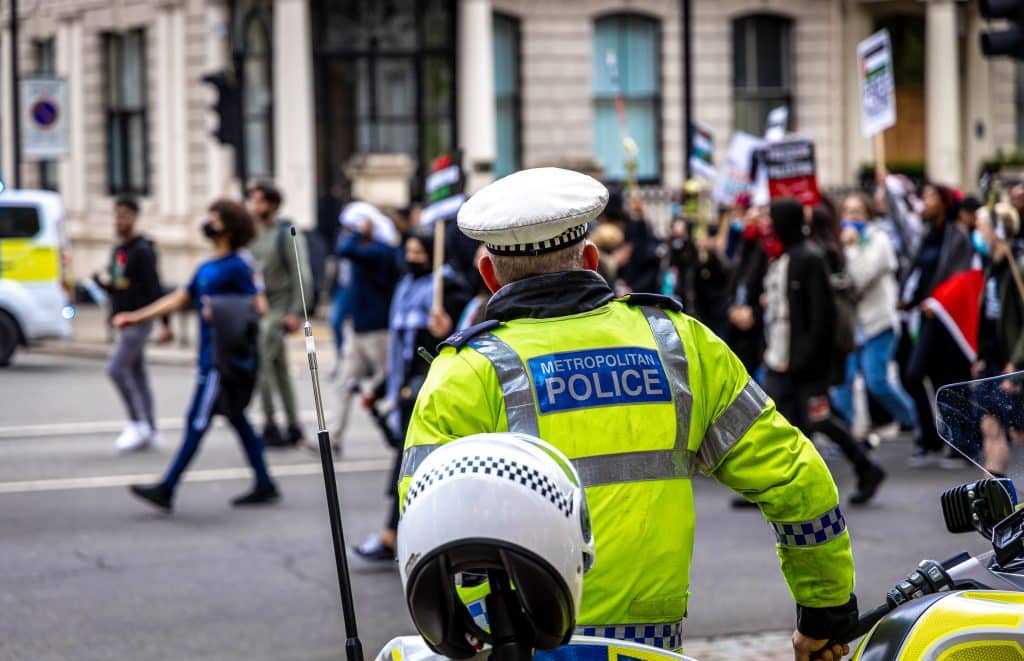
Biometrically speaking, our faces don’t give much away. Their points of individuality are great for comparison against database images to confirm ID but, compared to genetic information like DNA, our faces are quite shy. Unlike our genomics, we can change our facial appearance dramatically – and the growth in businesses offering ‘tweakments’ suggests we’re doing it a lot. However, faces are more than a biometric credential, particularly in policing. Anti-immigration protests in the UK over the past weeks have reignited debates about balaclavas and bans, and how far we should be entitled to cover up in public. But advances in AI-enabled biometric surveillance are raising important questions about ID globally – and not just for the protestors.
Citizens in the UK are under no general obligation to show their faces when in public and people choose to cover up for all sorts of practical, cultural, religious and other personal reasons. If, in covering up, we try to disguise crime or camouflage criminality, there are ways to tackle it. Banks clocked this years ago and we’ve become accustomed to removing crash helmets and masks before going into financial and other sensitive premises. Operators of private commercial space can apply reasonable conditions of entry, and some have gone on to augment this with biometric security technology like facial recognition technology (FRT) to prevent theft and attacks on staff.
Policing public space is different. For all its ingenuity, live FRT needs sufficient facial features to allow comparison with a probe image. The state hasn’t (yet) made face visibility a condition of lawfully remaining in a public area in the UK – even where the police are using live FRT to investigate serious crime. We have the right to protest peacefully not anonymously and our freedom to conceal our faces in public isn’t an express legal entitlement – but masking up is a simple expedient for avoiding recognition. Without a power to require exposure of the face, the impact of police FRT will be very restricted.
Face masking is not a biometric-specific challenge for policing or even a new one. It’s been over 20 years since Parliament empowered the police in England and Wales to require the removal of face coverings being worn to conceal ID in an area where a temporary order to tackle serious violence in is force. In surveillance, conspicuity can be an alert – being the only person in the street wearing a balaclava may invite closer investigation. But where there are hundreds, dressed in uniformly dark clothing, acting in concert, there can be different considerations and the police now have powers to designate areas where it will be an offence to wear an item concealing your identity or someone else’s. These powers and the circumstances in which they can be used are the exception. Temporally and geographically limited, they need authority from a senior officer; they are also reportedly supported by 68% of the British public.
Much has been said about this aspect of policing protests, but concealment of ID runs both ways.
Transparency is a critical element of police accountability, anonymity its antithesis. The compulsory wearing of numbers and name badges to identify individual officers is an established feature of democratic policing and particularly important in the context of public protest. However, the citizen now has access to biometric surveillance technology, reverse lookup algorithms and tools that only recently were the preserve of state intelligence agents: they are powerful, sinister and fallible. This is a global challenge for law enforcement officials. In Canada there is evidence of officers being doxxed after policing ‘politically contested events’ so that they could be harassed when off duty. In 2020 the French parliament supported a bill to prohibit the publication of pictures of police officers on duty, while last year the State of California considered passing one to stop law enforcement officers wearing masks during operations. Meanwhile, the dire risks for officers being identified when off duty have resulted in Mexican drug police looking more like Darth Vader than public servants.
Face-to-face interaction has profound cultural and psychological considerations for democratic policing; it’s elemental to the relationship between the police and the policed, the model of policing by consent and the status of the constable as a ‘citizen in uniform’. However, with the un-uniformed citizen routinely using biometric surveillance while we require the police to advertise in advance their use of cameras that can be defeated with a woolly hat, balancing the competing issues is becoming harder.
Concealing personal ID is stirring debate but transport is also a key part of the intelligence picture for facilitating peaceful protest – and vehicle masking is a critical national vulnerability. While MPs were debating the policing powers, I posted the evidence for this assertion here. The undisguised reality is that we still can’t reliably identify the UK’s 40 million registered vehicles on the country’s road network. That we are also unable to measure the size of this deficiency may be its most worrying aspect.
The global trend is towards police and protestors covering up and many specialist officers in European forces now wear face coverings in public. With even lifeboat volunteers being advised to conceal their ID for fear of being targeted after the protests, we can expect more face covering in public. But the impact of extending police powers is only part of that picture which must also take account of the explosion in the unregulated use of private biometric devices. As AI-enabled zoemetrics link our gait, pulse and even brainwaves to remote ID capabilities, the rest of us may start thinking about being more discreet too.
One onlooker at the anti-immigration protests told the Times that, while protestors’ concerns were legitimate, “once you put that mask on, you’ve lost the argument”. He may have a wider point than he recognises.
About the author
Professor Fraser Sampson is the former UK Biometrics and Surveillance Camera Commissioner, Professor of Governance and National Security at CENTRIC, non-executive director at Facewatch, strategic advisor to the Alan Turing Institute’s Centre for Emerging Technology and Security (CETaS), and a longtime Biometric Update columnist. He is also the author of the Springer Nature book How AI-Driven Surveillance is Changing our World: Do Robots Have the Right to Remain Silent?, which explores the legal, ethical and societal implications of AI-driven surveillance.
Related Posts
-
 January 12, 2026
-
 September 9, 2026
-
 October 30, 2025
-
 February 13, 2026
-
 April 9, 2026
-
 December 11, 2025
Article Topics
biometric identification | biometrics | law enforcement | live facial recognition | UK | video surveillance


Comments