
Western Australia Police claim LFR trial success after 900K scans in 3 months
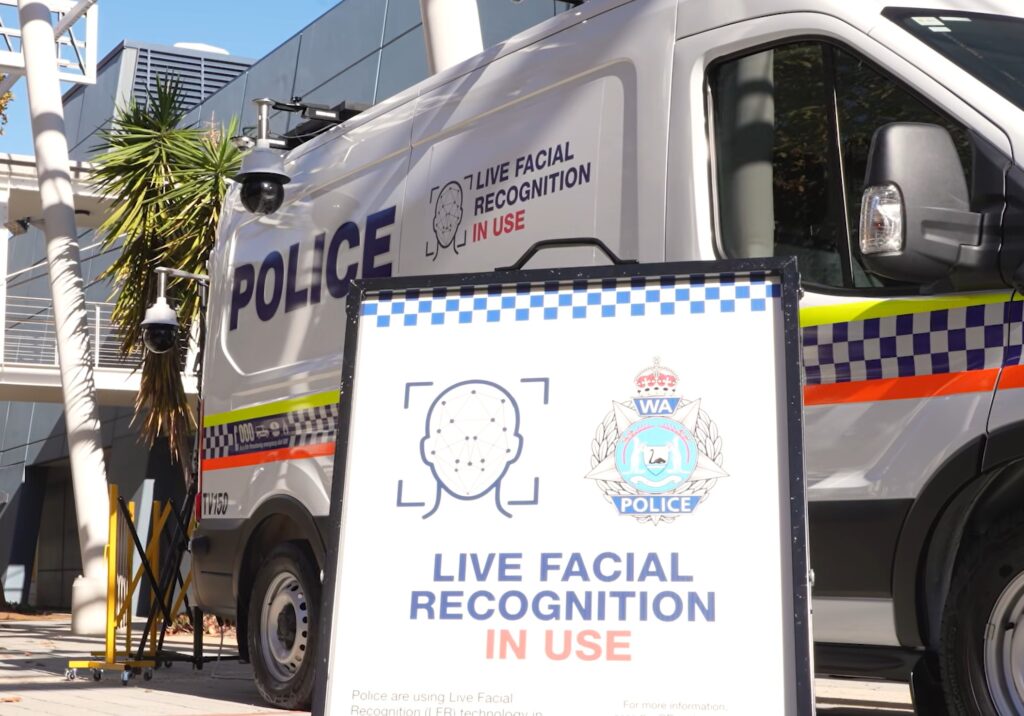
Police in Western Australia continue to trial overt live facial recognition (OLFR) technology provided by NEC, and say it has so far produced “significant results” and a “tangible increase in community safety.”
Rolled out on June 22 around the cities of Perth and Freemantle, NEC’s Neoface m40 OLFR has been deployed 77 times across 36 metropolitan and regional locations, scanning 905,117 faces and generating 209 alerts, according to a statement from the Western Australia Police Force posted on Facebook. The deployments resulted in 79 arrests over the first three months, 36 of which related to outstanding warrants.
Police also “identified and engaged with 114 Registered Sex Offenders and located eight people to ascertain their welfare.”
The OLFR technology did not, however, perform perfectly: it recorded eight “incorrect alerts,” representing a rate of 0.0009 per cent. All of the false matches misidentified people with darker skin tones. Police say the eight people were questioned but not arrested.
No apologies, regrets for government or police
The deployment has been controversial, with privacy advocates raising concerns about privacy risks and a weak consultation process, particularly in engaging Western Australia’s First Nations.
However, the Minister for Police appears unconcerned, proclaiming at a press conference that “the government makes no apology whatsoever for using technology to make Western Australians safer.”
“This is technology which only identifies and captures information about people who represent a risk to the community,” says minister Reece Whitby. Biometric templates generated for non-matches are deleted immediately. Data retention only applies when a match occurs.
WA Police Commissioner Col Blanch doubles down on Recce’s statement, also declaring that “we make no apology” for using the tech. He insists that strong governance measures are in place, and that a human-in-the-loop system means that every match generated by OLFR must be confirmed by a human officer before escalating.
“We don’t put people in handcuffs immediately,” Blanch says. “We ask questions.” He maintains that the program is primarily about deterrence, “the support of our community and us being highly visible.”
OLFR joins AR-15s among police tools for ‘deterrence’
Some, however, wonder about visibility on the receiving end, and how OLFR deployments could lead to mass surveillance. The “overt” part of OLFR is a clearly labeled police van that drives around and parks at events, ostensibly advertising its activity in an attempt to reassure people.
Blanch says retailers have told him they feel safer and that there have been no thefts or “disorderly behavior” in the areas of the deployment. In an interview with radio 6PR, he expands on how this “visibility” leads to deterrence.
“In my view, deterrence of people seeking to do harm is better than trying to catch them on the quiet,” he says. He notes that cameras also capture “people who look suspicious,” which allows officers to (politely) question them. It may be nothing. It may just be an interaction with police.”
Branch does not seem to realize how close he is getting to the red line, over which concerns about potential misuse of facial recognition are justified by practical use and intention. A live facial recognition van parked in a public space as an implied threat to criminals and would-be wrongdoers is a real-world mobile panopticon, which fundamentally leverages surveillance and fear as a tool for control.
Certainly, while 0.0009 sounds like a negligible number of false matches, the view would be different among those eight people misidentified as criminals or sex offenders.
It is worth noting that, later in his interview, Branch defends his decision to have officers armed with AR-15s patrol public spaces in what he describes as “one of the safest places in the world.”
Nonetheless, there may be a public appetite for OLFR in Western Australia. Branch says that at street deployments, “overwhelmingly the engagement with police is very positive, particularly among people with families.”
Formal evaluations will tell more of the story. The website for the WA Police Force says “the trial will be assessed against set performance measures.” The Equality Impact Assessment conducted in May 2026 specifies that “all deployments will be subject to a post deployment review, including analysis of false alerts, demographic patterns, system performance, and community impact. Findings will be reported to appropriate oversight groups and used to inform continuous improvement and ethical governance.”
Related Posts
-
 August 11, 2026
-
July 10, 2026
-
 April 16, 2026
-
 February 3, 2026
-
 January 27, 2026
-
 October 15, 2025
Article Topics
Australia | biometrics | criminal ID | law enforcement | live facial recognition | NEC | Western Australia Police

Comments