
Cameroon’s civil registration reform faces $85M funding gap
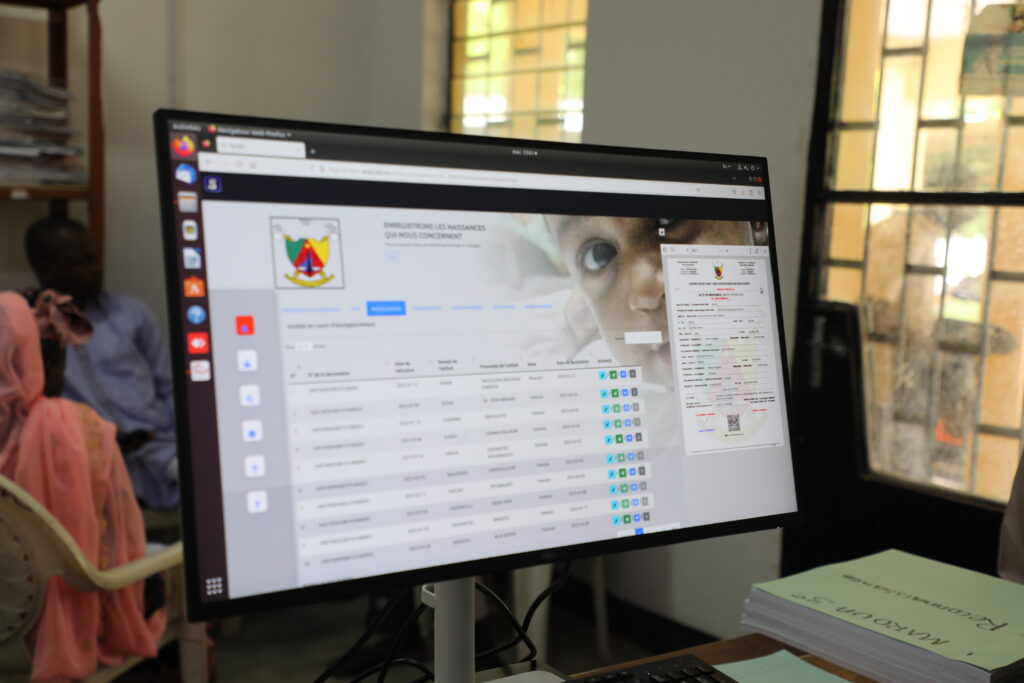
Cameroon needs more than FCFA 50 billion, about US$85 million, to fully digitalize its civil registration system by 2029–2030, according to the Director General of the National Civil Status Registration Office (BUNEC), Alexandre-Marie Yomo, who identified financing as one of the primary hurdles.
In a recent interview with Presidence Actu, a program on state broadcaster CRTV, Yomo made a thorough X-ray of efforts undertaken by the civil registration body to advance a reform process that the government launched in 2018. He discussed the challenges which he noted are at several levels, including financial, operational and administrative, the state of their current work, as well as perspectives for the future including a planned Public-Private Partnership (PPP) engagement.
According to the BUNEC boss, considerable efforts have been made over the past eight years to build the country’s foundational identity architecture, citing a 2024 milestone that saw the enactment of a new legal framework reorganizing the civil status registration ecosystem. The legal framework, which is intended to refocus the country’s legal identity journey, provides for several innovations aimed at streamlining civil status registration, but many of the provisions are yet to be fully operationalized through implementing decrees.
Yomo said most of their work so far has been in collaboration with international development partners such as the World Bank, the United Nations Children’s Fund (UNICEF) and other UN agencies working in the area of identity for development.
The beginning of the reform
The reform process, Yomo said, effectively started during his tenure from 2015, when he was appointed Director General of BUNEC. In 2018, a preliminary technical evaluation was conducted by a consultant recruited through German cooperation and estimated that the cost of full nationwide computerization of the country’s civil status registration system was FCFA 25 billion (US$42.7 million). That estimate has since proved insufficient. Yomo said the assessment has now been revised to a little more than FCFA 50 billion (US$85 million), taking into account factors including inflation and expanded needs.
He explained that after the study, active deployment of a national civil status database began in 2022 with a pilot project that covered civil status registration centers in some local councils in the capital, Yaounde.
Cameroon currently has 432 principal civil registration centers, which include 49 in diplomatic missions and consulates across the network. In addition to this, there are 2,439 secondary centers and 149 special centers which operate in health facilities. Yomo said to date, the computerization process has been extended to 60 principal centers, and efforts are being made to increase the number.
At the moment, Cameroon runs a hybrid model of civil status registration, which includes a paper-based manual process, which is the more dominant one, as well as a parallel digital registration model which operates only in selected councils. The common factor between the two systems is that documents and signatures generated under both carry identical legal validity under the 2024 legal framework.
Litany of operational constraints
Over the years, there has been a number of operational constraints which BUNEC has faced on the road to the modernization drive. Apart from the huge financial needs, he cited constraints related to fraud and duplication, noting that manual operations leave the civil status registration system vulnerable to document falsification, identity theft and circumvention of legal provisions.
The interviewer referred to more than three million people reportedly affected by double identities or duplicate civil status records, while Yomo responded that fraud is manifest in the country and takes several forms, including identity theft, document falsification and circumvention of legal provisions.
It will be recalled that recently, the government launched an audit to re-identify public servants who benefit from a child allowance scheme, where hundreds of thousands of birth certificates submitted for it are suspected to be fraudulent. The audit was launched after the number of children declared for family allowances rose from 594,728 in June 2024 to 923,307 in March 2026.
According to Yomo, issues related to unpaid personnel and resistance to change are also hampering their efforts. He said while workers at principal civil status registration centers receive salaries through councils, personnel operating in secondary and special health facility centers do not have the same employment status or fixed remuneration. This exposes the system to negligence, delay and corruption, he said. Yomo added that there has been some noticeable resistance to change, especially at the level of local councils, where some mayors and other municipal authorities appear to prioritize other local expenditures over civil status computerization.
The government, through the Ministry of Decentralization and Local Development, has been working to implement a digital master plan intended to accelerate the pace of local and regional councils in the digitalization of their public services.
Sometimes, because of the non-payment of staff in some secondary centers, there is room for corruption and extortion, as some of them charge illegal fees for initial civil registration, a phenomenon that is persisting at the local level despite the existence of explicit legal mandates declaring initial registration free of charge.
In September 2023, the Public Independent Conciliator for the North West Region launched a three-month campaign against extortion and corruption at the level of civil status document issuance. The move led to several mayors in the region making public commitments to sticking to the legal provisions which say that initial civil status registration services are free of charge.
Other constraints cited by Yomo in the ongoing reform process include archival degradation and field obstacles where paper registers in many council archives are poorly maintained, missing or damaged, which limits the historical data that can be ingested into the digital database.
He also mentioned additional field constraints such as administrative vacancies in remote centers, cultural and religious delays in declaring births, such as waiting until naming ceremonies in some cultures, socioeconomic priorities, as well as security instability in conflict-affected regions such as the Far North, where Boko Haram insurgency is a problem, and the North West and South West English-speaking regions, where an armed conflict has persisted for almost a decade.
PPP engagement and future perspectives
Yomo noted that despite this litany of challenges, there is some hope, and a strategic plan they are currently implementing has a stated 2030 objective which they intend to meet. The idea is to coincide with Target 16.9 of the UN Sustainable Development Goal, which calls for legal identity for all, including birth registration, by 2030.
He said, among other things, that following encouragement by the state, BUNEC is planning to leverage public-private partnerships in order to raise private capital.
Last year, BUNEC announced a partnership with Liber Technologies, a Luxembourg-based company specializing in digital government services, which it said would support the ongoing reform process. The partnership was discussed during a working session in Yaounde in October 2025, with the two sides identifying funding for the national civil registration policy, securing existing archives and connecting civil registration centers among the challenges facing the reform. PPP is increasingly becoming vital in helping countries build digital public infrastructure systems.
Meanwhile, Yomo said they are also working to ensure a dual digital entry, a process that will combine real-time digital creation of new civil status records with retro-digitalization of legacy paper archives in all civil status registration centers across the country.
Relatedly, he said BUNEC is also currently working on a proposal for a nationwide civil registration population survey, which is aimed at reconstructing destroyed, missing or unrecorded civil status archives directly from households. This, he said, will make it easier for them to identify Cameroonians who do not yet have a foundational identity.
Civil registration-National ID linkage
Speaking further, the BUNEC chief reiterated plans of linking the civil registration system and the country’s national ID system, which is a recommendation from the African Union.
He said in this light, BUNEC is already deploying an inter-administrative platform to create that linkage in order to streamline the issuance of national ID cards and passports.
In Cameroon, BUNEC issues birth certificates, but national ID cards are issued by the General Delegation for National Security. He added that this interoperability vision is expected to be extended to the Ministry of Finance, as part of efforts to eliminate state payroll ghost workers and to better manage pensions. Cameroon is currently implementing a platform called AIGLES, which authorities have touted as a response to pervasive payroll fraud in the country.
Yomo said BUNEC also intends to link its systems with the National Social Insurance Fund (CNPS), for automated family allowances, commercial banks, insurance companies, the transport and education sectors, and the automated compilation of the national electoral register.
He also added that efforts are being made to continue to build capacity and oversight of the system. About 15,000 civil status officers and secretaries have already been trained since BUNEC’s establishment, he disclosed. He said efforts are constantly being made to maintain the annual distribution of civil status registers across the country in order to eliminate shortages in the field. BUNEC is also scaling up annual field inspections of registration centers to have closer follow-up on their activities.
Per the BUNEC boss, efforts are also being made to include minority and marginalized communities in parts of the country. In Djoum, in the East Region, for example, BUNEC has identified nearly 2,000 Baka people without birth certificates and planned a catch-up registration exercise for them.
With this reform push, Yomo stated that the broader objective is to build a modern civil registration system that is capable of providing reliable legal identity, generating accurate statistics and sharing data securely with other public institutions for seamless public service delivery. The scale of the task, however, means that the 2029–2030 target remains closely tied to one fundamental requirement, which is securing the resources needed to complete the computerization of the system.
Related Posts
-
 November 17, 2025
-
 January 12, 2026
-
 March 2, 2026
-
 March 3, 2026
-
 October 27, 2025
-
 October 2, 2026
Article Topics
Africa | Cameroon | civil registration | identity management | legal identity | National Civil Status Registration Office (BUNEC) | national ID | public-private partnerships | SDG 16.9

Comments