
Western Australia live facial recognition trial results: 1.4M faces, 122 arrests
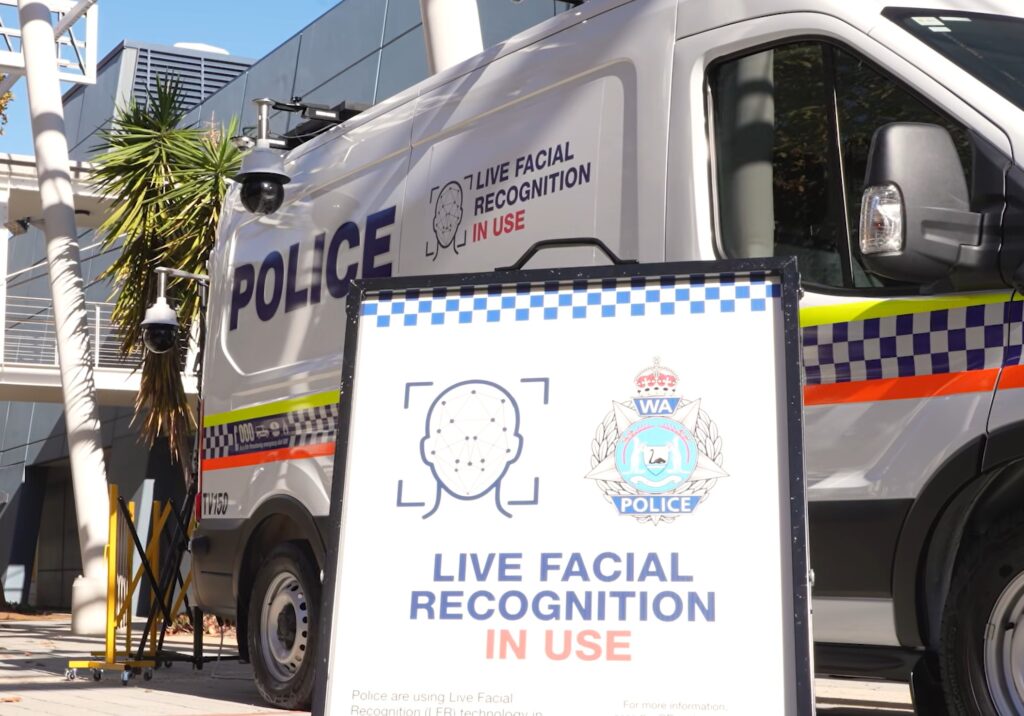
Western Australia’s trial of live facial recognition has now concluded. According to a government release, the five-month trial, supported by NEC’s Neoface M40 biometrics platform, saw 1,380,882 faces scanned by 100 cameras deployed across 43 locations, generated 292 alerts (9 of which were incorrect), identified 146 registered sex offenders and led to 122 arrests.
The government holds up the 0.00065 percent false match rate (FMR) rate as evidence of the trial’s technical success. But statistics go both ways, and the scale of Western Australia’s live FRT trial raises critical questions about proportionality.
Western Australia has a total population of 3,076,528, as of December, 2025. Some 2.4 million of those live in the greater Perth area.
The government’s Overt Live Facial Recognition deployment register shows that at least 36 of total OLFR deployments were in Perth, totaling 878,599 faces scanned. The figure for scans surely includes multiple scans of some individuals, but no figures on repeat scans are provided.
Thus, quick calculations show that Western Australia’s OLFR trial scanned faces amounting to the equivalent of approximately 45 percent of the total population of the state, and roughly 37 percent of the greater Perth area.
Effective does not mean proportionate
The framing of the trial illustrates the difference between an effective system and a proportionate one.
Police laud the system’s technical functionality and how useful it is for their purposes.
But a system is not automatically fit for purpose simply because it works.
Police in Western Australia say live FRT is an effective tool for fighting crime and maintaining community safety. They believe highly visible facial recognition cameras, mounted on or near a marked police vehicle and deployed in designated public spaces, can act as a powerful deterrent. Officials have been unapologetic in their endorsement of live FRT as an effective support for law enforcement.
Yet there is no way to determine the number of crimes that might have occurred, but didn’t. And the authorities’ promise to turn their focus to an internal evaluation examining system performance, operational effectiveness, community impact, and governance and compliance is likely to place its emphasis on the first two categories. There is no hard metric for measuring privacy losses against public safety, and the mere volume of biometric scans conducted on the public is not a reasonable gauge for success.
Internal evaluation sure to frame live FRT as a win for police
Western Australia Police have already faced criticism for doing minimal consultation before the deployment, including a note from the Office of the Information Commissioner WA (OIC WA) saying it was aware of the trial “but was not invited to participate in any formal consultation process with WA Police and did not provide input into the design.”
The country’s Aboriginal population has also raised concerns about bias and systemic oppression resulting from the use of face biometrics.
Now, police face the question of how to interpret results that they have already declared show live FRT to be a success. Which is to say, any further internal evaluation of the trial’s findings is unlikely to arrive at a different conclusion.
The police’s arguments in favor of the tech have also highlighted that it does not store biometric information of individuals who aren’t identified against a watchlist. Yet the point, again, is not what the system does, or how much the system can do it, but rather the extent to which it should be applied.
If a trial scans more than a third of the faces in Perth, further deployments will aim for more coverage. Moreover, trials presage production deployments. Without consultation or independent oversight, Western Australia’s live FRT plan begins to look a lot like the total surveillance state that critics of facial recognition technology fear it enables, and a textbook example of scope creep.
Related Posts
-
 September 22, 2026
-
July 21, 2026
-
July 10, 2026
-
August 11, 2026
-
June 19, 2026
-
 February 3, 2026
Article Topics
Australia | biometrics | law enforcement | live facial recognition | NEC | Western Australia Police

Comments