
UK police force to test robot dog equipped with AI analytics
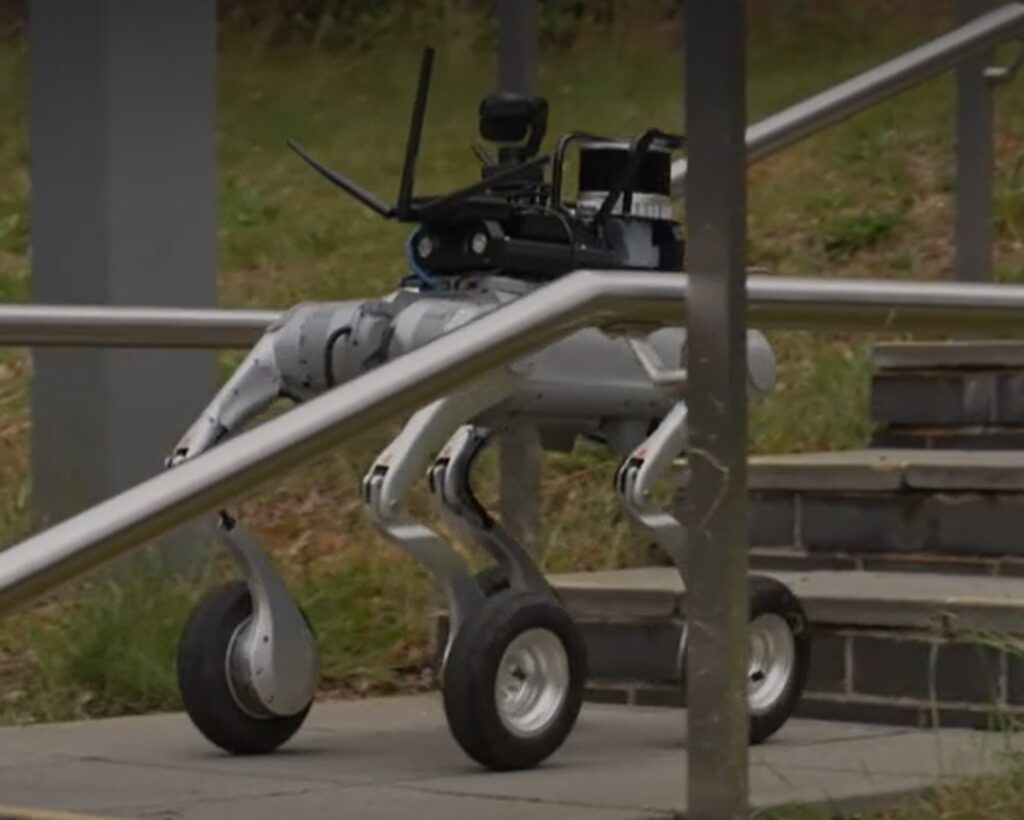
A UK police force is about to test its first robot dog, equipped with cameras that detect weapons and people with AI analytics and a LiDAR system that creates 3D maps of the environment.
Nottinghamshire Police plans to test the device in training scenarios such as armed sieges, hostage negotiations and building searches. The trial will last three months with potential deployments starting in 2026.
The device was designed by 22-year-old Nathan Wallace, who believes that the robot could be used as a land-based drone.
“We have an AI camera which can detect weapons – so handguns, knives, baseball bats, hammers, that sort of thing,” says Wallace. “Then on the back, we’ve got cameras which are all viewable by the remote, so we’ve got a kilometre of range there.”
Aside from several cameras, the robot dog is equipped with a loudspeaker, allowing police to speak to a suspect remotely, and moves on four legs with small wheels. The device could allow police officers to gather intelligence about a volatile situation, without putting lives at risk, according to Nottinghamshire Police Superintendent Louise Clarke.
“In the unlikely event of an incident involving chemical or biological agents, for instance, we would have access to another form of reconnaissance to gather vital information about a dangerous situation,” says Clarke.
The robot dog could also carry supplies and be sent to confined spaces that cannot be reached by aerial drones.
The device is funded by the Office of the Chief Scientific Adviser. The testing will be conducted by Nottinghamshire Police’s Firearms Training Team, with results submitted to the Home Office. Aside from its capabilities, the trial will also evaluate whether the £24,000 (US$32,200) price tag per unit is value for money, the BBC reports.
The UK police have been exploring and deploying other technologies, including facial recognition, drones and AI analytics. For now, it is unclear whether Nottinghamshire police could use video feed from the robot drone to match faces with facial recognition.
Robot dogs are slowly entering the mainstream when it comes to policing in other countries as well. In the U.S., police forces have been testing the devices in cities such as Honolulu, Denver and Los Angeles. Not everyone, however, is excited about their arrival.
Earlier this year, media found that the Honolulu police had not used its $150,000 robot dog in three years, with the department reportedly unsure what to do with it. In 2021, the New York City police abandoned the use of a similar device made by Boston Dynamics after a public backlash.
“It’s creepy, alienating and sends the wrong message to New Yorkers,” a spokesperson for the New York City mayor, Bill de Blasio said at the time.
Robot dogs, however, may find their niche on private grounds. The Mercedes Benz Stadium, located in Atlanta, introduced a robot dog in 2023, equipped with facial recognition and license plate recognition. Designed by Boston Dynamics and developed by Asylon Robotics, the robot is used to autonomously patrol 11 acres and send back real-time video during 30-minute shifts.
Related Posts
-
 March 5, 2025
 -
 March 10, 2025
 -
 December 13, 2024
 -
 September 11, 2024
 -
 March 6, 2025
 -
July 15, 2025
Article Topics
AI | law enforcement | LiDAR | research and development | robots | UK | video analytics | video surveillance

Comments