
Continental challenges, continental solutions: Africa Digital ID Hackathon 2026
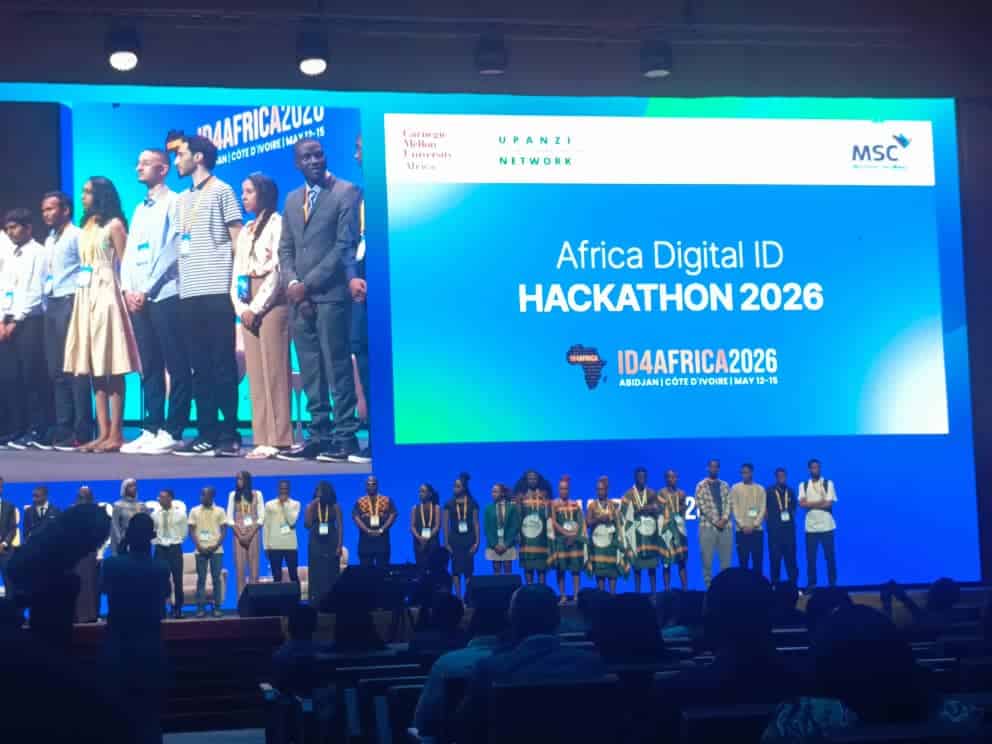
For the second consecutive year, a team from Senegal has won the African Digital Identity Hackathon. Team TrustSeal was judged the best overall application using digital identity to address practical problems African people face in their daily lives from among a field of consistently impressive finalists.
The problems addressed by the teams are not unique to Africa, but they is no indication foreign firms are about to develop better solutions, let alone tailor and export them to Africa. In the midst of the Hackathon’s final pitches, the reverse seemed radically more likely.
Year 2 of the Hackathon culminated in a pair of presentations at ID4Africa’s 2026 AGM on day 2 and 3. The Hackathon is organized by the Upanzi Network at Carnegie Melon University (CMU) Africa and MicroSave Consulting.
The inaugural competition concluded at last year’s ID4Africa AGM with working applications based on national digital identities from students across Africa.
Last year’s crop of young innovators completed applications has contributed to a growing digital identity startup ecosystem in Africa, ID4Africa EC Dr. Joseph Atick said in introducing the Hackathon. The following day as the final competition began, he urged the student participants to reject prescriptions about how things should be done, and contribute to Africa’s digital future based on their own experiences.
Eight finalist groups gathered in Abidjan for the 2025-2026 edition. The number of participants and the countries they come from has increased to around 1,000 students, a third of them women, from 35 countries.
Andrew Musoke, a research engineer with the Upanzi Network of research labs based at CMU Africa, Upanzi Network and CyLab Africa Co-director Moise Busogi and Microsave Senior Manager Anshul Pachouri took the stage on day 2 to introduce the finalist teams.
Web3 developer and consultancy IDS (Intuitive Data Solutions) joined the Hackathon for its second year as its first private-sector supporter, and is offering internships to several finalist teams. All eight finalist teams used tools provided by either MOSIP, IDS or both.
UIDAI’s Priya Patil, Uganda’s Rosemary Kisembo, Ethiopia NIDP Technical Director Eyob Alemu and Cote d’Ivoire’s ONECI CISO Kwame judged the winners from among the selected finalists. The judges posed questions to the contestants following each presentation.
Reusable digital ID for refugees
Team Tech Enthusiast from Ethiopia presented their application for improved access to help from NGOs for refugees; RefuProof.
The reusable digital identity with privacy-first data control and a unified verification system for use across NGOs and humanitarian agencies. The system was built on eSignet and aligned with Fayda.
Aid workers enroll refugees through a simplified process with PDFs and QR codes to provide them with a digital wallet. They note that the UNHCR estimates it costs $10 per traditional refugee verification, and say their solution can dramatically reduce those costs.
The team says RefuProof can be scaled to serve 30 million people with health and other digital services.
Voice biometrics with feature phones
Tanzanian team VeriVoice presented a system for remote identity verification for aid delivery and payments with voice biometrics through feature phones. Challenge phrases are used during onboarding, and liveness detection is applied during verification.
Voice biometrics are analyzed by Twilio and bound to national IDs with eSignet, avoiding the need for a smartphone or dedicated hardware that typically comes with the use of face or fingerprint biometrics.
VeriVoice uses homomorphic encryption and cryptographically signed tokens for privacy protection and proof of consent. It uses an IVR call on exiting hotlines to work in the absence of an internet connection.
Transparency for remote physical infrastructure projects
Team TML from Morocco introduced Transparency Middleware Layer for public infrastructure payments.
The application secures the verification chain to prevent contractors or government inspectors from falsely claiming a project has been completed and collecting the money, and then pointing fingers at weaknesses in the confirmation process, or each other to avoid culpability.
Completed milestones are verified with multi-party attestations using verified digital identities.
TML uses eSignet authentication and DID-bound sessions connected with OIDC. An attestation engine manages sequential sign-offs and enforces quorum automatically. The national digital identity authority provides the ID used to generate DIDs.
SSI for financial inclusion
Team Afroza Editor from Cameroon addressed the financial inclusion challenge in Central Africa with the Polygon blockchain and self-sovereign digital identity.
The Afroza Pay System uses Verifiable Credentials, OCR, selfie biometrics with liveness detection and the AI Simba Bot, with a Domain-Driven Design architecture to generate smart contracts. The user’s ID is algorithmically analyzed for authenticity. Once onboarded, users are provided with a digital wallet for local storage of a DID and the QR code that enable the user to make payments.
The team claims its main innovation comes from the combination of intelligent biometrics use, Web3 identity verification and immediate financial service access.
Trust for social media ecommerce
Senegalese team TrustSeal, a solution to link the profiles of social media vendors to certified digital identities.
They began by setting out a scenario in which a fraudster uses the details of a legitimate ecommerce vendor to defraud a victim, who then blames the real vendor whose business profile was stolen.
TrustSeal provides portable reputation by matching the biometrics of the profile and the seller, generating a verifiable credential stored on a self-sovereign decentralized identity chain to prevent spoofing. The vendor receives a badge with a QR code that buyers can scan to see the verified identity link.
They say this makes anonymous fraud structurally impossible, and builds trust in ecommerce through social media platforms.
Team TrustSeal arrived in Abidjan with letters of intent from 100 online sellers to adopt its application, and goes home with the award for best application in the Africa Digital ID Hackathon 2026.
Proof of income for farmers
Evolutics, a team from Benin, described how behind the country’s continental leadership in cotton production, many farmers struggle to make ends meet in between harvest seasons. Microcredit provides on option, but without proof of income any request is likely to be denied.
The CottonPay solution addresses this problem by authenticating the farmer with NPI and an OTP, again, via eSignet. At harvest, the cooperative the farmer sells to verifies his identity and registers his harvest details. The system calculates a value for the farmer’s crop, and produces a QR code he scans to store proof of his income, which is stored in a digital wallet.
The solution uses an offline-first approach and can also be adapted to other agricultural products.
Evolutics took second place in the Hackathon.
Fair prices for farmers selling into opaque markets
The only all-female team among the hackathon finalists was AgriTrust, from Zimbabwe and South Africa. The problem they addressed is the frequent exploitation of tobacco farmers, who sell into an opaque market that makes him vulnerable to unfair price manipulation.
The farmer registers his details and MOSIP digital ID number with a tobacco market regulator such as TIMB and is issued a credential through eSignet. The regulator can record his harvest details in the AgriTrust application to receive an SMS that assesses the fairness of the price he or she has been offered.
AgriTrust does not require digital literacy or a smartphone, and can be scaled to support other agricultural products and integrated with AI to expand its functionality.
Data-sharing for cross-border medical services
Team Eswatini IT Scopes presented ZuriCare, a privacy-preserving digital health identity platform for refugees or cross-border patients. It is intended to provide secure access to identity and medical data like prescriptions and allergies to enable healthcare delivery.
ZuriCare consists of separate applications for healthcare providers and patients, using eSignet for patient OTP logins and Inji stack components for credential issuance, storage and verification. Healthcare workers scan the patient’s QR code and an OTP is sent to the patient to grant consent to unencrypt and share the medical data stored in a VC.
The application also creates a full audit trail to assist compliance.
Eswatini IT Scopes finished third in the competition.
Related Posts
-
 July 17, 2025
 -
 October 21, 2025
 -
 September 16, 2025
 -
 June 6, 2025
 -
 December 15, 2025
 -
October 2, 2025
Article Topics
African Digital Identity Hackathon | Carnegie Mellon University Africa (CMU-Africa) | digital identity | ID4Africa | ID4Africa 2026 | Upanzi Network

Comments