
Diebold Nixdorf integrates Yoti age checks with produce recognition for self-checkouts
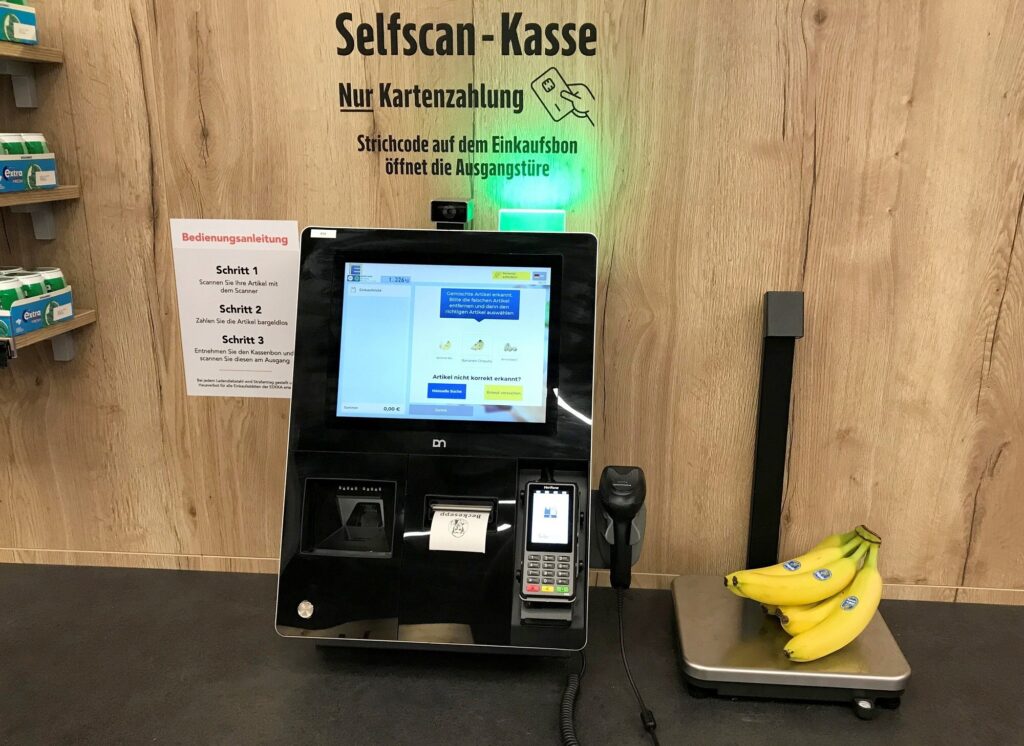
The biometrics and digital payments industry has seen plenty of facial recognition, and even (at ball games) some hot dog recognition. Now, meet the next evolution in object recognition in the shopping experience: automated fruit and vegetable recognition.
According to a release, Smart Vision technology from Diebold Nixdorf installed at the new EDEKA Beckesepp store in Waltershofen, Germany powers self-service checkouts that can perform age checks – and tell a banana from a kumquat.
EDEKA Beckesepp is part of German supermarket EDEKA Group, which also includes the EDEKA Jäger brand.
“With Vynamic Smart Vision Fresh Produce Recognition, customers at EDEKA Beckesepp can easily and correctly capture products without barcodes, such as fresh fruits and vegetables, directly at the self-service checkout,” says the release. “A camera placed on top of the scale, combined with sophisticated algorithms, identifies items and their quantities, which is then shown on the display.”
Meanwhile, the Vynamic Smart Vision Age Verification product proves poorly named, since, according to its description, it provides facial age estimation (FAE): “customers are given the option to opt for automatic age recognition. Once consent is given, a camera installed in the system analyzes the customer’s facial characteristics using advanced AI algorithms to determine their age. The transaction can be continued if the customer’s age is above a predefined threshold.”
Specifically, the system uses facial age estimation tech from Yoti. The UK age estimation provider is a partner in the Vynamic Smart Vision Age Verification product, which has already been deployed at three EDEKA Jäger stores.
The store’s system also enables customers to purchase age-restricted items outside of daytime opening hours,with an ID scan: “access to the store happens via an ID card, which then authorizes them to make the purchase.”
“EDEKA Beckesepp is another excellent example of how our self-checkout and AI technologies support retailers in implementing modern store concepts,” says Leyla Feghhi, head of retail sales in the DACH region at Diebold Nixdorf. “Consumers can shop at a time and in a way that suits them best and benefit from a faster and more intuitive process at the self-service checkouts, which makes them less dependent on staff on site.”
A post on Yoti’s blog makes a somewhat exasperated case for facial age estimation as an ideal method of checking age for alcohol sales. What frustrates Yoti isn’t necessarily lack of faith in FAE – but the enduring faith in a model that is so clearly inferior.
“Let’s just get this out there: humans are not great at guessing ages,” the post says. Even in a theoretical scenario in which so-called Super Recognizers could be mustered to estimate age en masse, it still wouldn’t be as accurate as Yoti’s biometric age assurance.
Facial age estimation, says Yoti, is “fast, consistent, tested and doesn’t get flustered or tired. Retailers want to use it. They’ve already tested it. Staff love it – mostly because it means they don’t have to awkwardly guess whether someone is 17 or just has a baby face. And customers like it too.”
“The technology has been sitting there on the shelf, ready to go for a few years. Surely it’s time to stop pretending that retail workers trying to guess the age of customers is the gold standard in age assurance, especially since the government says it wants to see tech make people’s lives easier.”
Yoti is also currently involved in a trial of biometric age assurance kiosks employing FAE at a major supermarket chain in Lithuania.
Related Posts
-
 April 1, 2025
 -
 October 8, 2024
 -
 December 20, 2024
 -
 December 13, 2024
 -
 August 2, 2024
 -
 August 15, 2024
Article Topics
biometric age estimation | biometrics | Diebold Nixdorf Technology | face biometrics | retail biometrics | Yoti

Comments