
ID4Africa speakers urge legal identity inclusion for refugees, stateless persons
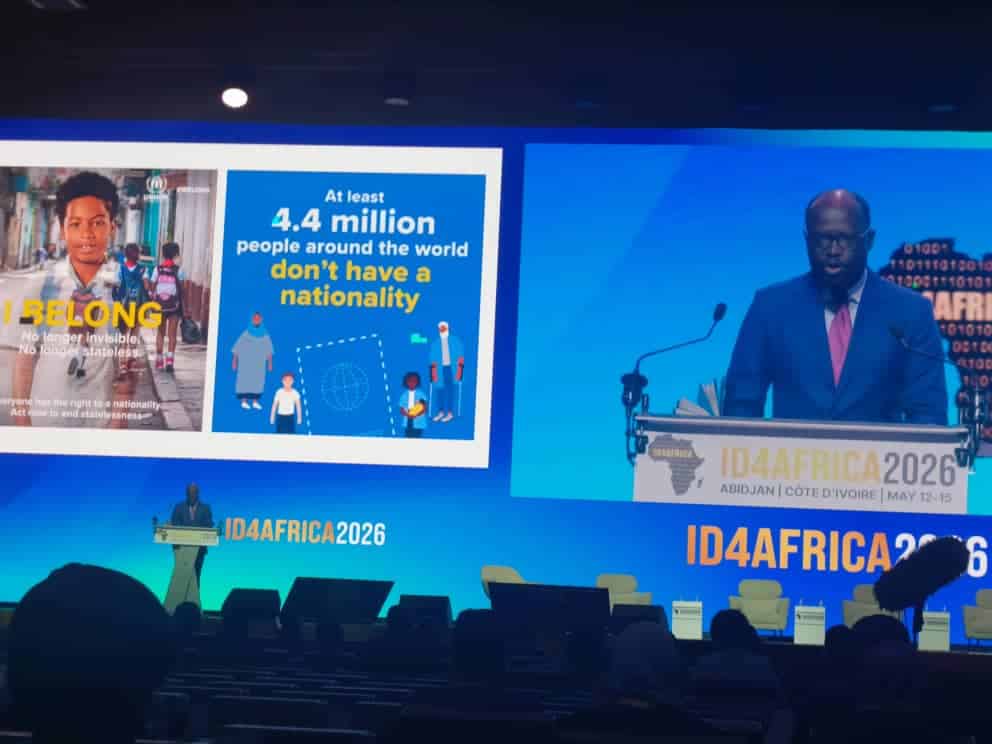
African governments must accelerate efforts to provide legal and digital identity to refugees and stateless populations, according to speakers at the 2026 ID4Africa Annual General Meeting in Abidjan.
Officials from identity agencies, civil registration authorities, UN organizations and development institutions called for more inclusive national ID systems, stronger legal safeguards and deeper integration between civil registration and foundational identity infrastructure.
The discussion comes as an estimated 4.4 million people worldwide remain stateless and roughly 800 million people still lack legal identity, despite years of efforts tied to the UN Sustainable Development Goal 16.9 target and the World Bank’s Identity for Development (ID4D) agenda.
Speakers repeatedly emphasized integration between civil registration and vital statistics (CRVS) systems and national identity platforms, arguing that disconnected systems continue to leave vulnerable populations outside formal identity frameworks.
Dr Patrick Eba, Deputy Director at the UNHCR’s International Protection and Solutions Division, said governments should prioritize inclusion of refugees and stateless persons in national ID systems, safeguards against discrimination and misuse, accessible correction and redress mechanisms, and stronger integration between civil registration and identity systems.
“Universality cannot be just a word; it must work in practice,” Eba said.
Beyond the aspect of inclusion, countries must also build safeguards into ID systems from the onset.
“They must protect against discrimination, feature robust governance structures, and ensure that data collection is fully informed and consensual. Equally important are accessible redress mechanisms. If individuals believe their information has been recorded incorrectly or under the wrong category, they must have a clear pathway to correction. These safeguards cannot be an afterthought; they must be embedded by design,” Eba stated.
The UNHCR official also emphasized the point on CRVS-ID integration: “ID and civil registration systems should be better integrated so that birth registration and identity enrollment can help identify stateless individuals and connect them to nationality pathways, whether through domestic recognition or consular referral to a country of linkage.”
Heads of civil registration authorities from countries including Chad, Mali, Angola, Cameroon, Senegal, Benin, Sierra Leone, Tanzania and Côte d’Ivoire outlined ongoing efforts to improve birth registration, connect CRVS systems with national ID platforms and extend legal identity coverage to marginalized populations.
Speakers said meaningful integration will require stronger governance frameworks, secure data systems and interoperability between civil registration and national identity platforms.
Bhaskar Mishra, a CRVS and legal identity specialist at UNICEF, said CRVS-ID integration has become an operational necessity rather than a policy aspiration. He warned that many countries continue to struggle because agencies operate in silos or adopt models poorly suited to local realities.
UNICEF is developing a practical implementation guide for CRVS-ID integration that could be released later this year, Mishra said.
Speakers warned that without stronger integration between civil registration, national identity and refugee protection systems, millions of vulnerable people will remain excluded from formal services, legal protections and participation in the digital economy.
Related Posts
-
 February 24, 2026
 -
 October 27, 2025
 -
 June 4, 2025
 -
 January 22, 2026
 -
 March 24, 2026
 -
 September 16, 2025
Article Topics
birth registration | civil registration | digital identity | ID4Africa | ID4Africa 2026 | legal identity | national ID | SDG 16.9

Comments