
Tech vendors urge PPP, decentralized digital ID models at ID4Africa
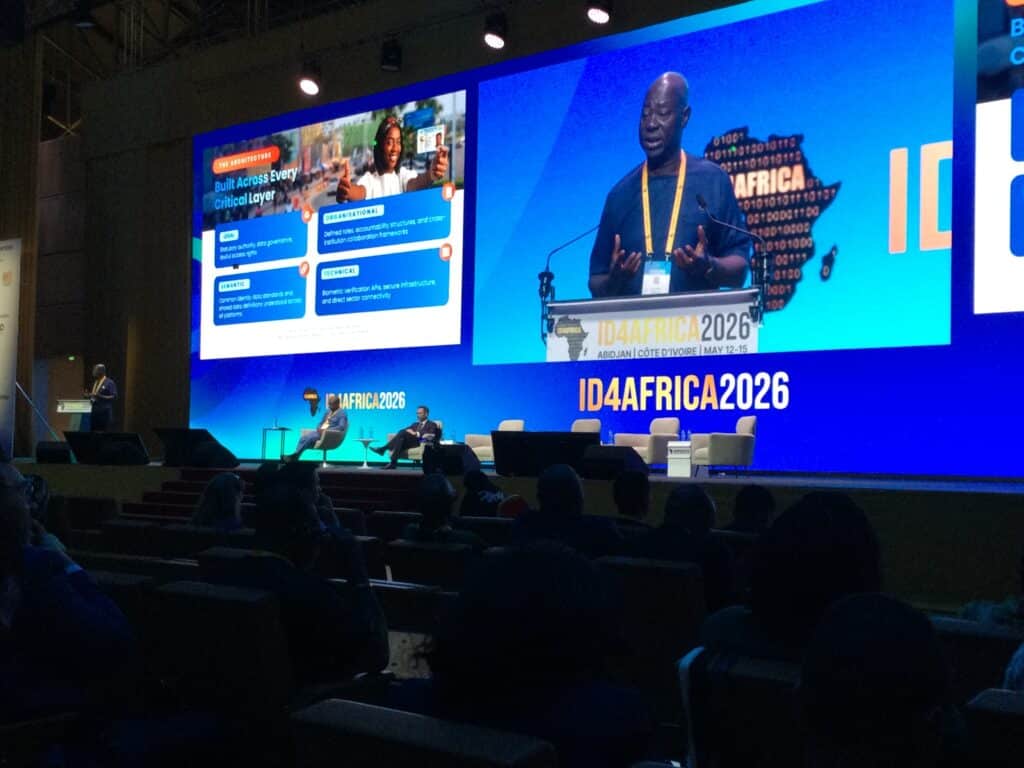
Ideas continued to flow in the main hall of the Parc des Expositions in Abidjan on May 13 as the conversation on digital identity at the ongoing ID4Africa 2026 Annual General Meeting (AGM) reached a new tempo. The focus was on how countries can build identity infrastructure that guarantees not only trust but also inclusion, scale, and impact.
In the opening session, which set the tone for the rest of the day’s segmented exchanges, executives from five companies in the biometrics space, viz Digital Trust Technologies, Veridos, Tech5, iDakto, and Toppan Security, made the case for decentralized digital ID.
They argued in their respective presentations that this model of digital identity, developed about ten years ago, is now the way to go. They explained why and how governments can easily build such systems in a sovereign and sustainable manner.
Rahul Parthe, Co-founder, CTO, and Chairman of Tech5, and Xavier Prost, Managing Director and Regional Head of Sales for MEA at Veridos, shared converging views on the need for a public-private partnership (PPP) model in building decentralized digital ID systems, arguing that this approach offers several advantages.
In their presentations, they asserted that traditional government-led or single-vendor digital ID projects fail not because of bad technology but because of structural fragility, such as being tied to one administration, one funding cycle, or one vendor contract, where stagnation or collapse can occur if any of these conditions change.
“There is only one sustainable answer: build sustainable digital public ecosystems (DPEs) through genuine public-private partnerships. We have looked at various models, and PPP seems to have the highest potential because it delivers value to each stakeholder,” Parthe said.
“The beauty of PPP is speed. In traditional procurement, you spend years defining requirements and negotiating. With PPP, you can go live in months. In many cases, you already have digital ID systems in place,” he said, citing the example of Honduras, where through a PPP, the country went from contract to a live decentralized digital ID and trust framework deployment in just three months.
“With a mature partner, you can lay the trust rails within weeks. Then you can start a portfolio of use cases, because betting everything on one use case is a disaster. A portfolio acts as insurance and hedging.” Tech5 has been involved in decentralized digital ID projects with wallet initiatives in Ethiopia, Djibouti, and Papua New Guinea, among others.
Prost highlighted the aspect of sovereignty, stating that PPPs for digital ID systems allow countries to avoid vendor lock-in and enable a clear plan for knowledge transfer, capacity building, and infrastructure handover within a defined period.
The Founder and CEO of Digital Trust Technologies, Ramamohan Reddy, brought the trust perspective into the discussion. He shared a concept he described as the digital trusted nation, through which countries can build trust infrastructure and strengthen their digital economies.
He stated that widespread adoption of digital ID is largely a product of trust, and only systems designed as citizen-centric solutions, rather than purely technical projects, can achieve that feat.
Reddy emphasized that authentication, now the most common first use case of digital ID, does not excite citizens as much because it does not meaningfully improve their daily lives. Instead, people want safe, secure, and predictable service delivery from governments, which requires what he termed “executive commitment.”
“While ID and identity verification are key enabling aspects of trust, they are only necessary conditions, not sufficient ones. So what else is required? Primarily, if citizens are to feel happy, empowered, and benefited, what do they want? They want safe, secure service delivery, and they want predictable service delivery by the government. We believe countries should look at digital trust as a combination of technically solving trust-related problems and bringing predictability to service delivery,” he stated.
Shashank Kumar, Head of Sales for Digital ID and Digital Government at Toppan Security, and Hassan Maad, Founder and CEO of iDakto, added their voices to the decentralized ID advocacy. Kumar said that with decentralized systems, an individual can have their credentials verified and access important services without needing to visit a physical office.
“In my opinion, decentralized digital identity is the way forward for the next generation of digital identity because verifiable credentials are the infrastructure of trust,” Kumar said.
He added that contrary to what some people think, governments do not lose control over data in decentralized ID systems. “The government still holds the tools. They are the only trusted issuer in the country. They are the ones who set the frameworks, audit every verifier, and monetize the whole ecosystem.”
Maad also emphasized the role of trust in digital ID. “Deploying a digital identity platform is precisely the trust layer we want to establish, on which the entire digital economy will be based. So you can see that this is a real challenge, because this trust layer will enable that engine of growth and sustainable development,” he said.
He added that centralization of ID systems is a security trap because there is a growing number of data breaches happening around the world, and the question is not whether a centralized system will be hacked, but when. “The more we centralize, the more risk we have of losing information. If we decentralize, we can ensure security and privacy. That is why today, decentralized architecture is winning in many deployments. It is the future,” he opined.
Maad also stressed the importance of building critical infrastructure, because deploying decentralized digital ID at scale requires a solid foundation.
Identity at scale, interoperability
Meanwhile, speaking during a different but related segment, the Vice President of IN Groupe, Olivier Laurence, said digital ID adoption can be driven if digital ID systems operate through a system of ecosystem adoption. He shared a recent report produced by IN Groupe, which found that only 33 percent of 204 countries or territories surveyed have attained leader status in digital identity deployment.
The CEO of Margins ID, the company that produces the Ghana Card, Moses Biden Jr., spoke about ways to fully integrate national digital systems. He mentioned the need for multiple use cases, interoperability, trust, and building sovereignty by design. He highlighted the role of the private sector as a key player in supporting sustainable models of digital identity, explaining the work done with the Ghana Card.
“In Ghana, we adopted an instant decentralized issuance model. It is one identity trusted across the economy,” he said, adding that more than 15 million people registered in just the first year of the card program.
Related Posts
-
 May 14, 2025
 -
 June 9, 2025
 -
 July 18, 2025
 -
 March 10, 2026
 -
 November 14, 2025
 -
 August 19, 2025
Article Topics
biometrics | decentralized ID | digital identity | ID4Africa | ID4Africa 2026 | iDAKTO | public-private partnerships | TECH5 | Toppan Security | Veridos

Comments