
MyGov Malaysia app launches July for public services, linked to MyDigital ID
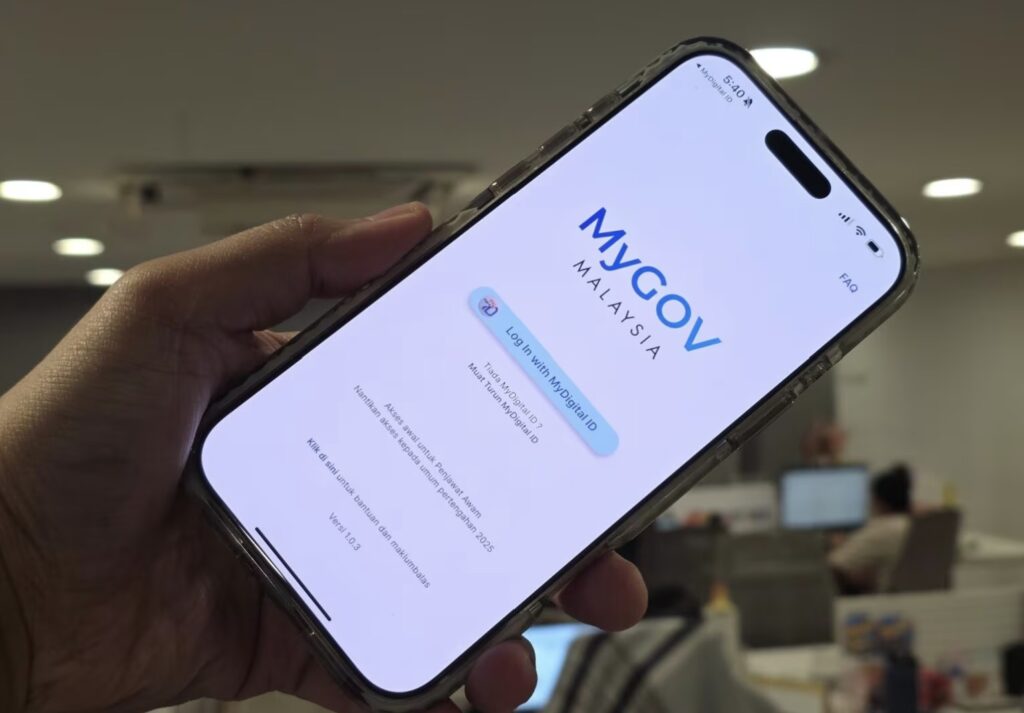
Malaysia will soon launch its digital gateway for government services.
The MyGOV Malaysia mobile app will launch in July, serving as the country’s single digital platform for accessing public services.
“This is part of the government’s plan to transform Malaysia into a digital nation,” said Digital minister Gobind Singh Deo. “It is only right to ensure we have a single platform where Malaysians can deal with various government agencies seamlessly.”
The app will offer seven main services: passport applications, driving license and road tax renewals, birth and citizenship registration, medical appointments and records, summons payments, land tax and assessment rates, and the Sumbangan Tunai Rahmah (a cash assistance program). The app is part of the Malaysian government’s GovTech initiative.
MyGov Malaysia will link to MyDigital ID, the national digital ID system, allowing users to log in and verify their identities to access government services, Gobind said.
Currently, there are more than 2.6 million users registered for MyDigital ID. Previously, the prime minister Datuk Seri Anwar Ibrahim has expressed frustration at the slow progress of MyDigital ID. In March, the government began automatically registering children and those who lose their MyKad (a government-issued identity card that holds biometric data) to increase the MyDigital ID registration rate.
The digital ID will be linked to 34 government systems, with more to be added. The MyGOV Malaysia app was developed in collaboration with private sector partners such as banks and telcos. “This is part of our journey in transforming Malaysia into a digital nation,” said Gobind.
While Malaysia undergoes digital transformation, and takes first major steps in its journey, the experiences of other countries and their implementation offers lessons, tips and strategies for successful deployment.
Learnings from digital ID implementation in Estonia, DR, Norway
During a Global Government Forum webinar, experts from Estonia, the Dominican Republic, Norway and Visa shared their digital identity lessons.
Helen Raamat, eID expert at Estonia’s Information System Authority, outlined Estonia’s identity ecosystem, which includes the state’s digital ID and its X-road data exchange platform. The pioneering country offered digital ID through its banks initially, for the purposes of online banking and filing income tax returns. In 2002, the mandatory national digital ID card was launched after five years of preparations.
In 2007, the government introduced mobile ID, which is SIM-based allowing it to be used on older-style mobile phones for the purposes of digital inclusion. There’s the e-Residency programme that enables non-Estonians to register their company in the country and access its digital services remotely.
An app-based electronic ID was launched by the private sector in 2017 and is recognized by Estonia’s government as a “signature creation device” having met EU legislation and the highest level of security assurances, Raamat said.
Raamat advised keeping the regulations and procedures that work in order to prevent creating “a parallel world” for countries beginning their digital ID journey. This includes retaining existing technology that is trusted and secure. She also recommended having more than one trusted service provider to prevent a single point of failure risk and providing multiple e-ID tokens – secondary e-IDs based on the primary one, so people can use them if they lose access to their primary IDs.
Compared to Estonia, the Dominican Republic is a youngster in the digital ID world. It passed a law supporting digital ID and digital signatures in 2002, and government office the Dominican Institute of Telecommunications (Indotel) has since worked on expanding the ecosystem. Indotel developed a regulatory framework to inspire public trust in and adoption of government services while encouraging innovation.
According to César Moliné Rodríguez, Indotel’s director of cybersecurity, e-commerce, and digital signatures, progress faltered between 2006 and 2015. It wasn’t until 2019 that the Dominican Republic stepped on the gas pedal: the government issued a regulation to standardize its national trust-services framework with the European Union’s eIDAS standard.
By mirroring one of the world’s most respected rulebooks for electronic trust, the DR laid the groundwork for mutual recognition with EU providers and signaled to businesses and citizens that its digital ID was open for cross-border commerce. However, Rodríguez says the country is still early in its digital ID development.
“We have foundational components like a biometric ID card that’s run by our central electoral board,” he said. “But unlike Estonia, where they have this fully integrated system, we’re still taking baby steps and getting there slowly.”
The DR is currently working to develop its own interoperability platform based on X-road.
Svyat Svyatoslav, head of Visa Government Solutions for Central Europe, the Middle East and Africa, spoke on Visa’s mission to further the digital economy while ensuring inclusion.
Addressing the challenges faced by governments, Svyatoslav explained that Visa partners with national authorities to design and implement digital ID ecosystems that drive broader digital transformation and close the financial inclusion gap.
He highlighted the African Continental Free Trade Area and a lack of IDs as a barrier for increasing volumes of African trade. Without an ID, people face hurdles accessing cheaper loans to grow their business, he said.
Looking ahead, Svyatoslav proposed the creation of government super apps that integrate digital ID, payments and public services into a single, user-friendly platform — ideally with offline capabilities to reach underserved or connectivity-poor communities. Such solutions, he argued, not only streamline citizens’ interactions with government but also furnish authorities with vital data to inform smarter public policy.
He mentioned his native Ukraine’s Diia app, which launched in 2020 in partnership with the Ministry of Digital Transformation. Today, 22 million Ukrainians access more than 40 services, from business registration to driving-license renewals, via Diia’s unified portal. Svyatoslav said Visa was a strategic partner to the ministry and discussions during the app’s design phase ensured that elderly and digitally vulnerable populations would not be excluded.
“You need to understand the country context and how every government programme addresses the needs of elderly, vulnerable, disabled people and others,” he said. “It’s very nuanced work… We need to consider each and every citizen of the country and bring the right technology to the right context to [navigate] the problems the governments of today face.”
Raffaele Angius, senior adviser and product owner in the identity expert team of Norway’s Directorate of Immigration, focused on Norway’s national e-ID strategy, which was published in 2023.
Norway’s 2023 e-ID strategy is built around five high-level objectives. First, it guarantees universal, needs-based access so all user groups can obtain an e-ID with the appropriate security level.
Second, it promotes seamless, cost-effective services by breaking down silos and enabling public agencies (and private partners) to link workflows. Then, activities like job applications, identity verification and bank-account setup can all occur in one smooth step. This kind of approach has already delivered some strong returns on investment, Anguis said.
The third objective is to establish a framework for effective solutions. The fourth main goal is ensuring government e-ID technology keeps pace with market innovations for future-proofing. The fifth goal seeks to enable cost-effective interoperability across systems, sectors and levels of public administration.
Meeting these goals will bolster Norway’s e-ID offering and make public services more accessible than ever.
The full webinar “The identity opportunity: how digital IDs can help unlock government service transformation” can be found here.
Related Posts
-
 October 6, 2024
 -
 October 29, 2024
 -
 March 20, 2025
 -
 February 6, 2025
 -
 October 2, 2024
 -
 February 21, 2025
Article Topics
digital government | digital ID | digital identity | e-ID | government services | Malaysia | MyDigital ID | MyGOV Malaysia

Comments