
CBP biometric expansion at US borders moves ahead with new global entry plans
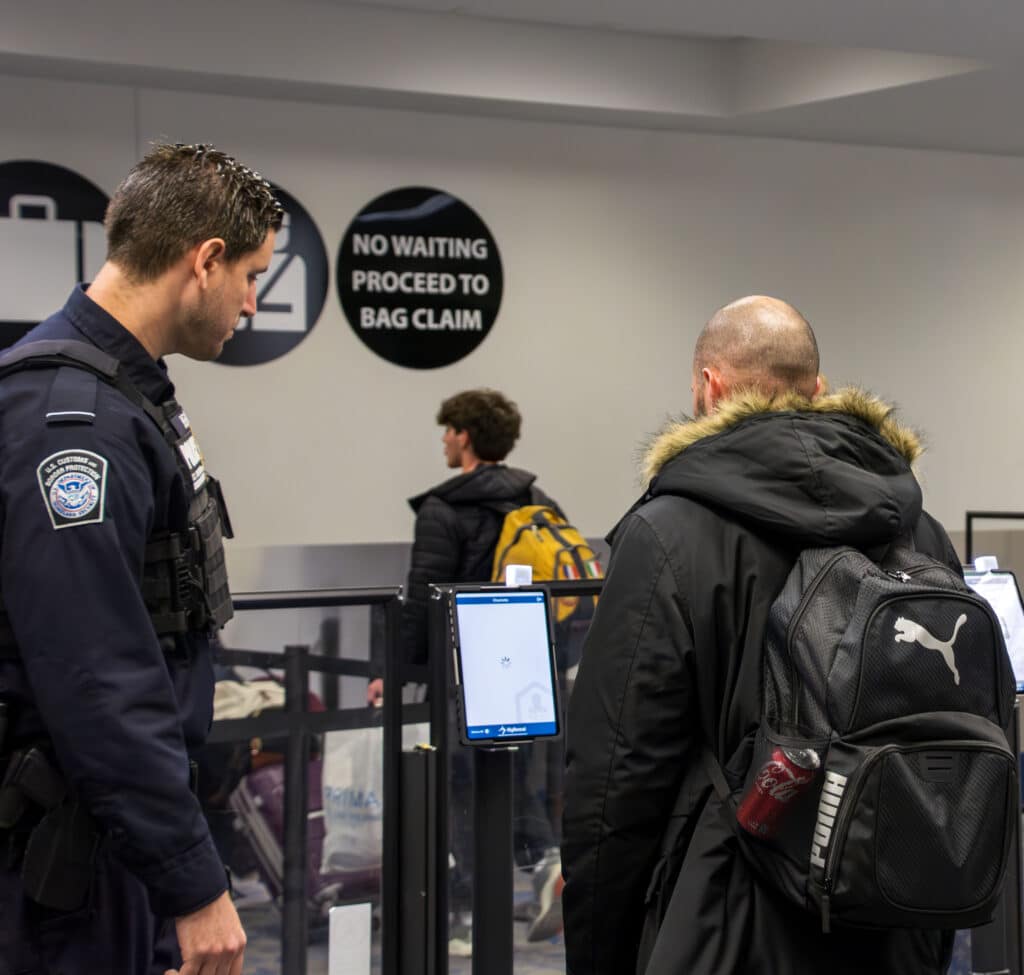
As the Trump administration doubles down on biometric surveillance at U.S. borders, Customs and Border Protection (CBP) is preparing for a sweeping expansion of its Global Entry program, with a major emphasis on seamless facial recognition technology.
CBP disclosed its plans in a series of solicitations and planning documents to identify private sector vendors capable of delivering biometric facial capture solutions for what it calls “Seamless Border Entry,” or SBE. These moves signal CBP’s determination to fully automate identity verification across ports of entry, including airports and land borders, ahead of major international events and amidst growing scrutiny over privacy and civil liberties.
The Global Entry Seamless Border Entry solicitations come at a time when public confidence in federal surveillance and data practices is already under strain. Recent reporting has exposed the proliferation of surveillance tools across federal, state, and local law enforcement agencies, including the use of facial recognition databases, AI-enhanced monitoring, and data brokers harvesting location and personal data.
The Global Entry SBE development effort certainly comes amid a broader federal push for integrated digital identity infrastructure and real-time surveillance capability at the border. In January, CBP and the Department of Homeland Security (DHS) jointly announced their intent to implement biometric matching across all modes of entry, including air, land, and sea.
All of this comes as CBP is on the verge of reissuing a sweeping regulatory overhaul that will usher in a new nationwide biometric surveillance regime. At the core of this new regulation is facial recognition technology, which will be embedded into CBP’s Traveler Verification Service (TVS) and applied across all air, sea, and land ports of entry and exit, marking a revival and formalization of Trump-era ambitions to track every non-U.S. citizen who crosses the country’s borders.
The Traveler Verification Service was originally launched to identify non-citizens through facial recognition, but has since been expanded to encompass U.S. citizens enrolled in Global Entry and other trusted traveler programs. Moreover, CBP has sought pilot programs for vehicle-based facial recognition at land ports, an initiative that has drawn fire from both privacy advocates and border communities.
In April, CBP issued a Request for Information on commercial solutions for capturing high-quality facial images of vehicle occupants in officer-manned “primary zones” at inbound land ports of entry.
This approach is an extension of the Trusted Traveler Programs, particularly Global Entry, which has offered expedited processing to low-risk, pre-approved travelers since 2008. While Global Entry traditionally used self-service kiosks for identity verification and declaration processing, the Seamless Border Entry model replaces those with biometric-only checkpoints.
According to CBP’s public statements, SBE is currently operational at select U.S. international airports including Miami, Los Angeles, Houston, Newark, and Chicago O’Hare. It is also active at Toronto Pearson International Airport, indicating the agency’s commitment to integrating these systems at preclearance locations.
CBP describes SBE as a key part of its Enhanced Passenger Processing (EPP) strategy, which aims to reduce wait times and better allocate officer resources. Under SBE, a traveler enrolled in Global Entry simply walks through a biometric corridor. A hidden facial recognition camera captures their image mid-stride, compares it against TVS and automatically clears them for entry.
CBP claims that in current deployments, the system achieves an identity match within two seconds and that its accuracy exceeds 99 percent. However, the agency has released little recent data to back those claims, and earlier assessments of land-based vehicle capture programs showed far lower success rates.
A DHS Inspector General report from 2020 noted that CBP’s biometric system at land ports of entry was only able to successfully photograph all vehicle occupants about 76 percent of the time, and of those, only 81 percent produced usable biometric images.
Meanwhile, lawmakers have worked to put the brakes on expanded deployment of biometrics at the borders. In May, there was a renewed bipartisan push to curtail the expanding use of facial recognition technology by federal agencies. Democrat Sen. Jeff Merkley and Republican John Kennedy said they would introduce a revised version of the Traveler Privacy Protection Act that is designed to limit how the Transportation Security Administration (TSA) can deploy biometric surveillance at airports.
CBP’s Sources Sought Notice – issued under the Passenger Systems Program Directorate – outlined the agency’s near-term goals for enhancing Global Entry’s biometric infrastructure and calls on industry to respond with proposed technical solutions.
According to the notice, CBP is seeking to identify qualified vendors who can deliver advanced facial image capture and processing services and help shape technical and operational requirements for SBE deployment. This includes recommendations on acquisition strategies and support in drafting official procurement documents such as statements of work and requests for quotes.
While the notice emphasizes that this is not yet a request for proposals, it is a clear signal that CBP is laying the groundwork for formal acquisition.
Submissions from industry are intended strictly for market research, CBP said. It also made clear that proprietary or sensitive responses will be handled under strict nondisclosure agreements with its internal and contractor review teams.
The technical expectations described in planning documents are exacting and reveal the operational complexity behind the SBE effort. These documents detail software and interface requirements for vendors whose products must capture facial images of travelers in motion, transmit those images to CBP systems for identity verification, and do so without any external Internet access.
Each device must operate entirely within CBP’s network environment using secure, persistent WebSocket connections and Protobuf messaging. All devices must be installed with a CBP-issued system image and communicate only with URLs provided in the planning documents. The biometric verification pipeline relies on real-time health status updates, device registration messages, and remote start/stop capabilities issued by CBP officers. All vendor software must also be compliant with Section 508 accessibility standards.
Section 508 is an amendment to the Rehabilitation Act of 1973 that requires federal agencies to make their electronic and information technology accessible to people with disabilities.
One of the core technical goals is what CBP calls “biometric facial capture on the move.” Rather than requiring travelers to pause at a kiosk, the system will use facial recognition cameras positioned along a walking path to verify the traveler’s identity in real-time. This eliminates the need for document scanning or manual interaction, creating what CBP hopes will be a faster and more secure entry process.
Images captured by the system will be paired with metadata and transmitted to CBP’s backend, which will validate the traveler’s identity and transmit a result back to the device. The capture devices must also allow for remote diagnostics and error logging on the CBP-issued machines.
Last August, CBP issued a Request for Information for “on the move biometric facial capture” technology solutions that it can deploy at ports of entry and other “high throughput border environment” entry points to confirm the identity of individuals seeking entry into the U.S..
Privacy and civil liberties organizations remain concerned about the expansion of these programs, particularly as CBP prepares to scale SBE nationwide. Groups such as the Electronic Frontier Foundation and the Center on Privacy & Technology at Georgetown Law have raised objections to the opaque nature of CBP’s data retention practices, the demographic accuracy of its facial recognition systems, and the lack of opt-out options for U.S. citizens.
While CBP claims that U.S. citizens can decline biometric screening and request manual processing, the signage at airports often fails to make this clear, and anecdotal evidence suggests travelers are often unaware that their faces are being scanned.
Further concern stems from the growing role of AI in these biometric systems, especially as CBP explores partnerships with vendors that offer AI-enhanced facial matching, behavioral analytics, and real-time video surveillance integration.
While the latest solicitation does not mention AI explicitly, industry insiders anticipate that many vendors responding to the sources sought notice will propose AI-enabled biometric capture solutions capable of handling poor lighting, facial obstructions, or high throughput volumes. Such capabilities, while potentially useful, raise questions about accuracy, explainability, and systemic bias in decision-making.
Adding to the urgency of CBP’s efforts is the impending 2026 FIFA World Cup, which the U.S. will co-host alongside Mexico and Canada. CBP officials have stated that biometric enhancements are necessary to prepare for increased international travel during large-scale events.
The agency has promised improved efficiency through automation, which it claims will allow CBP officers to focus on higher-risk travelers rather than routine identity checks. But critics argue that the shift toward automation masks a deeper shift toward normalization of biometric surveillance and away from traditional civil liberties protections.
The Global Entry SBE initiative, while designed for convenience and efficiency, thus becomes a flashpoint in the ongoing debate over the trade-offs between technological modernization and privacy rights.
CBP’s official position is that all data collected through Global Entry biometric systems is handled according to strict privacy and security standards. The agency insists that facial images of U.S. citizens are deleted within 12 hours and that all systems undergo regular auditing for compliance.
However, watchdog organizations argue that those assurances are undermined by DHS’s own inspector general reports showing lapses in data protection, including a 2019 breach in which CBP contractor Perceptics was hacked, leaking photos of travelers and license plates.
As CBP continues to refine its Global Entry SBE architecture, the agency finds itself walking a tightrope between innovation and intrusion. The promise of frictionless travel and expedited entry appeals to business travelers and frequent flyers alike, but the technological apparatus that enables it demands careful scrutiny.
Related Posts
-
 August 7, 2024
 -
 September 1, 2024
 -
 October 16, 2024
 -
 August 27, 2024
 -
 November 18, 2024
 -
 September 30, 2024
Article Topics
biometric identification | biometrics | border security | CBP | contactless biometrics | facial recognition | Traveler Verification Service | United States

Comments