
New Orleans ID emerges as national test for municipal autonomy, resistance to ICE
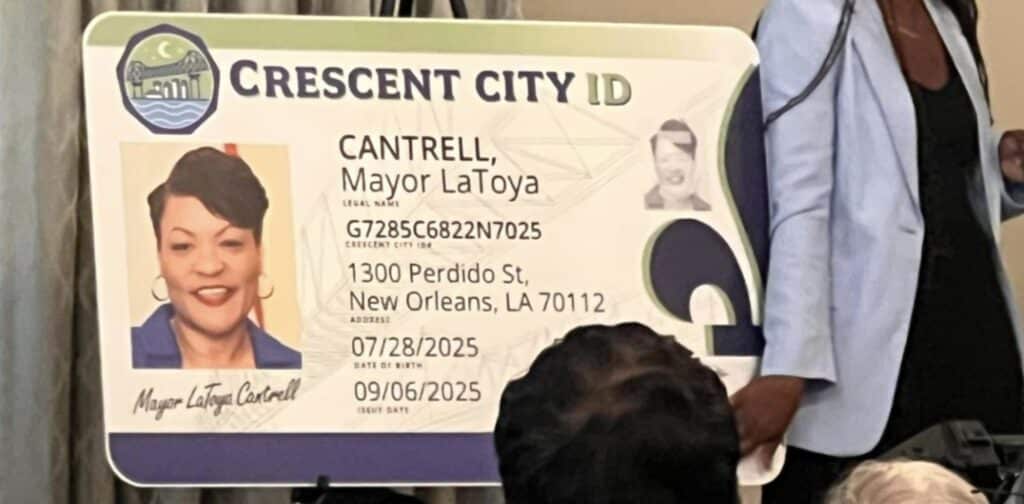
In late July, New Orleans announced the Crescent City ID, a municipal identity card program specifically designed to support inclusion in vulnerable communities. Spearheaded by Mayor LaToya Cantrell and City Council Vice President Helena Moreno, the initiative responds directly to heightened federal immigration enforcement, offering a secure form of identification for residents who lack access to state or federal IDs, including undocumented immigrants, the homeless, survivors of violence, and LGBTQ+ residents seeking to reflect their gender identity.
“The card is accepted by city departments, and it includes the option to have essential information such as emergency contact details and medical conditions such as allergies and disability,” the city says, noting that the “Crescent City ID card will be open to all residents including children and youth, with an expiration date of six years for adults and three years for minors.”
The legal foundation for the ID was laid in November 2024 when the city council unanimously approved an ordinance establishing the initiative and rulemaking from the Mayor’s Office of Human Rights and Equity. Applications are set to begin in early September, and the card will be issued at no cost, funded entirely by the city. “Mobile pop-up sites” will be “scheduled weekly where [residents] can obtain a Crescent City ID more conveniently.”
Applicants must show proof of residency within New Orleans and identity documents, but the city explicitly limits data collection and retention. Applicants can choose to opt‑out of allowing retention of their personal data, which includes name, birth date, address, gender identity marker, and disability status.
“No documents or information from these documents will be stored in our system,” the city tells residents. “Data entered will only be used to populate the fields on the ID. That data is wiped from memory as soon as an ID is printed.”
The new ID is intended to affirm identity, facilitate the use of city services, serve as valid identification across municipal departments, and extend economic and civic belonging. The ID cannot replace state or federal documents and does not permit voting, but it is intended to ease day-to-day bureaucratic barriers to renting housing, accessing social services, even opening a bank account or using public transit.
This move aligns New Orleans with other cities that have previously adopted municipal ID programs like New York, San Francisco, Los Angeles, Seattle, and places it at the center of ongoing conflict with the Trump administration, which has repeatedly challenged sanctuary‑style policies through legal action and threats, cutting federal funding and suing cities over their limits on cooperation with ICE under provisions like 8 U.S.C. §1373.
Chicago abruptly ceased its municipal ID program after ICE subpoenaed records related to it. That development reportedly influenced New Orleans’s decision to adopt stringent privacy safeguards. Program administrators made clear that they would collect minimal information and allow cardholders to opt out of storage of their personal data to reduce risk of federal access.
Under the Trump administration, ICE enforcement has grown more aggressive in sanctuary states and in regions like Louisiana, which is viewed by federal authorities as a politically favorable venue for immigration court actions, with local courts and the Fifth Circuit often yielding decisions aligned with enforcement priorities.
Municipal ID programs are drawing heightened federal scrutiny in part because they represent municipal solidarity and limit coordination with ICE, such as refusing detainer requests unless accompanied by judicial warrants.
Because ICE detainers are administrative rather than judicial orders, jurisdictions can lawfully decline to honor them absent a judicial warrant, something many sanctuary cities, including New Orleans, already practice. Through the municipal ID program, city officials aim to preserve trust in immigrant communities and to ensure that public safety is strengthened by cooperation in reporting crime instead of fear and withdrawal.
In effect, New Orleans’s launch of the Crescent City ID in September is an act of local assertion in the face of federal enforcement. It reaffirms sanctuary-style refusal to turn municipal institutions into extensions of ICE operations while offering practical supports to residents who carry out daily life outside the reach of conventional identification systems.
Consequently, the Trump administration views municipal ID programs like New Orleans’ Crescent City ID with deep suspicion and hostility, seeing them as tools that undermine federal immigration enforcement and provide sanctuary to undocumented immigrants. These programs are perceived by the administration not as instruments of civic inclusion, but as legal and technological shields that obstruct the identification, detention, and deportation of noncitizens, especially in cities that have adopted sanctuary policies.
At the core of the administration’s opposition is the belief that municipal IDs enable undocumented individuals to “disappear” within American cities by granting them access to services and identification without triggering federal scrutiny. From the Trump administration’s perspective, these programs create an administrative barrier to ICE operations by limiting data-sharing, refusing to cooperate with detainer requests without judicial warrants, and denying federal access to local databases.
This is especially problematic under the administration’s aggressive immigration agenda, which prioritizes mass deportations and views local noncompliance as a direct challenge to federal authority.
In practical terms, the administration has responded to municipal ID programs through legal, financial, and administrative pressure. Cities with such programs have faced federal lawsuits, threats to withhold funding, and, most recently, subpoenas for applicant records. The incident involving Chicago’s CityKey program, which suspended online applications after receiving an ICE subpoena, exemplifies this tactic.
The administration’s strategy is not merely rhetorical; it is operational, aimed at dismantling what it views as an ecosystem of noncooperation cultivated by progressive city governments. The Trump administration frames its opposition through a national security lens, asserting that the inability to access local identity systems compromises ICE’s ability to identify and remove individuals deemed threats. In this context, municipal ID programs are labeled as loopholes or sanctuaries that harbor criminal aliens, language frequently employed in official communications and social media posts by Trump and his surrogates.
As cities like New Orleans move forward with programs like the Crescent City ID, they are likely to be met with intensified scrutiny, legal maneuvering, and data access demands from a federal government determined to reassert immigration control.
The Crescent City ID program’s minimal data policies, no-cost access, and explicit protection of inclusion mark a calculated balancing act in affirming the dignity and logistical needs of marginalized people while minimizing the risk of personal information being handed over to federal authorities.
The broader implications hinge on how the Trump administration responds. In the meantime, the Crescent City ID stands as a symbol of municipal sovereignty, inclusivity, and resilience. It is not merely a card, but rather a part of an evolving dialogue between local governments defending the dignity of its residents, and federal immigration authorities asserting national enforcement.
The next chapter will unfold as the program rolls out this fall and as the broader legal and political dynamics continue to play out.
Related Posts
-
 June 17, 2025
 -
 April 4, 2025
 -
 March 3, 2025
 -
 February 3, 2025
 -
 April 4, 2025
 -
 September 9, 2024
Article Topics
Crescent City ID | data privacy | digital ID | human rights | ICE - U.S. Immigration and Customs Enforcement | identity document | identity management | legal identity | municipal ID | New Orleans | United States

Comments