
ICE’s biometric surveillance reach expands with BI2 iris scanning tech
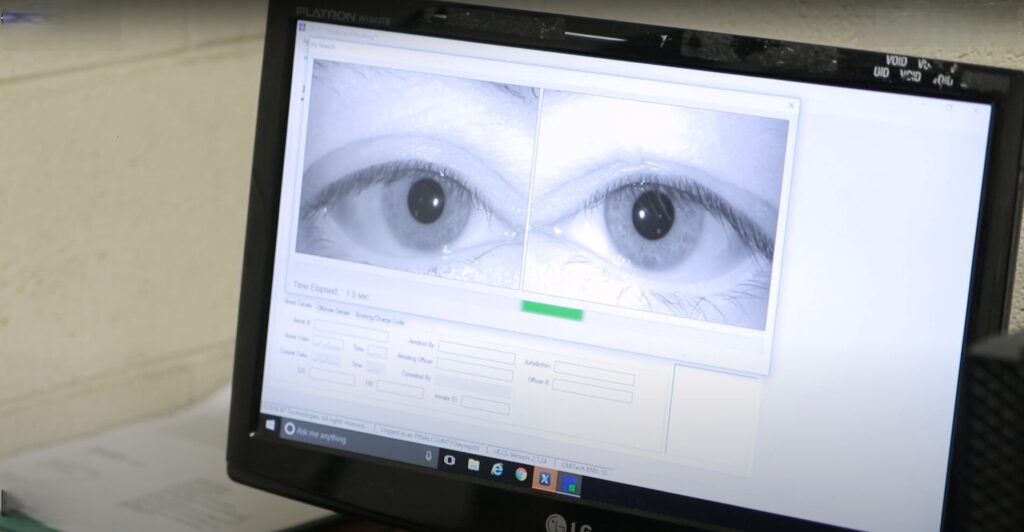
U.S. Immigration and Customs Enforcement (ICE) is preparing to acquire advanced iris biometric systems from BI2 Technologies through a sole-source contract, a move that has drawn attention for both its implications on immigration enforcement and its role in expanding biometric surveillance infrastructure nationwide.
According to ICE’s published Notice of Intent, the agency plans to negotiate and award a noncompetitive purchase order for licenses to two systems developed by BI2: the Inmate Recognition and Identification System (I.R.I.S.) and the Mobile Offender Recognition and Information System (MORIS). ICE justifies the sole-source contract by stating that Bi² Technologies is the only vendor capable of providing these specific systems and maintaining compatibility with its operational requirements.
The deal with BI2 Technologies has not yet been finalized, but the Notice of Intent indicates ICE’s clear direction. With the agency expanding its field and facility-based biometric operations, and with tools like MORIS and I.R.I.S. promising real-time identity verification on the move, the federal government’s investment in iris biometric scanning may soon be a normalized, yet largely invisible, cornerstone of immigration and law enforcement practices in the U.S.
The IRIS platform is designed to collect highly detailed biometric data from the human eye, capturing over 265 unique points from the iris to generate a biometric template for rapid identification.
Long used in correctional facilities, the system enables staff to verify identities during booking, intake, and release, and to authenticate individuals in real time across institutional workflows. It is marketed as a more accurate, non-invasive alternative to traditional fingerprinting or facial recognition.
MORIS is the mobile counterpart and extends iris scanning capabilities to field operations. Compatible with Apple, Android, and Microsoft handheld devices, MORIS enables agents to conduct mobile iris captures and match those images against Bi²’s national iris repository or integrated Department of Homeland Security (DHS) databases. The system includes built-in liveness detection and can reportedly function from distances of up to one meter. These features allow real-time identity verification in remote or high-tempo enforcement environments without requiring transport to a centralized processing facility.
This appears to be ICE’s first known contract with BI2 Technologies. A source inside the agency, speaking to 404 Media on condition of anonymity, said they were unaware of any prior collaboration between ICE and the Massachusetts-based firm.
However, BI2 has longstanding relationships with other law enforcement agencies. Its iris capture systems were used in pilot programs for the FBI’s Next Generation Identification (NGI) system, one of the most expansive biometric databases in the U.S., housing fingerprints, facial images, palm prints, and increasingly, iris scans.
BI2 has also partnered with local sheriff’s offices, particularly those in border regions. In 2023, the company offered sheriffs in 31 U.S. counties along the southern border free access to MORIS as part of a broader initiative to expand mobile biometric identification across jurisdictions involved in immigration enforcement.
The integration of these technologies into ICE operations represents a notable shift in the agency’s biometric strategy. ICE’s Enforcement and Removal Operations (ERO) division, which conducts arrests, detentions, and removals of noncitizens across the country, is expected to be the primary user of the new systems.
In fixed facilities such as detention centers, I.R.I.S. could accelerate identification during intake and release processes, while also reducing human error or document fraud. In the field, MORIS would allow agents to verify identities without returning to a facility or relying on mobile fingerprinting, which has known latency and accuracy issues under certain conditions.
Although iris scanning is considered one of the most precise biometric modalities, concerns have mounted about how law enforcement agencies implement such technologies without sufficient legal or procedural oversight.
The procurement of these systems through a sole-source contract though eliminates the competitive bidding process, which critics argue reduces transparency and may inflate costs. It also raises questions about whether ICE conducted a rigorous assessment of privacy, civil liberties, and data protection risks before committing to this procurement.
The choice to invest in iris biometrics also signals a strategic direction within DHS and ICE to diversify beyond fingerprint and facial recognition. An expansion that introduces new questions about consent, necessity, and proportionality, especially in contexts like immigration enforcement where under the Trump administration individuals have been detained and profiled without judicial oversight.
The move also comes amid a broader biometric surveillance surge at ICE under the Trump administration’s second term. Since January, ICE and other components of the DHS have quietly expanded access to the Automated Biometric Identification System (IDENT) that became operational 30 years ago. A system that is set to be replaced by the Homeland Advanced Recognition Technology (HART) program, which has been plagued with problems for years.
HART is being built to house not only fingerprints and facial images, but also iris scans, voiceprints, and behavioral biometrics such as gait or typing patterns. ICE, through its enforcement programs, plays a central role in populating this system.
Meanwhile, ICE is reportedly deploying apps such as Mobile Fortify, a smartphone-based biometric tool that allows agents in the field to conduct face or iris recognition in real time. Though the app has not been formally acknowledged by DHS, leaked documentation and reporting suggest it is already in operational use.
When combined with systems like MORIS and I.R.I.S., these tools suggest ICE agents now carry a biometric arsenal capable of silently and rapidly identifying individuals during traffic stops, surveillance, or neighborhood operations, with little to no visibility into how these identifications are logged, challenged, or stored.
Some legal analysts argue that this convergence of data and mobile identification tools represents a new form of “decentralized surveillance infrastructure” in which immigration enforcement no longer depends on fixed checkpoints or detention centers. Instead, agents can remotely and quietly identify individuals, verify immigration status, and trigger detainment decisions with minimal oversight or transparency.
It remains unclear how ICE’s new systems will integrate with existing DHS databases. While I.R.I.S. and MORIS could be configured to interoperate with IDENT or the forthcoming HART platform, ICE has not publicly disclosed technical specifications, data-sharing agreements, or audit controls. The opacity surrounding system interoperability is a recurring concern among privacy experts, who warn that biometric integrations across agencies can quietly expand surveillance far beyond what the public or Congress has authorized.
ICE’s move to procure these systems under a sole-source arrangement signals a broader federal trend to rapidly embrace intrusive surveillance tools without commensurate public debate or oversight. While the technology may enhance operational efficiency and accuracy, the absence of legal safeguards governing its use continues to be a critical gap.
As biometric surveillance grows more mobile, accurate, and embedded in federal enforcement agencies, civil liberties advocates warn that a failure to implement comprehensive data protection laws could transform extraordinary surveillance capabilities into a permanent feature of routine government operations.
Related Posts
-
 December 3, 2024
 -
 March 10, 2025
 -
 November 11, 2024
 -
 April 1, 2025
 -
 February 5, 2025
 -
 August 26, 2024
Article Topics
BI2 Technologies | biometric identification | biometrics | government purchasing | ICE - U.S. Immigration and Customs Enforcement | iris biometrics | iris recognition | law enforcement | U.S. Government

Comments