
Trust inevitable in building human rights-sensitive digital ID systems
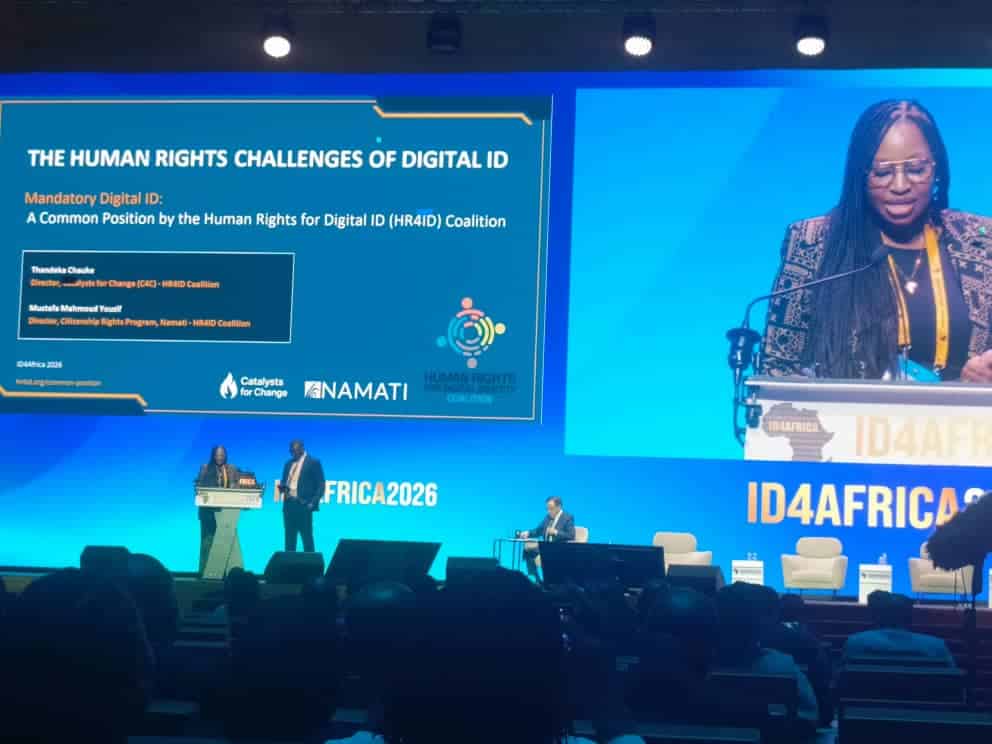
Some digital rights advocates who spoke at the recent ID4Africa 2026 AGM in Abidjan emphasized that for African governments to build rights-respecting national digital ID systems, they must establish a strong foundation of trust with their citizens through transparency and robust legal protections.
This was the thrust of the argument put forth by Thandeka Chauke, Director of human rights and social justice consultancy, Catalysts for Change, in South Africa, and Mustafa Mahmoud, Director of Citizenship at human rights organization, Namati Kenya. Namati has been involved in advocacy for human rights and privacy improvements in Kenya’s Maisha Namba digital ID system launched in September 2023. It had also been vocal about shortcomings in the previous Huduma Namba system.
In a co-presentation that dwelled on the human rights side of digital identity, the duo thoroughly examined the human rights risks associated with the implementation of mandatory digital ID systems.
Chauke and Mahmoud noted that this infrastructure can sometimes lead to function creep, structural discrimination and the exclusion of vulnerable groups like stateless or undocumented people, if not properly designed and deployed. At the same ID4Africa event, speakers also made the case for identity inclusion in favour of stateless persons and refugees.
The rights advocates argued that requiring digital identification for essential services such as healthcare and education, which is the case in some African countries, threatens fundamental rights when people lack the necessary documentation to enroll for such systems in the first place.
To them, this can be a worrying situation given that digital ID systems must be designed to serve as inclusive enablers rather than barriers, such that the transition to digital identity does not leave behind those already marginalized either by geography or lack of birth registration.
Chauke outlined that identity systems that are prone to exclusion or human rights issues are those that are foundational or meant for multi-purpose uses, systems that are linked to nationality and legal identity, as well as those that rely on biometrics like fingerprints, iris scans, and facial recognition.
“While we’re highlighting them as three separate categories, of course, they overlap. And when they overlap, then the risks compound; the concern isn’t just one of these types in isolation. We’re looking at exclusion, surveillance and discrimination that is structural and baked into the infrastructure,” she said.
According to her, it is the duty of the state to ensure that the right systems are in place: “It remains the obligation and duty of public institutions to ensure that digital ID systems comply with human rights. It’s important to look at the aspect of legality, of proportionality, and even of necessity. That all has to be clearly articulated in order to justify the adoption of a digital ID system.”
She went on: “I think the common ground for us is to build trust. First, we should know that you cannot compel trust, you cannot police trust, but trust is built by conversations, and by sharing the purpose so that people will understand why they need a digital ID. Basically, the biggest problem that we have is trust. So, we need to have systems that are built on trust.”
Digital ID should not be mandatory
Mahmoud for his part pointed out that making digital ID mandatory, expressly or otherwise, can negatively affect multiple human rights.
“When you deny people access to services because of an ID, you put them in situations whereby not only their human rights, but also their life is impacted. For example, if you tell someone that without an ID, they cannot even be admitted to hospital, it’s not only impacting their right to health, but also the right to life,” Mahmoud remarked.
He said they believe public institutions should not require mandatory enrolment in to digital ID systems.
“Why should we compel people to produce a digital ID when we already have ID systems where, maybe, the penetration level is still wanting?” he asked.
“Public institutions should not require mandatory use of digital IDs to access public services or privately provided public services,” Mahmoud strongly advised.
He suggested however that in cases where digital ID systems already exist or are being developed, “we should have a guarantee mechanism that allows us to be able to include people who have been left out through systemic discrimination or even geographical discrimination.”
The speakers also advised that conversations and investments regarding digital ID should not happen in isolation. According to them, governments must prioritize civil registration, put in place guardrails to protect the right to birth registration, and take concrete steps towards addressing the issue of statelessness.
Integrating civil registration and national identity systems was emphasized as a priority during another conversion in Abidjan.
Related Posts
-
 January 7, 2026
 -
 June 16, 2025
 -
 March 10, 2026
 -
 August 19, 2025
 -
 December 18, 2025
 -
 September 25, 2025
Article Topics
Africa | biometrics | digital ID | digital ID infrastructure | digital inclusion | government services | ID4Africa | ID4Africa 2026 | national ID

Comments