
Researchers inspired by palm vein tech develop invisible product ‘digital identity’
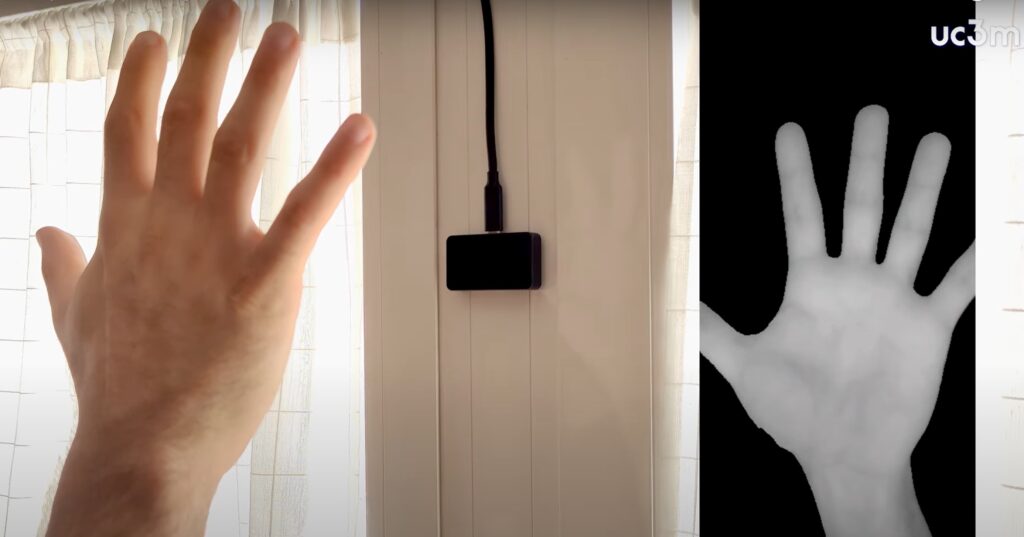
The sensing and pattern recognition technologies behind biometrics can also be applied to identifying and learning things about inanimate objects. As part of an ecosystem leveraging infrared technology and palm vein biometrics, a group of researchers from Universidad Carlos III de Madrid (UC3M), the Massachusetts Institute of Technology (MIT) and Adobe Research have developed a way to embed invisible digital information in printed documents using infrared ink and a special USB camera, to enable “a new generation of hybrid interfaces between paper and augmented reality.” Naturally, the infrared ink system is called Imprinto.
The larger system incorporating vascular biometrics is called VeinGoOne, according to a release. Raúl García Martín of UC3M’s Department of Electronic Technology, who was heavily involved in leading the project, says it analyzes palm vein images captured in real time, “allowing not only 2D visualization but also 3D reconstruction of vein depth using techniques such as stereoscopy or Time-of-Flight.”
The patent-pending system relies on a compact camera, connectable via USB-C to any mobile device, which allows blood vessels to be observed under the skin. While its near-term use cases include palm vein authentication and medical imaging, its projected future has a hint of sci-fi zeal behind it: the authors hope to replace mobile phones with “Augmented Reality glasses or contact lenses, capable of recognizing and interpreting the environment using integrated infrared cameras.” In this world, we will constantly be scanning the Imprinto’d labels on everything with our infrared goggles, ingesting a steady stream of encoded data.
In a video demonstration of the tech, García Martín says the team is in talks with various companies about commercializing VeinGoOne for palm vein recognition.
In the meantime, the Imprinto technology, an infrared inkjet watermarking technique that can be done using off-the-shelf IR inks and a camera, is designed to allow “advanced interaction with physical documents, without altering their visual appearance.” That means no more QR codes or visible watermarks. For digital identity, document authentication could be a major use case.
The team is also developing a complementary system, BrightMarker, which allows invisible codes to be embedded in 3D objects using fluorescent polymers, making it possible to print objects with hidden digital labels. García Martín says this can be useful for tracking plastic products in mass production environments, and to “create advanced, personalized interactions with objects using augmented reality.”
Related Posts
-
 September 9, 2024
 -
 January 23, 2025
 -
August 1, 2024
-
April 25, 2025
-
 March 4, 2025
 -
 September 5, 2024
Article Topics
biometrics | digital identity | Imprinto | infrared | palm vein biometrics | ToF sensors | VeinGoOne

Comments