
Boarding tomorrow: SITA envisions the future of air travel in Singapore Experience Center
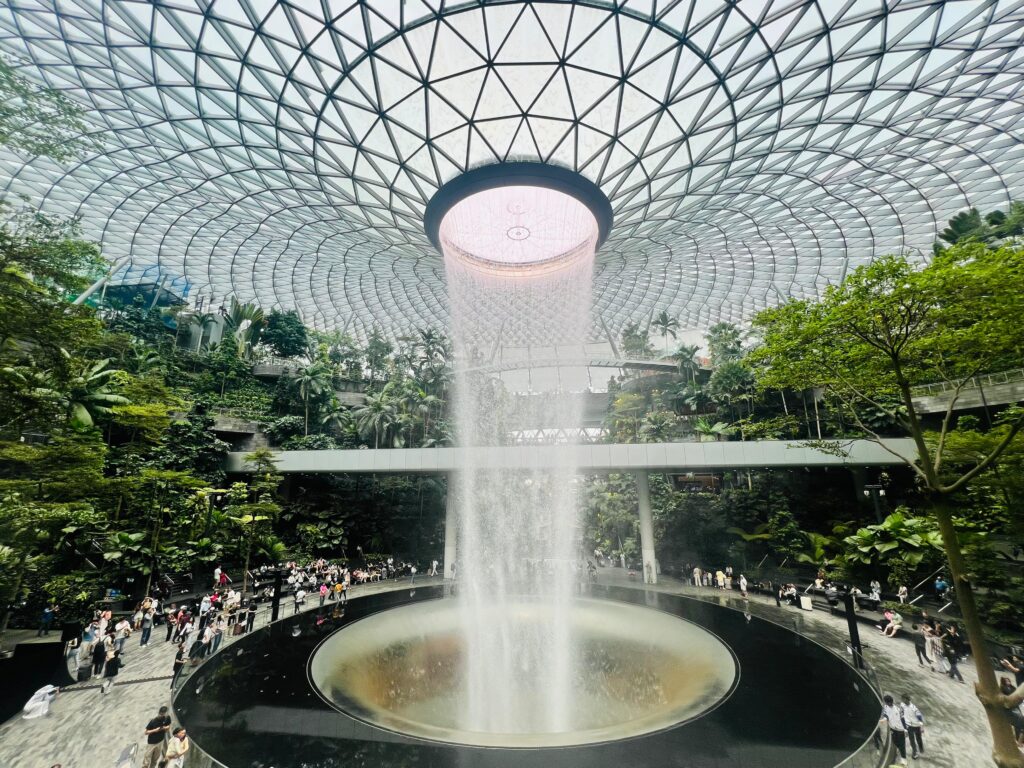
Jewel Changi waterfall at Singapore Changi Airport, November 2025 (Photo/Lu-Hai Liang)
Singapore Changi has a singular distinction among airports. Besides the advanced technologies and efficient processes, perhaps the greatest achievement of Singapore’s international airport is to transform what is usually just a transit and travel hub into a destination itself — and it’s easy to see why.
Jewel Changi is a circle of restaurants, shops and cafes. Locals come here to lunch and tourists throng its avenues, jostling for the perfect picture spot. It’s a shopping mall, a climate-controlled greenhouse with thousands of plants, and recreational space, all held together by the Rain Vortex waterfall as its centerpiece. The jewel in its crown. But beyond the eye-catching design, Singapore’s airport is a marvel of convenience.
It’s a brief interlude from deplaning to crossing immigration, officially entering the country, and picking up luggage. Automated e-gates scan passports and collect biometrics. A similar openness is found at Departures. Singapore Changi has a sparsity of airline counters compared to many other airports, while space-saving kiosks dot the airy terminals. The threshold to cross for boarding gates is just across the way; unhidden and inviting.
Airports are getting busier. International travel is becoming ever more popular and accessible. But the political and economic space for airports to expand is fraught. Physically increasing an airport’s footprint is both expensive, requiring huge capital investment, and bureaucratically challenging as clearing red tape can take years. This is where technology, design and forward-thinking has the potential to maximize the available space.
A short distance from Changi airport sits one of SITA’s regional offices. A few weeks ago, the multinational aviation company opened its new Experience Centre. The hub features immersive demonstrations of the latest technologies such as biometrics, digital identity and smart airport solutions. Designed to help airlines, airports, and governments explore innovations that enhance passenger experience and operational efficiency, Biometric Update was invited to experience the center.
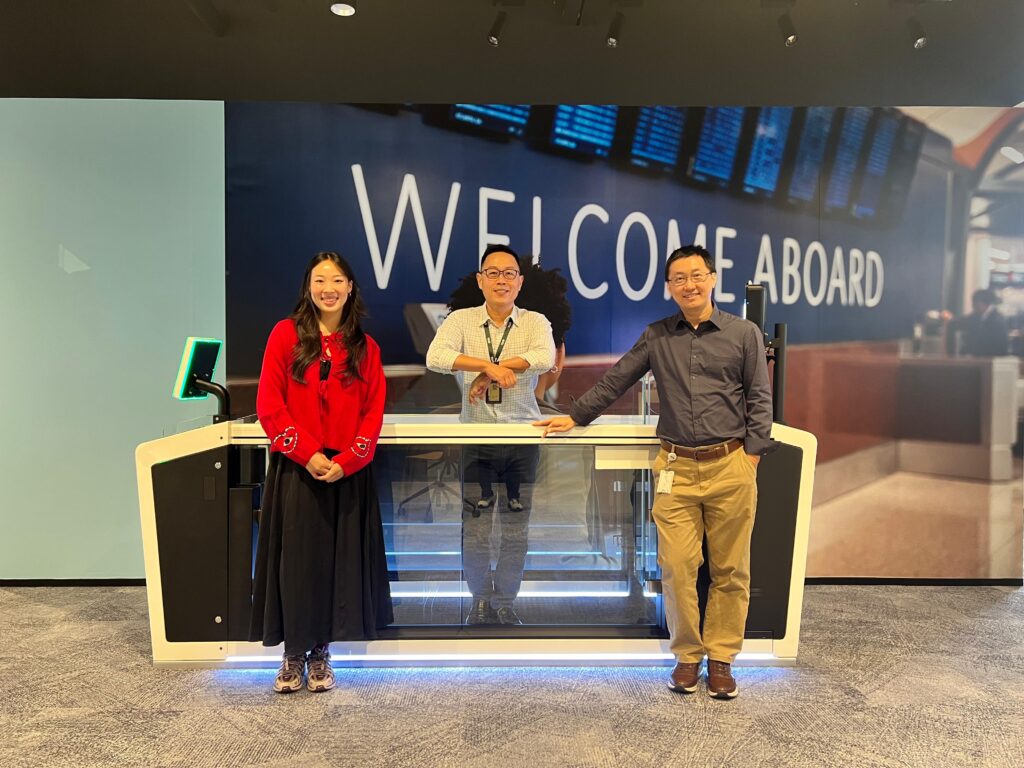
“We have been hosting a lot recently,” Yudhy Wijaya, senior manager of the Customer Experience Center (CEC), SITA, tells Biometric Update. Airlines and airport delegations have come through, with SITA educating on best practices. Due to the success of the previous experience center – “we got a lot of traction” – Singapore SITA managed to secure the budget to build a bigger area. The Singapore Experience Center is soothingly furnished, with coffee machines, TVs and the latest smart airport equipment.
A brave new digital world
A recent global survey from SITA revealed a shift in passenger expectations. Travelers want faster, smarter and greener journeys that mirror their digital lifestyles. While the demand is driven by younger travellers responses from over 7,500 passengers worldwide, the 16th edition of SITA’s Passenger IT Insights report revealed that simplicity, trust and sustainability must now define the air travel experience.
Passengers increasingly expect travel to function like their favorite apps — intuitive, connected and frictionless. Nearly half (42 percent) want a single ticket that covers their entire journey across air, rail and road; a wish that’s second only to shorter airport wait times.
Younger, mobile-first travellers are planning more complex trips. Digital identity adoption is accelerating, with 79 percent of passengers now ready to use digital IDs on their phones, up from 74 percent in 2024, and 66 percent willing to pay for the service.
Biometric technology is steadily gaining ground, with 62 percent preferring biometric checkpoints over traditional border counters and 58 percent favoring biometric check-in over staffed desks. Use of self-scanning gates during boarding has risen by seven percentage points, while automated border checks and biometric verification increased by two and three points, respectively.
This smartphone-enabled air travel begins at home. Kelvin Ng, senior manager, Business Development for Border Management, leads a demonstration. SITA’s International Civil Aviation Organization-compliant Digital Travel Credential (ICAO DTC) enables passport-less travel. The company has tested a proof-of-concept in Aruba in the Caribbean. Partnering with Delta Air Lines, decentralized digital identity company Indicio, and government officials from Aruba, SITA often engages in multi-stakeholder collaboration to realize such smoother travel experiences for passengers.
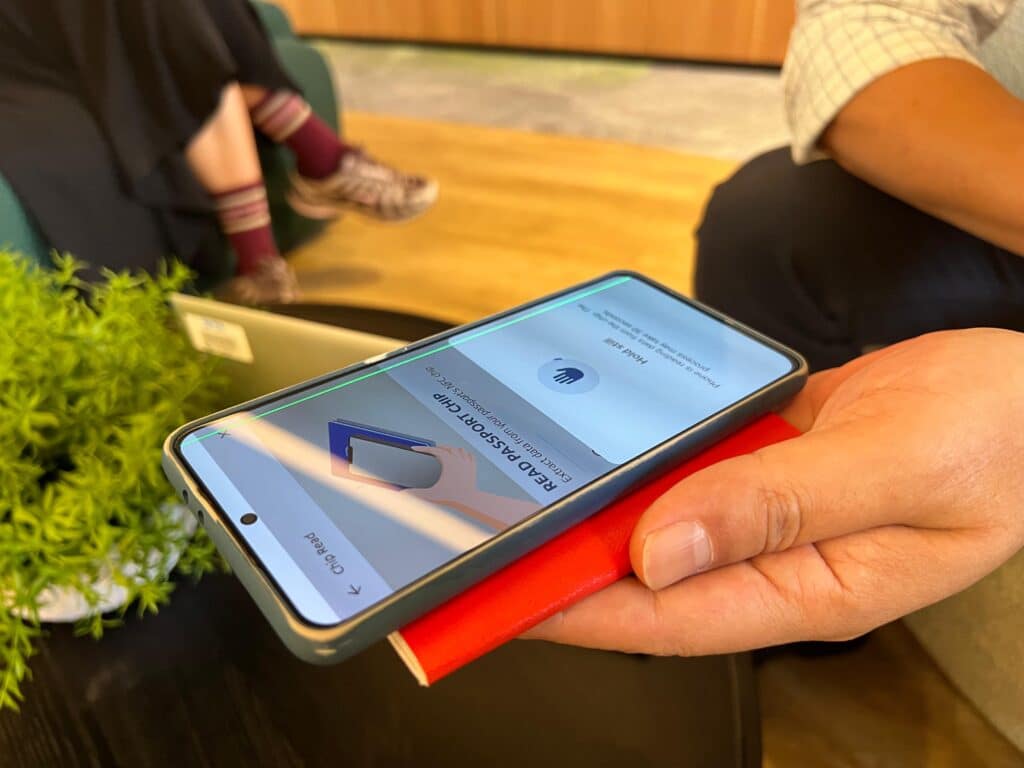
Ng opens up an app on his phone. He places the phone atop his passport and via NFC it reads it and pulls out the details. It’s seamless and takes seconds. When passengers get to the airport and into Aruba, face biometrics and face matching verifies the passenger, their travel details, and the information needed for immigration and customs. The whole process needs only the passenger’s face and completing pre-clearance. Ng explains that ICAO DTC is government-grade ID, while the IATA OneID is different as airlines don’t need to know as much personal information. The IDs are held within the phone’s digital wallet.
SITA is integrating border biometrics and airport biometrics. Its argument is that airlines benefit from faster gate clearance, which reduces ground-time costs, with automated boarding processes. Pre-clearance reduces inadmissible traveller rates. Less time spent in lines and queues means passengers have more time to spend in airport retail and dining areas; while pre-clearance means duty-free shopping is also made more convenient.
In short, it should all lead to improved security for officials whilst bettering the travel experience for the passenger. Beyond Aruba, SITA is currently engaged in additional proof-of-concepts but cannot yet publicly reveal them. But SITA tells Biometric Update that there are activities in Europe, between the French and the Dutch, for passport-less passage as Europe trends towards more border regulation and maintenance.
A new report from the World Travel & Tourism Council (WTTC) and SITA outlined how border modernization with biometrics and advanced travel authorization could add billions in economic growth and millions of jobs around the world. Digital IDs and a Digital Travel Ecosystem, pushing toward cross-border interoperability, could open up this new reality.
The “Better Borders” report forecasts that adoption of technologies like DTCs and policies in support of eVisas could increase global GDP by $401 billion and generate 14 million new jobs in the G20, the European Union and African Union by 2035. The report outlines six key principles, which includes electronic travel authorization (ETA) processes, and makes 18 recommendations for governments to realize these gains.
Planning for bottlenecks and capacity challenges
Getting buy-in from airports and airlines is one of the main challenges, Wijaya reveals. While Singapore Changi is a leader, along with Qatar and its Hamad International Airport in Doha, not every airport “thinks like this,” the SITA manager explains.
Some airports and governments want to do things their way, but there are benefits to thinking ahead. Wijaya names destinations in Southeast Asia where the airport officials consider operational efficiency once the airport has already reached capacity — “and then they think about it” he says. This is not ideal.
While better technology is often a solution, the top-tier utilize holistic thinking. It’s not just the technology, but how the technology connects with everything else. As ever, good design and forward thinking can support, complement and maximize technological solutions. SITA Flex — which is available via cloud, on-premises or hybrid — is a modular platform that streamlines passenger processing, offering the flexibility to plug in where it’s needed.
Summer Chew, Solution Engineer, CEC, demonstrates the Flex box that prints boarding passes or luggage tags, and which can be installed at a train station or cafe, for example. Flex is also the name for an API that allows for the registration of biometrics so air journeys can start at home. It’s a range of options for digitalization and integration into apps.
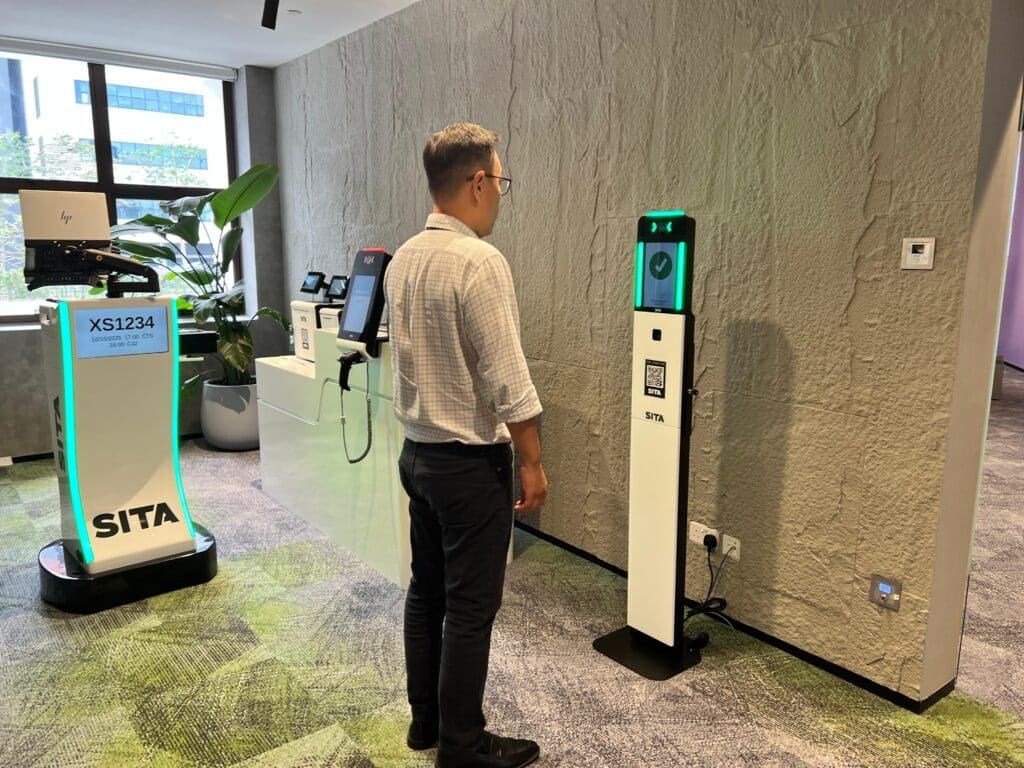
There’s POPPs, which looks like a bellboy trolley (a hotel luggage cart), that can weigh and process luggage, and is co-designed with Singapore University of Technology and Design. There’s a movable kiosk on wheels, so airline staff can scan and board passengers standing in the queue or anywhere in an airport; a face biometrics stand for self-check-in.
SITA shows a futuristic vision of biometrics and air travel with a gate where passengers “just walk through.” A screen behind the gate demonstrates what officials would see. Passengers would need to register on their phones before walking through the gate. On the screen details on each passenger flash up as they approach the gate, showing their nationality, name and other details. Algorithms could automatically flag issues, as face biometrics are scanned.
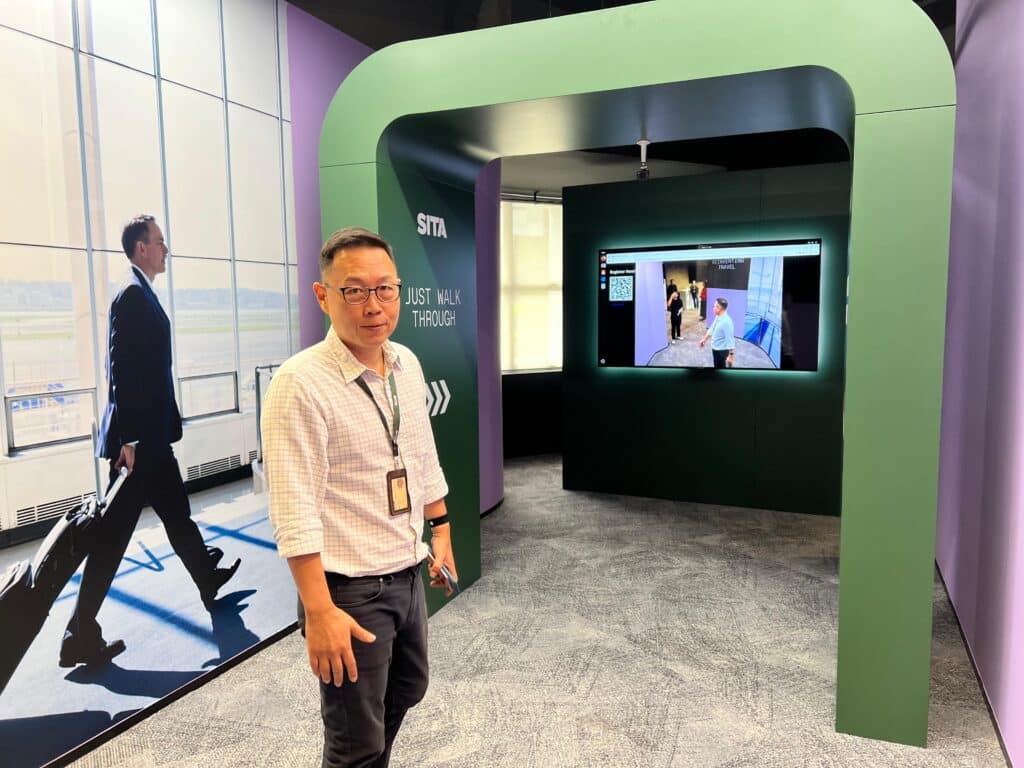
This is a future where passengers walk through airports with minimal friction and SITA’s CEC is the way to visualize it and experience it in person. And it’s just a stone’s throw away from an international airport that regularly wins awards for being the world’s best — an experience so good that the airport itself has become a destination worthy of being photographed and envied.
Related Posts
-
 December 12, 2024
 -
 April 14, 2025
 -
 April 7, 2025
 -
 July 29, 2025
 -
 December 10, 2024
 -
 February 24, 2025
Article Topics
airport biometrics | biometrics | border security | digital identity | digital travel | digital travel credentials | Singapore | SITA | SITA Experience Centre

Comments