
UK ETA, eVISA milestones position Entrust to expand citizen identity footprint
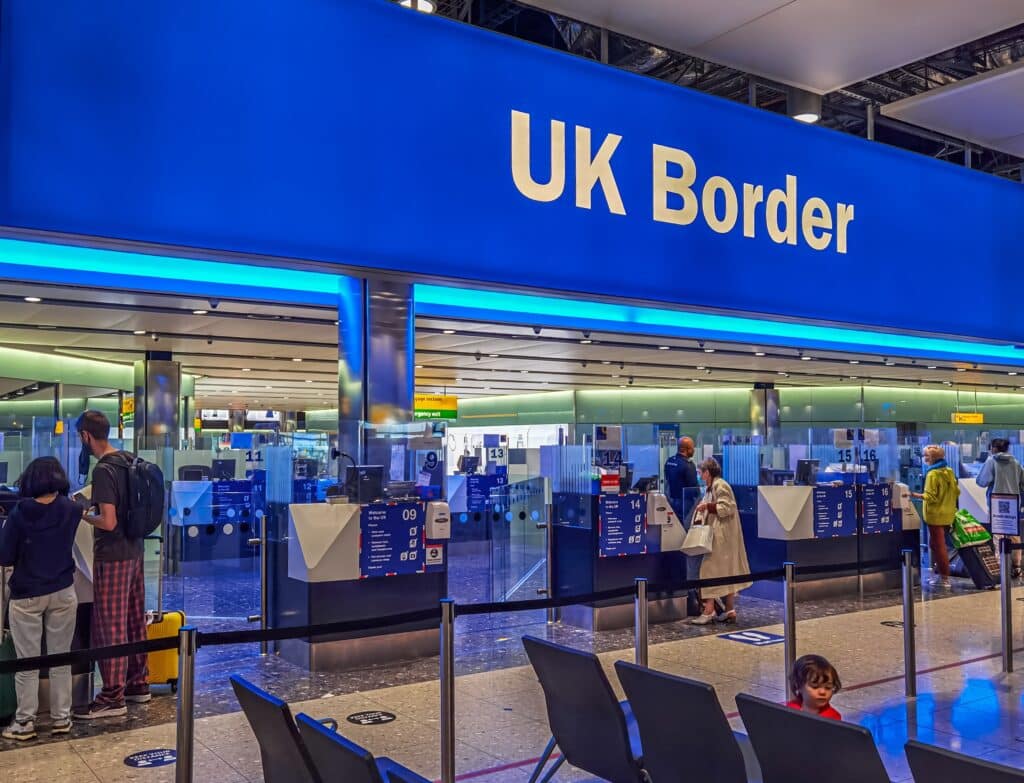
The UK’s Electronic Travel Authorization system and eVISA is backed of Entrust’s Citizen Identity Orchestration solution and scaling successfully, according to a company announcement.
Home Office’s system had issued 19.6 million ETAs and 2.2 million visas between its launch in October of 2023 and this past September.
The program’s successful scale-up is the product of a long-term investment by the Entrust and the Home Office, Entrust CEO Tony Ball told Biometric Update in an exclusive interview on the system’s progress. He identifies the collaboration and “transparency” in the partnership as a factor in getting to 20 million users, when issuances since September are included.
Applicants for ETAs or visas can apply through the ETA App or GOV.UK, scanning their passport chip and completing a face biometrics and liveness check with a selfie for identity verification.
The program was originally begun to address the need to issue visas on a different scale following Brexit, Ball explains.
It has now progressed under what he describes as a “crawl, walk, run-type approach, along with a best-in-breed approach where we’re enabling this program to benefit from advances we make in understanding how biometric onboarding is best to take place.”
That means using the right tech at the right time to enhance user experience while ensuring security.
With it’s success, Ball says, “this is now part of the critical infrastructure for the government.”
Scale and speed gains prove success
Scale introduces new challenges, Ball says, in terms of optimizing service for different jurisdictions, different profiles and user experiences.
And it is ongoing. The pace of adoption has continued to increase, such that Ball says the system is getting closer to 30 million ETAs.
“It’s becoming more of a referenceable service not only for the way that travel is being undertaken and the way other programs are being considered, but also when you broaden the lens to how other countries across the world are starting to look at that as an enviable solution that is making travel a lot easier for the target audience,” he says.
An example of that increased convenience is that UK ETA’s issued through Entrust’s technology are valid for two years, so they can be used for multiple entries and exits.
“It’s built for flexibility as much as it is built for convenience,” Ball says.
The AI toolsets now available stand out to Ball as an advantage “enabling us to get to outcomes far faster, but more dependably, with more accuracy”
“The time to get to an outcome has collapsed quite dramatically, and those advancements in technology have brought about much better user experiences,” Ball says.
Process completion times have halved in the last six months, and Paravision’s biometric algorithms have also cut the volume of manual verifications needed by more than 50 percent.
Ball refers to Paravision as “a long-standing partner,” and says that Entrust has worked on using its technology “in other applications to gain the comfort to bring it to a program of this critical importance and scale.”
“When you’re called upon to deliver these types of solutions, you’ve done an awful lot of the homework and got the comfort level to be able to put that forward,” he adds on the use of third-party technology. “And that’s where I would use the term ‘best-of-breed.’”
More improvements of this kind of magnitude can be expected as Entrust continues to integrate modern tools, according to Ball.
The need to reach challenging subgroups like the less digitally literate is one of the reasons for the long duration of the project, Ball says, noting “you can’t run before you can walk.” Alienating people through exclusion is the biggest risk for any government body, he points out, and governments want people’s interactions with them to feel natural.
Ensuring that they do involves a big investment in tech, but also “iterative testing cycles, in terms of understanding use cases, before we move to the point where we can say this is ready for us to broadly utilize.”
Proof builds confidence
The market for these kinds of digital public services is fragmented, Ball acknowledges, but large scale government programs providing “the appropriate returns” are “giving more countries confidence to make those investments,” he says.
The appropriate returns can only be achieved at scale, so seeing an active, large-scale program continue to deliver results with robustness and dependability gives Entrust an invaluable example of how it can help governments meet their digital service objectives.
As confidence rises, the appetite to trial similar systems is increasing. The urgency of doing so is only increasing, as the appeal of touchless processes remains high, and post-pandemic travel volumes surpass previous highs.
The company is still working with the Home Office to help scale the program, “broadening the value, and also offering other services through that to the UK Home Office’s desire, and also adjacent referenceable entities inside the UK as it makes sense.”
Entrust’s collaboration with the Home Office also extends beyond the ETA scheme, under the department’s Generic Identity Verification (GIDV) program.
The company has been around for 55 years, with roots in payments, cryptography and PKI. “So we understand encryption extremely well,” Ball says. “We understand how data needs to be protected, how you utilize data. And more recently we’ve made investments in next-generation fraud prevention technology and incorporated AI tools.”
Ball and his predecessor at Entrust Todd Wilkinson discussed the company’s shift toward digital identity with the Biometric Update Podcast during the company’s CEO transition last year.
This background creates a strong position from which to leverage investments in data protection and fraud prevention, with best-of-breed partners, to get to outcomes faster than others in the space. Entrust has also made substantial investments in AI and also post-quantum to be ready to take advantage of them.
Confidence unlocks investment
Ball believes Entrust’s experience working with the UK Home Office on the ETA and eVISA system not only supplies the confidence to potential future customers, but also the technical template.
“From a technology perspective, adaptation is not the major challenge,” he observes.
The challenge of adaptation to another country come from differences in preferences in how to give access to data, or the country’s comfort level with access to government sources of truth. There is also infrastructure that the country has already invested in to consider.
“Can you integrate into their infrastructure, can you make that something that they can manage financially to outcome? All of those things play much more into the decision-making than it is if you can take Entrust’s ETA technology and be able to stand that up in a host of other countries. Objectively; yes.”
Regulatory, compliance, and data privacy concerns are all part of the discussion, but Ball says “we see those things as very much our friend in being able to advance these solutions.”
He compares the advance of digital identity to the payment ecosystem’s evolution. Different debit systems were originally put in place in each country, while the credit card system worked across different countries. “Now the world has changed.”
“The payment ecosystem in many respects is the forerunner to the citizen identity ecosystem,” Ball says.
Entrust’s Citizen Identity Orchestration is already working in Uruguay, Barbados, Jamaica, and Ball sees opportunity ahead for further adoption all over the world.
But he cautions that the long-tail approach is necessary, even if many of the concerns are not immediately visible to governments looking for a way to improve their service delivery.
“The question I would continue to ask of organizations that participate in this area is: how do you continue to make sure that you’ve got scale, and how do you make sure that you’re able to continue to offer a service that delivers on your original promise, and how an organization invests to continue to do that,” Ball says.
“Many see the tip of the iceberg, and the tip of the iceberg is the presentation layer you see in your hand, or the web application that you’re interfacing with. What many don’t see is the day-in, day-out investment that companies like Entrust make in critical infrastructure, in making sure that we protect the integrity of everything that goes on under the surface.”
Related Posts
-
 February 28, 2025
 -
 February 26, 2025
 -
 February 25, 2025
 -
 August 4, 2025
 -
 July 29, 2025
 -
 April 1, 2025
Article Topics
biometric liveness detection | border security | digital ID | digital travel authorization | electronic visa | Entrust | face biometrics | Home Office Biometrics (HOB) | identity orchestration | Paravision | visas

Comments