
Philippines unveils digital civil registration service with QR code verification
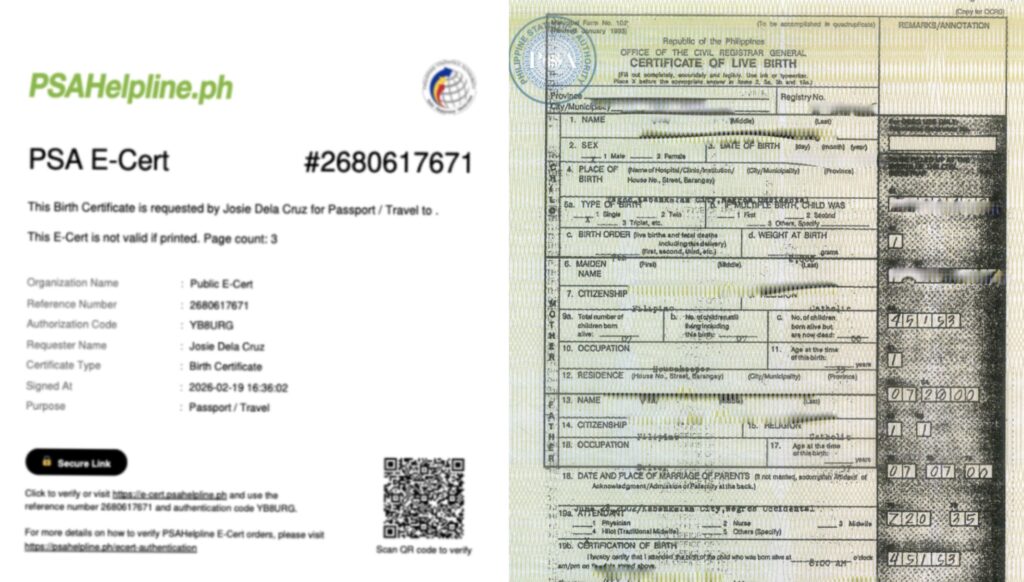
The Philippines is making changes to civil registration documents and processes to make them more secure and convenient. Among them, an E-Certificate Service was launched by the Philippine Statistics Authority (PSA) this week.
National Statistician Claire Dennis Mapa said at the launch of the service that the move means applications for civil registration documents, their processing, issuance, and verification will henceforth be done entirely online. Applicants submit a selfie for face biometrics matching and liveness detection to prevent fraudulent issuance.
The service has been designed with features that improve usability, convenience and security including the integration of a QR code into each certificate that will be issued, in a bid to prevent tampering and identity fraud. The QR code feature and other security elements were first tested in a pilot in 2022.
This eliminates the need for manual verification of civil registry records such as birth, death and marriage certificates.
Mapa explained that the innovation aligns with the government’s ongoing digital transformation agenda which aims for the full digitization of access to several public services.
“This service utilizes an advanced cryptographic safeguard. This will ensure that the issued civil registry document is impossible to forge or tamper with,” Mapa said.
“This [QR code-based verification] feature provides institutions with greater assurance that the document is authentic, allowing real-time validation of the certificate’s details. The seamless verification process minimizes the risks of fraud, strengthens institutional trust, and delivers confidence in every transaction,” he added.
Institutions such as schools and businesses can use the document verification service for faster identity verification by scanning the QR code on it, or via a reference number which can be entered on the E-Certificates Service website, Daily Tribune indicates.
According to the PSA, digital certificates issued through the new system will have the same legal recognition as their physical counterparts. Mapa also hailed the E-Certificate Service as a cost-saving measure, and one that streamlines civil registration procedures and renders them more innovative and sustainable.
To access the service, users are urged to visit the PSAHelpline.ph website, and the platform is expected to be particularly useful for educational and financial institutions, as well as for employees.
MOSIP, on whose software the Philippine national digital ID system runs, recently made enhancements to its QR code specifications, Claim 169, with the goal of adding inclusivity and flexibility to ID cards.
Pakistan also recently greenlighted changes to its identification regulations to introduce QR code-based verification to its national ID cards for enhanced security.
Related Posts
-
 June 4, 2025
 -
 January 13, 2026
 -
 November 17, 2025
 -
 August 8, 2025
 -
 June 5, 2025
 -
 August 19, 2025
Article Topics
civil registration | Claim 169 | digital identity | ID verification | identity document | MOSIP (Modular Open Source Identity Platform) | Philippines | QR code

Comments