
Your phone could replace the ballot box
By Amy Allshouse, civil defense attorney
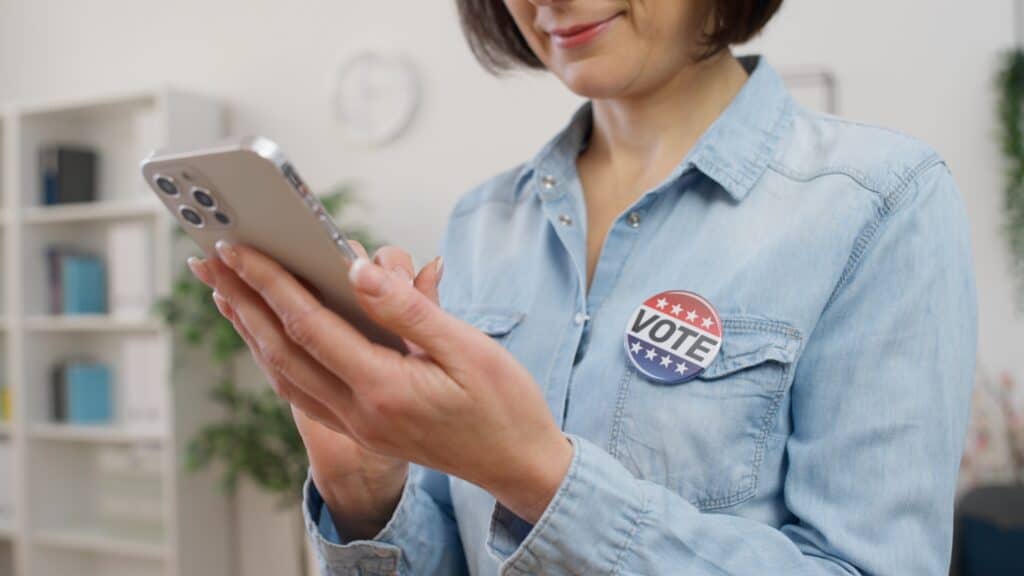
Voter turnout in the United States consistently hovers around 50–65% in presidential elections — and far lower in midterms and local races. We accept this as normal. But imagine if you could vote the same way you unlock your iPhone or approve a bank transfer: with your face or fingerprint. That future is closer than most people think, and the legal and regulatory framework we build around biometrics today will determine whether we get there.
The tech stack already exists
Three technologies are converging to make smartphone-based voting a real possibility: biometric authentication, blockchain, and the modern smartphone. Your phone already contains a fingerprint reader, a high-resolution camera capable of facial recognition, and enough processing power to run encrypted transactions. What has been missing is a trusted legal and technical framework.
Companies like Voatz have been quietly proving this out. Their platform combines hardware-based security, biometric identity verification (a live selfie matched against a government-issued photo ID), and a blockchain ledger to create a tamper-evident, auditable vote record. As of late 2025, Voatz has served more than 5 million voters across 150 elections in 8 countries,was last certified in November 2025, and in 2018 became the first platform used for a mobile vote in U.S. federal election history. The global blockchain voting market was valued at $290 million in 2024 and is projected by industry analysts to reach $770 million by 2034.
Here is how a secure smartphone vote could work in practice: a voter opens the app, takes a real-time selfie that is matched against their government ID photo (liveness detection prevents spoofing), and casts their ballot confirmed by their fingerprint or face scan. The vote is encrypted, assigned a one-time-use token, and written to a blockchain where it is immutable and publicly auditable—but not traceable to the individual. Personally identifiable biometric data is deleted once the vote is secured. A paper trail is generated at the jurisdiction level for physical audits. Whether the app is run by a private company or a government agency is itself a critical legal question—one addressed below.
The legal friction: Biometric ID is already here
State laws designed to protect your fingerprint and face data from corporate misuse could inadvertently block the infrastructure needed for biometric voting. Importantly, however, existing state biometric privacy laws explicitly exempt government entities. This means a government-administered voting app would sidestep the consent and collection restrictions that apply to private companies. A private company running the same app would face a significant legal obstacle: it would need to navigate consent requirements across fifty different state regulatory environments, making a nationally uniform system nearly impossible without federal intervention.
However, we are already seeing states accept the privacy protections of biometric collection on smart phones where one is able to store their driver’s license in a digital wallet. The federal government concurs, by way of TSA, allowing U.S. citizen smartphone users to store their passport credentials in a digital wallet as Digital ID—usable as RealID for domestic travel. For many smartphone users, the biometric ID issue for voting is already solved.
What actually needs to change
Two things have to happen for biometric smartphone voting to become reality in the United States.
One, election law needs to catch up with technology. Most state election codes were written for paper ballots and in-person machines. Blockchain-based mobile voting exists in a legal gray zone—some jurisdictions have piloted it, but none have fully adopted it at scale for general elections. Model legislation is needed that defines standards for cryptographic audit trails, biometric data handling, accessibility requirements, and what constitutes a valid ballot in a digital system.
Two, the public trust gap has to close. Security researchers have raised serious concerns about mobile voting platforms. A 2020 MIT study found high-severity vulnerabilities in Voatz’s architecture, later confirmed by a security firm Voatz itself commissioned. Voatz has addressed some of these issues, and the platform has continued to operate and expand, but the scrutiny underscores why open-source systems, independent security audits, and rigorous federal certification standards are prerequisites for public trust. Separately, industry surveys suggest nearly 60% of voters express apprehension about cyber threats in digital voting systems. On the other hand, as younger digital natives grow up, voting on a personal device will likely be adopted with less hesitation.
The stakes are higher than convenience
Voting by smartphone removes time and movement barriers and significantly impacts who gets to vote. Active military overseas, voters with disabilities, rural citizens without easy access to polling places, and people who cannot take time off work on a Tuesday in November—all are underserved by a system built around a physical polling place. According to Voatz, its platform has demonstrated meaningful accessibility gains for exactly these populations.
Biometrics also solve a problem that voter ID laws address clumsily: confirming that the person voting is who they say they are, without requiring physical documents that not everyone possesses. A biometric linked to a government ID is harder to fake and harder to steal than a driver’s license. It’s only a matter of time before every state adopts the digital (driver’s license) ID. And every smartphone user with a U.S. passport has this option today.
More than anything else, the benefit of voting by smartphone would move us toward something incredibly powerful: a democracy where every eligible citizen can cast a secure, verifiable vote from wherever they are, with nothing more than the phone in their pocket and the face on their head.
About the author
Amy Allshouse, CIPP/US, is a civil defense attorney and biometrics developer focused on the intersection of biometric technology and civic infrastructure. She writes about emerging technologies focusing on AI-driven human-computer interaction through biometrics.
Related Posts
-
 April 7, 2025
 -
 October 20, 2025
 -
 April 1, 2025
 -
 September 30, 2025
 -
 December 1, 2025
 -
 November 13, 2025
Article Topics
biometrics | blockchain | elections | smartphones | United States | voting

Comments