
Kenya adds iris biometrics to reused tablets for voter registration
The Independent Electoral and Boundaries Commission (IEBC) of Kenya will soon resume a Continuous Voter Registration exercise with a plan to get at least 6.3 million new potential voters, and to introduce iris biometrics capture.
IEBC Chairperson, Erastus Edung Ethekon, said during a recent parliamentary hearing that the biometric registration will target mostly young people who make up a large number of the potential voter population in the country.
During the Parliamentary Accounts Committee hearing, Ethekon spoke about the election agency’s preparations for an upcoming by-election, as well as a projection into the 2027 general vote.
The official, who was there to respond to questions from the Auditor General’s report for the financial year ending on June 30, 2023, said preparations for both elections were on good footing.
Ethekon mentioned that they will continue to work with parliamentary leaders as well as other well-meaning Kenyans in order to “enhance our electoral processes and voter experience.”
Trading a bulky suitcase for a bulkier security layer
Meanwhile, the IEBC has explained that the upcoming voter registration will include the capture of iris biometrics for the first time.
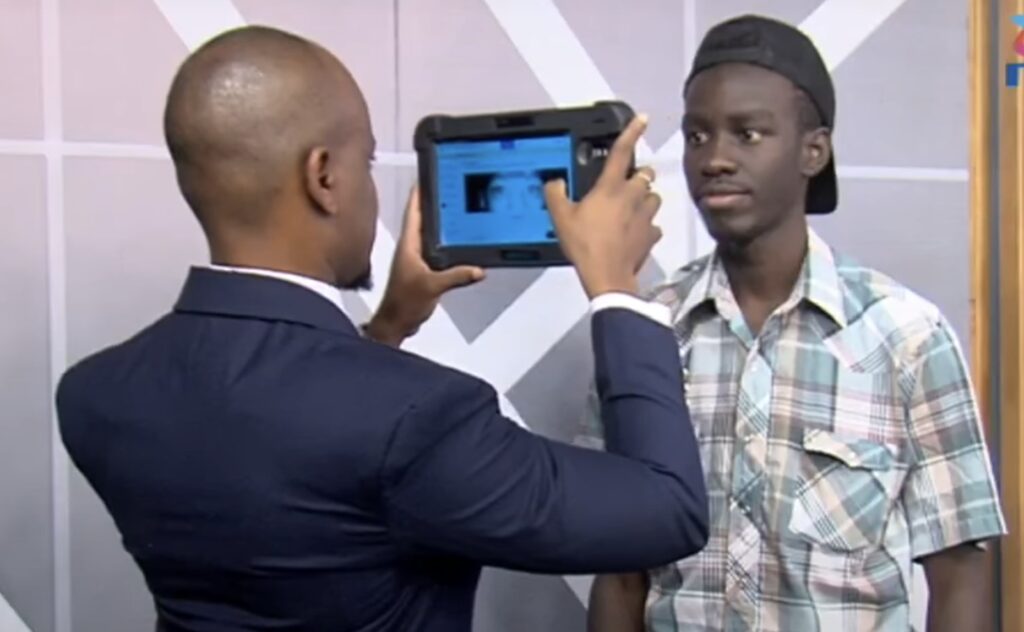
Speaking on a show on local TV channel NTV, a BVR operator from the elections management agency, Roy Lokaale, said the move to add the iris biometrics modality is to enhance the layer of security.
“We continue to improve our security features. In the past, we relied on fingerprints and facial photos. Now, we’ve added the iris as a third layer of security and identification,” he disclosed. Lokaale had a legacy BVR kit with him in the NTV studios and explained the various components contained within the suitcase.
“These gadgets were first introduced in 2012 for the 2013 elections. At that time, 14 million voters were registered. They continued to be used up to the 2022 elections, where we registered over 22 million voters. So, everyone currently on the register was captured using the BVR kit,” Lokaale explained.
The biometric kits to be deployed for the registration exercise were among those used for voter verification during the 2022 general elections. Glitches were reported then with the kits at hundreds of polling stations, out of 46,000. Some of the biometric kits used at that election were provided by Idemia, and others by Smartmatic. Reporting at the time indicated the Smartmatic kits cost KES 3.2 billion ($26.7 million), or roughly $1,890 each at August, 2022 exchange rates.
Lokaale added that in order to make things easier, the IEBC has incorporated the voter registration system into tablets, and the integration is happening under the Kenya Integrated Electoral Management System (KIEMS).
“This gadget can now handle registration, voter identification, and eventually transmission of results,” he revealed.
The reuse of the same tablets used for biometric voter verification in 2022 for the coming round of voter registration, even with an additional biometric modality, could potentially make the exercise much more cost-efficient for the IEBC.
Earlier this year, an audit found that 200 of the biometric devices linked to KIEMS were missing.
Related Posts
-
 September 4, 2025
 -
 April 1, 2025
 -
 October 1, 2024
 -
January 27, 2025
-
 May 14, 2025
 -
 March 10, 2025
Article Topics
Africa | biometrics | iris biometrics | Kenya | Kenya Integrated Elections Management System (KIEMS) | voter registration

Comments