
Heuristik targets healthcare biometrics with AI built for clinical conditions
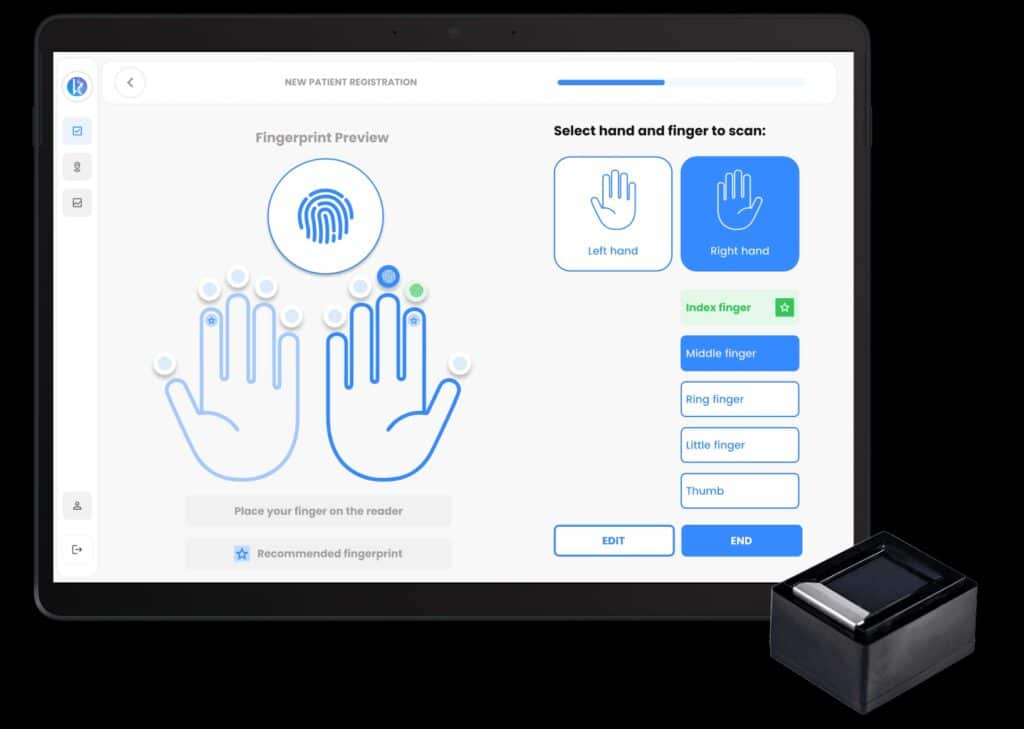
Spanish biometrics company Heuristik has global ambitions, a personal origin story and government backing for its neural network focused on fingerprints and healthcare.
Biometric Update spoke with Heuristik founder and CEO Antxon Caballero on expansion plans, identification and his grand vision. The Heuristik backstory starts with Caballero’s grandfather.
The family patriarch was given the wrong medication due to an identity mix-up. Following this accident, which could’ve led to serious issues in other contexts, Caballero began investigating patient identification errors and discovered that it’s a bigger problem than he realized.
Traditional fingerprint biometric systems are made for predictable environments like unlocking a smartphone or entering a gym. Clinical settings are different, Caballero says. “We created a model, a neural network, to identify patients’ fingerprints because common fingerprint systems are not ready to identify fingerprints when they’re blood stained, wet, dirty or whatever,” he told Biometric Update.
Hospital patients’ fingers can be wet, dirty, blood-stained or covered in therapeutic creams, causing standard scanners to fail. Heuristik has developed a proprietary neural network designed to identify fingerprints under conditions that traditional biometric technology would find challenging.
Heuristik is a pure AI research firm, but it’s developed a “360-degree hardware and software solution” that integrates into existing hospital workflows. Caballero says that all the hospital groups who’ve tried it so far have gone on to adopt his solution and pay for it. The AI platform is cloud-based and can replace traditional hospital methods like wristbands for identification.
While standard biometric security relies on a one-to-one verification process, such as matching a face to an ID card, Heuristik’s solution performs a one-to-many identification. With a single scan, the system cross-references a patient’s fingerprint against a database of millions, linking them securely to their electronic medical records.
The company is preparing to publish a peer-reviewed study demonstrating a 100-percent accurate patient identification rate in a live healthcare environment. Currently a pre-print, Caballero told Biometric Update the results are based on identifying a hundred-plus people.
Heuristik has a small team of 14 staff but significant institutional support. It recently received the Torres Quevedo grant, one of Spain’s most prestigious. To date, the company has secured €3.2 million ($US3.7 million) through venture capital and research grants. The Spanish Society for Technological Transformation (SETT), which is attached to Spain’s Ministry for Digital Transformation, is among the startup’s backers, investing more than €540,000 ($629,000).
With pending applications, Caballero hopes to increase funds by this summer. Caballero is already looking ahead, aiming to close a €5 million ($5.8 million) round by the end of the year to fuel market expansion.
The US, Europe and Latin America are the focus
Heuristik works with hospital groups, deploying the technology for live trials, which it oversees, before moving to a paid model. The strategy has proven effective as a hundred percent of the hospital groups that have trialled the system have converted into paying clients, according to Caballero.
Currently 20 hospital groups across Europe, the U.S. and Mexico have adopted the platform. Most are in Europe, while one is in the U.S. and another in Mexico, the founder says. Asked about biometric competition in the U.S., Caballero believes his solution is a complementary layer for the healthcare sector; with his focus purely on healthcare biometrics rather than a more generalized approach.
Data privacy is critical in this sector and Caballero says Heuristik acts strictly as a secure conduit, matching biometric data without accessing, storing or disclosing sensitive personal health data. “We don’t have access, we just link it [to the patient’s records],” Caballero says. Biometric Update asks him how his technology does this, but the founder can’t disclose more for fear of being copied.
We’ve closed the main hospitals in our target countries,” Caballero says. “[Now it’s about] growing with them to different areas, expand to the other hospitals. “[We’ve] created a breakthrough technology that we already evaluated and we have main customers for this. Next step is to grow, [become] the gold standard around patient identification. To keep growing to different markets.”
While Heuristik is focused on fingerprint identification (not verification), Caballero says they’re developing facial recognition software and is collaborating to explore scanning devices specifically for infants whose fingerprints are still developing.
“Time and money” is Caballero’s succinct reply when asked about the barriers to Heuristik’s vision. Managing international deployments, gathering feedback, and publishing papers requires those things. But Caballero is confident in the company’s trajectory, projecting that Heuristik will become the largest healthcare biometrics company in Europe in two years, and the global standard for patient identification in four. It’s certainly ambitious but it’s a biometric and AI vision that the Spanish government, and other investors, has backed.
Related Posts
-
 February 5, 2026
 -
 March 4, 2026
 -
 August 20, 2025
 -
 February 23, 2026
 -
 December 1, 2025
 -
 November 13, 2025
Article Topics
biometric matching | biometrics | fingerprint biometrics | healthcare | Heuristik | patient identification | startup

Comments