
Digital identity must be built for interoperability from day one, says Margins CEO
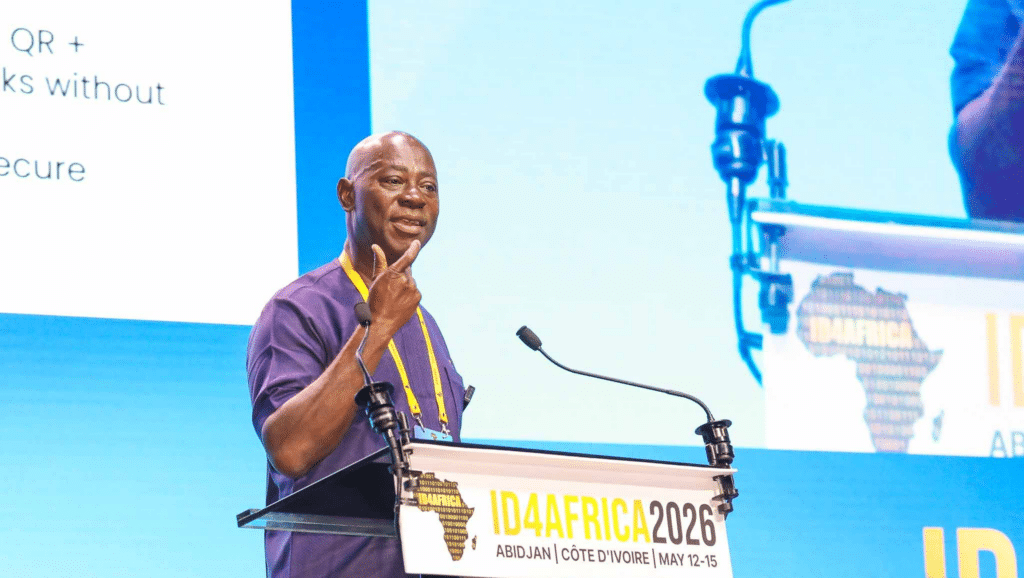
Prominent Ghanaian entrepreneur and Margins ID Group founder and CEO Moses Kwesi Baiden Jnr. has argued that national digital identity systems are only as valuable as their ability to interoperate across sectors and support access to public and private sector services.
Baiden, who is a regular speaker at corporate events around the continent, made the assertion in a keynote he presented at the recent ID4Africa 2026 AGM in Cote d’Ivoire, rallying thousands of people from across the global identity space.
He regretted that over the years, countries have had to deal with fragmented and siloed identity systems which have proven not-too-useful in advancing integration, digital trade or development.
Countries are increasingly shifting from national ID enrollment programs toward broader digital public infrastructure strategies built around digital identity, payments and data exchange. Baiden argued that without interoperability, even large-scale identity systems risk becoming little more than isolated databases rather than foundations for digital services.
This, he said, is because with traditional national ID systems in the past, people collected data in different silos. These data structures are different, he stated, meaning that they have different data fields, varying data quality, and sometimes even conflicting identities.
These identity systems have proven to be disadvantageous in many ways as the world enters the digital age because countries where citizens lack a digital ID to interact with the digital world, will suffer a negative impact on their social, economic, and political advancement, Baiden noted.
And who pays for this fragmentation? “Citizens pay for it. They pay with inefficient and ineffective services, sometimes paying three or four times the actual fee due to bribery and corruption caused by human interfaces. In public services, e-commerce is slowed down, the digital revolution is delayed, and financial services remain largely out of reach for ordinary people,” he said.
He explained that the approach of having standalone identity programs, fragmented governance, and retrofitting interoperability, rather than designing it ab initio (from the beginning), creates problems that become very difficult to fix.
Interoperability by design
The panoply of challenges notwithstanding, Baiden believes the persistent identity challenges of the past can be bypassed, if countries can go straight to digital ID systems that are fit for today’s modern digital ecosystem.
“It means that right from inception and design, we need to look at our objectives from day one to see what outcomes we want, what our priorities are, and how they align with our social, economic, and political goals. This allows us to gradually integrate and interoperate according to our needs for the highest impact,” the Margins ID CEO advised.
According to Baiden, doing this is not really a matter of technology. It actually starts with a legal framework because after all, the “who you are” question is determined by a country’s constitution, whether it is based on citizenship by birth or by blood. And this legal definition of who you are is an essential foundation for building a digital identity that reflects one’s legal status, he noted.
“So, design from the beginning is based on a legal framework. It is also based on how you are organized. We do not live in a vacuum. What environment are you in? How do citizens interact? How do they actually receive services on the ground? Designing outside the legal and operational frameworks of a country misaligns the technology we apply to solve the problem. All these elements must be integrated to be successful,” Baiden argued.
The Ghana Card example
Margins ID Group built the Ghana Card for the Ghanaian government, a national ID system that has more than 19.4 million people enrolled for it. Efforts continue to be made to expand the identity system for more inclusion with an ongoing enrollment drive for children between six and 14.
Baiden cited it as an example of an identity system which has fully integrated several use cases and has interoperability across several government institutions.
He said the system was built in a manner as to ensure that a person exists only once in the foundational database, “containing all the identity fields needed for both the public and private sectors, a system that cuts the costs of gathering data, tracking people down, and issuing cards, which are all processes that typically introduce weaknesses into identity systems.”
“Therefore, creating a single, highly trusted credential from which all other identities flow is critical,” the official mentioned.
The Margins ID CEO also explained that apart from the central database of the National Identification Authority (NIA) that public and private institutions rely on, there is also a physical Ghana Card.
“It features three profiles and 14 applications that can be shared with public and private institutions and enabled according to their priorities. This gives us multiple verification options.” Discussions are currently ongoing for the digital wallet application of the card to be activated for digital payments.
“In Africa, we are not just living in the future by leapfrogging legacy systems; we are also figuring out how to innovate within our current environment so that these use cases apply across the board. An ID is not just technology; it is a living thing that drives social, economic, and political action,” according to Baiden.
In making digital ID systems interoperable, efforts must also be made to deploy the right data governance frameworks and rules, ensure that the data flowing from system to system is standardized and traceable, and see to it that technology aligns with existing laws, Baiden added.
The Gambia announced early this year that it had selected a subsidiary of Margins ID Group for a contract to upgrade the country’s identity infrastructure.
Related Posts
-
 August 22, 2025
 -
 September 16, 2025
 -
 June 6, 2025
 -
 October 2, 2025
 -
 April 8, 2026
 -
 June 4, 2025
Article Topics
digital identity | digital public infrastructure | Ghana | Ghana Card | ID4Africa | ID4Africa 2026 | interoperability | Margins ID Group | national ID

Comments