
Miami International Airport sees largest deployment of SITA-backed EPP screening
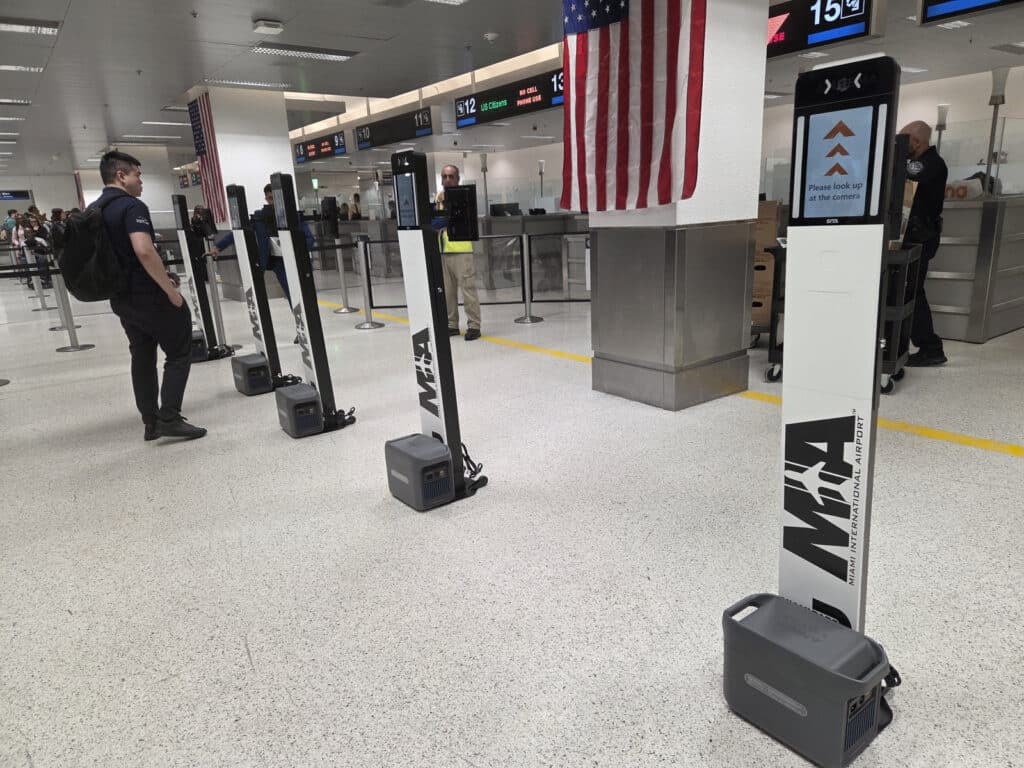
One of the busiest airports in the U.S. has introduced Customs and Border Protection (CBP)’s Enhanced Passenger Processing (EPP) system, which integrates SITA’s Smart Path face biometrics system. A release says Miami International Airport (MIA) is now host to CBP’s largest single deployment of automated passport screening in the U.S., and a demonstration of how biometrics and mobile connectivity can enable more efficient passenger processing without the need for new infrastructure.
SITA’s Smart Path platform captures and processes biometric photos during border inspection, verifying travelers by matching images against CBP’s records within three seconds. Per the release, at MIA, “the process involves 12 biometric face pods across MIA’s three passport control facilities, located in concourses D, E, and J.” The mobile pods can be repositioned as needed to optimize passenger flow. Each unit has an agent-facing screen for real-time monitoring.
“Miami is one of America’s busiest international gateways and the door to Latin America and beyond,” says President Americas for SITA Shawn Gregor. “This EPP launch is setting a new standard for efficiency at the border by using biometrics to make arrivals smoother, faster, and more secure for everyone, and can easily scale over time to additional terminals and to handle increased capacity.”
“Offering EPP for our travelers is part of our commitment to making MIA one of the most technologically advanced and passenger-friendly airports in the country,” says Miami-Dade County Mayor Daniella Levine Cava. “Because participation in EPP is completely voluntary, travelers may choose the option that works best for them – while still benefiting from improved security and a smoother, more efficient arrival process.”
SITA’s latest Air Transport IT Insights says 53 percent of North American airlines are already investing in biometric and digital identity management, outpacing the global average. And nearly 60 percent of airports have implemented touchless passenger flow technologies.
MIA is one of several U.S. airports to go live with EPP this year.
A blog from MIA says TSA Checkpoint 2 in Concourse D has also installed four Analogic eXpress baggage screening lanes, each equipped with 3D computed tomography (CT) explosive detection scanners and fully automated bin return conveyance systems that can screen 500 bins per hour. Automated conveyor belts transport carry-on bags into the CT machines and then return the bins, which are tagged with RFID, to the queue once screening is completed.
MIA is in the midst of a 9 billion dollar modernization initiative to renovate the entire airport over the next 5 to 10 years. The airport has been deploying SITA biometric kiosks since at least 2015.
Boarding tomorrow: SITA envisions the future of air travel in Singapore Experience Center
Related Posts
-
 July 29, 2025
 -
 December 12, 2024
 -
February 3, 2025
-
July 1, 2025
-
 January 29, 2025
 -
 September 12, 2025
Article Topics
airport biometrics | biometric matching | biometrics | Enhanced Passenger Processing | face biometrics | passenger processing | Simplified Arrival | SITA

Comments