
The high stakes push to fix America’s broken travel experience
In the final months of 2025, the modernization of the U.S. travel system is no longer a collection of pilot programs or isolated upgrades. It is coalescing into a coordinated – if still uneven – push to rebuild how passengers are identified, screened, and processed across borders and airports.
This modernization is being driven by biometric technologies, digital identity platforms, and growing political pressure to make air travel both faster and more secure.
This pressure is articulated in the report, A Vision for a World-Class Travel System in America, issued by the U.S. Travel Association’s Commission on Seamless and Secure Travel.
The commission’s core finding is stark. It says the U.S. is losing ground in global travel competitiveness, falling behind peer nations not because of weak security, but because outdated systems, staffing shortages, and fragmented leadership have made lawful travel slower and more frustrating than it needs to be.
The report argues that security and efficiency are no longer competing values but mutually reinforcing ones, and that biometric identity verification is central to reconciling them.
That framework helps explain why recent developments – from Customs and Border Protection’s (CBP) biometric expansion in Aruba to domestic deployments of Enhanced Passenger Processing (EPP) at major airports – are unfolding now, and with unusual momentum.
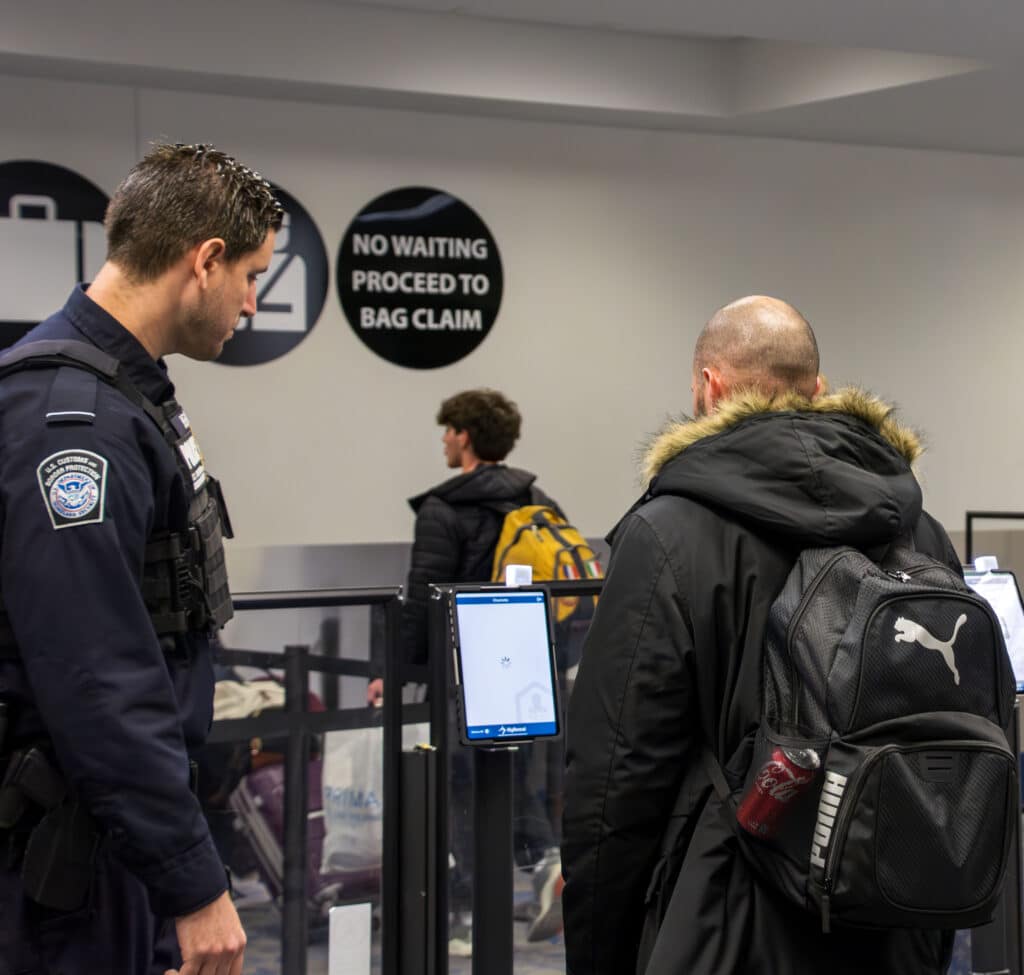
At Queen Beatrix International Airport in Aruba, U.S. travelers returning home are increasingly encountering a border process that feels less like a traditional inspection and more like a confirmation step.
Under CBP’s Enhanced Passenger Processing program, eligible U.S. citizens can complete pre-arrival vetting and biometric identity confirmation using facial recognition, often bypassing in-person customs interviews entirely unless flagged for additional review.
The system matches a live facial image against passport records already held by the U.S. government, allowing travelers to proceed without presenting documents in many cases.
While Aruba’s deployment has been framed publicly as a convenience upgrade, it closely tracks the commission’s recommendation that CBP expand EPP and Seamless Border Entry to eliminate hours-long customs waits for returning Americans and to better allocate officers toward higher-risk travelers.
The report explicitly calls for EPP to be scaled to the top 25 U.S. airports by the end of 2026, arguing that biometric confirmation of low-risk travelers is both more secure and more efficient than manual inspection alone.
The same logic is now being applied inside the U.S. At airports such as Orlando International, biometric border processing systems supplied by vendors like iProov are being used to verify arriving passengers against CBP records in seconds, sharply reducing wait times while maintaining high identity-assurance standards.
EPP uses biometric technology from iProov to expedite CBP’s screening of arriving U.S. citizens and to move them through the international arrivals area. It is currently deployed at 12 U.S. airports.
These deployments directly address one of the commission’s central warnings that border staffing shortages and outdated processing models are already costing the U.S. billions in lost travel spending and will become unmanageable as passenger volumes surge toward events like the 2026 FIFA World Cup and the 2028 Olympics.
The commission estimates that the Transportation Security Administration (TSA) screened more than 858 million travelers in 2023 alone, with daily volumes routinely exceeding three million during peak periods, a level that will soon become routine rather than exceptional.
Under current funding trajectories, the report warns, TSA will not complete nationwide deployment of advanced identity verification and baggage screening technologies for decades, leaving the U.S. far behind countries that have already modernized their checkpoints.
Biometric Update reported in November that Department of Homeland Security (DHS) budget records show long-planned TSA upgrades and investment in airport security technologies has been slowed by the on-going congressional diversion of aviation security fees.
Still, biometric identity verification is expanding beyond border control into the core of the airport security experience. TSA’s Credential Authentication Technology, mobile driver’s licenses, and touchless identity pilots are no longer experimental; they are increasingly framed as essential infrastructure.
The commission noted that nearly four in five American travelers support biometric use at TSA checkpoints and that automated identity verification is more reliable than manual document checks, particularly in detecting fraud and impostors.
These security-driven changes intersect with a parallel transformation on the consumer side of travel. Apple’s rollout of enhanced boarding passes in iOS 26 – which is now supported by major U.S. airlines – extends the digital travel journey beyond booking and check-in into real-time navigation, identity presentation, and situational awareness.
Boarding passes stored in Apple Wallet now integrate live flight updates, airport maps, and baggage tracking, turning a smartphone into a continuously updating travel credential.
While Apple’s announcement was positioned as a convenience feature, it aligns closely with the commission’s vision of a seamless travel ecosystem in which identity, navigation, and security processes are integrated rather than siloed.
The report explicitly urges federal agencies to partner with technology providers to support digital identity standards, wayfinding tools, and real-time queue management – capabilities already familiar to consumers in other contexts but only now entering the airport environment at scale.
Public sentiment appears to be catching up with these structural shifts. A December survey by the U.S. Travel Association found widespread dissatisfaction with the current airport security experience, alongside strong support for reinvesting the 9/11 Passenger Security Fee into modernization rather than diverting it to unrelated government spending.
Indeed. TSA modernization has been slowed for more than a decade because Congress has diverted significant amounts of the Passenger Security Fee into the Department of Treasury’s general fund.
Since 2013, roughly one-third of that fee has been redirected each year to offset unrelated federal spending, diverting more than $12 billion away from TSA’s security accounts.
The commission pointedly criticized this on-going diversion, saying Congress has systematically underfunded security technology while relying on a system designed for far lower passenger volumes.
Taken together, these developments suggest that the U.S. is entering a transitional phase in travel governance, one in which biometric identity confirmation, digital credentials, and automated screening are no longer optional enhancements but necessary responses to scale.
The commission framed this moment as a narrow window, and that without decisive investment and coordination, the U.S. risks losing not only travelers but strategic influence in how global travel systems evolve.
What remains unresolved is whether federal leadership will match the pace of technological change. The commission argues that the absence of a centralized, cabinet-level travel authority has left TSA, CBP, and other agencies operating in silos, even as their missions increasingly overlap.
Biometric systems deployed at borders, checkpoints, and gates are technically interoperable, but policy alignment has lagged.
As 2025 draws to a close, the direction of travel is clear. From Aruba’s biometric pre-clearance lanes to touchless identity pilots and smartphone-based boarding passes, the architecture of movement is being rebuilt around identity assurance rather than document inspection.
The remaining question is whether the U.S. will fully commit to that transformation or whether it will continue modernizing in fragments while competitors surge ahead.
In November, DHS Secretary Kristi Noem declared that the department is embarking on the most sweeping overhaul of airport security in more than a decade. “We will be putting over $1 billion into new scanning equipment, new X-ray equipment, [Advanced Imaging Technology] equipment,” she said.
The truth of the matter though is her billion-dollar figure appears to be existing work that involves multi-year procurements and technology replacements that have been moving through TSA’s budget pipeline for years, slowed by the diversion of passenger fees.
Consequently, the commission’s warning is unambiguous. In a world of record travel volumes and heightened security threats, inefficiency has become a liability.
The systems now coming online offer a glimpse of what a secure, fast, and integrated travel experience could look like, but only if the political will to finish the job holds. And it will require legislative and budget fixes.
Related Posts
-
 November 14, 2025
 -
 April 7, 2025
 -
 November 21, 2025
 -
 August 25, 2025
 -
 February 20, 2025
 -
 October 1, 2025
Article Topics
airport biometrics | Apple Wallet | biometrics | border security | CBP | contactless biometrics | digital ID | digital travel | Enhanced Passenger Processing | TSA | United States

Comments