
ICE facial recognition app Mobile Fortify powered by NEC
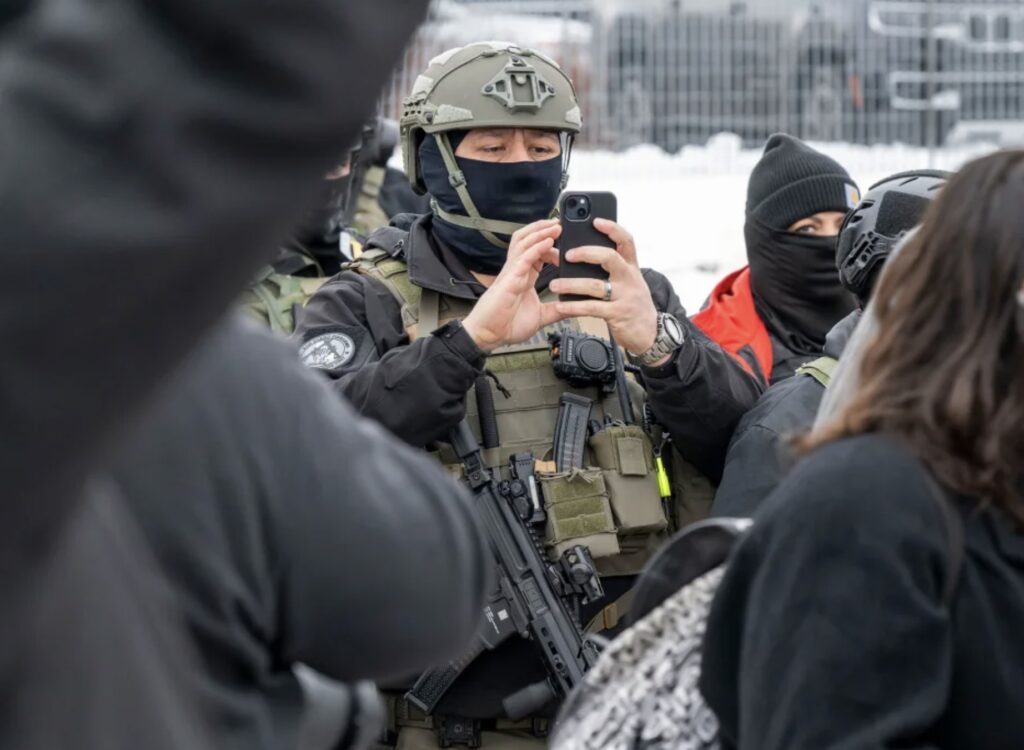
When the Department of Homeland Security (DHS) released its 2025 AI Use Case Inventory Wednesday, it included the first official confirmation that Immigration and Customs Enforcement’s (ICE) controversial Mobile Fortify facial recognition app relies on technology supplied by the NEC Corporation.
NEC’s facial recognition suite, marketed under names like NeoFace and NeoFace Reveal, represents some of the most advanced biometric matching software in operation today. At its core, NeoFace is an AI-driven pattern recognition system that leverages deep learning models to transform raw visual data into biometric templates.
Mobile Fortify uses NEC’s AI to compare a captured face against DHS’s repositories of millions of biometric records drawn from passport photos, visa issuances, criminal justice databases, and other sources to return possible matches to immigration agents with names, dates of birth, and other biographic details.
The disclosure that the app uses NEC technology resolved a question that had lingered since reporting first surfaced on the app’s existence and its use by ICE in the field, but taken on its own, the vendor identification only captures a small part of what the AI inventory reveals about how facial recognition and biometric AI are operating inside DHS.
Read as a whole, the inventory shows that Mobile Fortify is not a standalone enforcement tool, but rather a front-end collection mechanism that is embedded within a much broader biometric and identity verification ecosystem that DHS has already deployed across multiple components.
The individual use cases are listed separately, often framed narrowly around specific missions, but together they point to a coordinated architecture in which biometric data collected in the field is routed into shared systems that shape travel, vetting, and enforcement outcomes far beyond the initial encounter.
The most direct link appears in repeated entries for Customs and Border Protection’s (CBP) traveler identity verification systems. These CBP systems are described as “deployed” and “high impact,” performing both one-to-one verification and one-to-many identification using facial images matched against existing DHS databases.
While CBP frames these systems primarily around border crossings, airport operations, and trusted traveler programs, the inventory makes clear that they function as shared backend infrastructure.
Mobile Fortify explicitly sends facial images, fingerprints, and document photos to CBP-managed biometric systems for matching, meaning ICE agents in the field are relying on the same AI infrastructure that is used to determine admissibility, travel eligibility, and identity at ports of entry.
This helps explain ICE’s claim that it does not own or operate the underlying AI models. The inventory supports that assertion while simultaneously showing why it matters less than DHS suggests.
ICE may not control the algorithms, but its encounters feed directly into systems whose outputs carry consequences far beyond immigration enforcement alone. A scan performed during a roadside stop or field interview is adjudicated by the same AI-driven systems that govern trusted traveler status and border screening.
The inventory also includes several deployed use cases labeled as semi-supervised or third-party traveler identity verification services. These entries are notable because they reference systems designed to evaluate, refine, or assess identity matching performance over time using operational data.
DHS avoids explicit language about model training in some descriptions, but the functions described align with threshold calibration, performance tuning, and ongoing validation based on real-world use.
In practical terms, this raises the question of whether biometric encounters, including scans of U.S. citizens, are being used to adjust or validate facial recognition systems after deployment, even if agencies stop short of calling that process training.
Another related entry appears under ICE in the form of mobile device forensics used in investigations. On its face, this use case concerns data extraction from phones rather than biometric identification.
But read alongside Mobile Fortify, it reinforces a broader operational shift. ICE is increasingly equipping agents with mobile tools designed to collect data, identify individuals, and initiate downstream analysis during the encounter itself rather than after the fact.
Identification, data capture, and decision support are collapsing into a single moment in real time, with AI-enabled systems providing rapid responses that can shape what happens next.
Beyond these specific tools, the inventory repeatedly references vetting systems that ingest biometric and biographic data across DHS components. Many are labeled as “deployed” and “high impact,” yet they are described in general terms that obscure how data flows between systems.
What the inventory does confirm is that identity determinations made through AI matching do not remain localized. Results propagate into broader vetting and risk assessment frameworks that can affect admissibility decisions, travel privileges, and enforcement posture across the department.
What the inventory still does not do, and what remains one of its most consequential omissions, is map these systems end to end.
There is no single description showing how Mobile Fortify feeds into CBP biometric databases, how those databases interface with trusted traveler programs, or how identity determinations influence downstream enforcement or travel consequences.
The architecture has to be inferred by reading across multiple entries. When viewed holistically, however, the conclusion is difficult to avoid. Mobile Fortify functions as an access point into a mature, AI-driven biometric decision infrastructure that DHS has been building and expanding for years.
That conclusion is reinforced by a second DHS disclosure, the department’s inventory of “common commercial” AI tools. This document lists off-the-shelf, low-risk applications used for internal productivity, including transcription, summarization, scheduling, and content creation tools from companies like Microsoft, Adobe, and Nuance.
These systems are named openly, license counts are disclosed, and their use is framed as routine administrative support.
What is absent from that document is just as telling. There is no mention of facial recognition, biometric matching, mobile identification, vetting systems, or investigative AI. NEC, NeoFace, and Mobile Fortify do not appear.
The omission reflects a deliberate categorization choice. DHS does not treat biometric and facial recognition systems as commercial AI, even when they are built and supplied by private vendors under large contracts.
Instead, they are effectively classified as bespoke government capabilities, disclosed only through narrower, compliance-driven inventories with limited operational detail.
Taken together, the two documents reveal a two-track approach to AI transparency inside DHS. Low-risk productivity tools are disclosed plainly and comprehensively.
High-impact AI systems tied to identity, surveillance, and enforcement are disclosed minimally, fragmented across components, and without a unified description of how they function as a system.
The NEC disclosure matters not because it introduces a new vendor, but because it anchors Mobile Fortify within this larger structure.
The inventory does not contradict DHS’s public statements about Mobile Fortify, but it complicates them. It shows that the app is neither experimental nor isolated.
It is one visible node in a biometric enforcement ecosystem that is already deployed at scale, already shaping outcomes for citizens and noncitizens alike, and only partially visible through public-facing disclosures.
Related Posts
-
 January 15, 2026
 -
 November 27, 2025
 -
 September 12, 2025
 -
 October 30, 2025
 -
 November 5, 2025
 -
 April 1, 2025
Article Topics
biometric matching | biometrics | CBP | DHS | facial recognition | ICE - U.S. Immigration and Customs Enforcement | live facial recognition | mobile app | Mobile Fortify | NEC | NEC America | NeoFace | real-time biometrics

Comments