
Idiap, PXL Vision introduce biometric document injection attack detection contest
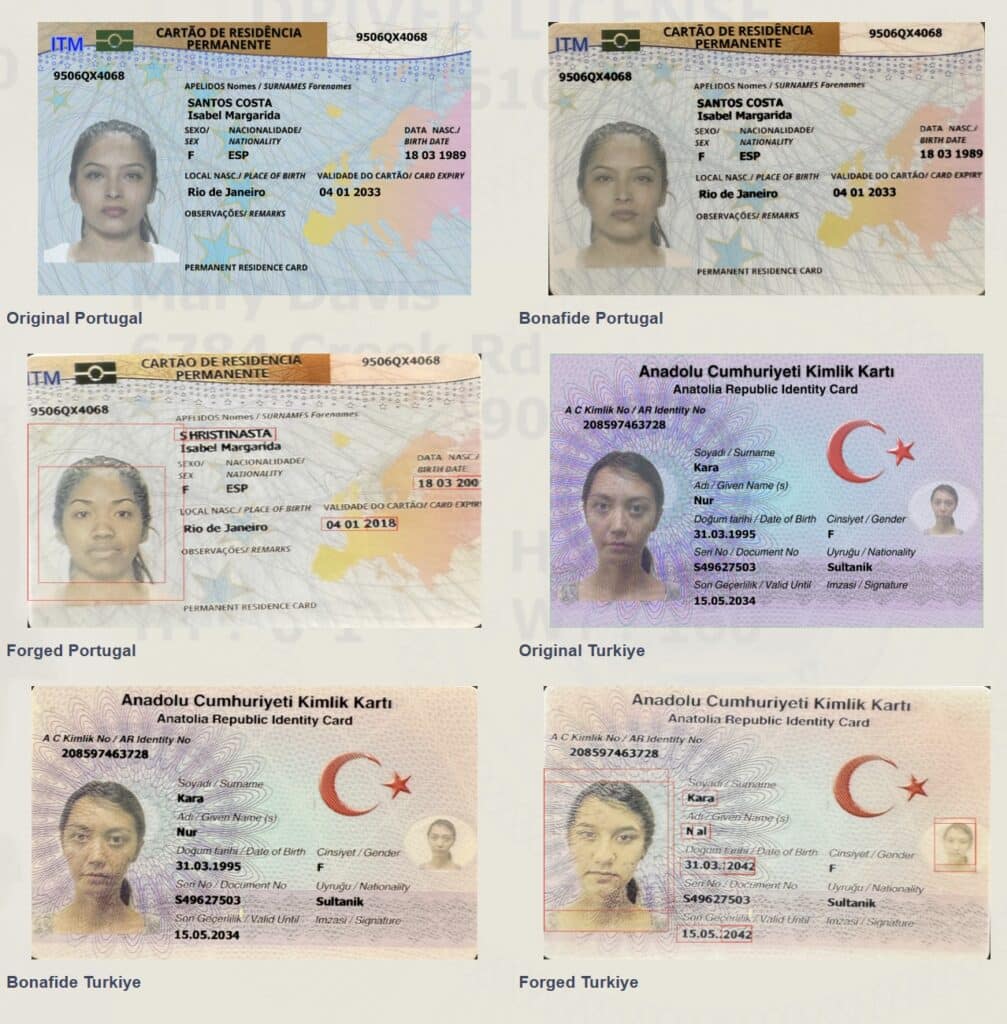
The Biometrics Security and Privacy team at Idiap Research Institute and PXL Vision are hosting “the first competition that challenges participants to detect synthetic manipulations” – i.e. injection attacks, rather than presentation attacks – in identity documents, which a release says has become a “pressing issue.”
The challenge focuses on four tasks. Entrants should prioritize detection of face swaps in an ID document, and of full or partial text inserted on textual fields of ID documents using diffusion-based or other generative technologies. The performance of automated visual forensics, and the challenges of practical deployment with computational limitations, are also priorities.
The competition features two tracks of ID document fraud detection: binary classification of documents as bona fide (1) or forged (0) and localizing masks of manipulated regions, wherein for a given image of an ID card, “submitted models return a binary mask of the same size as an image: with values at 0 for manipulated regions and values at 1 for bona fide regions.”
Competition results will be presented and discussed at the International Conference on Computer Vision (ICCV) 2025 workshop in Honolulu this October. Top performing teams in the challenge will be “invited to be co-authors of the overview competition paper, which will be published in the ICCV proceedings, and will be asked to present their approaches during the workshop.” The winning team will receive a “monetary token of appreciation” provided by Zurich-based digital identity verification firm PXL Vision.
The competition provides participants with the Fantasy ID Dataset for training detection and localization models, comprising 262 Fantasy ID cards designed to resemble ID documents from 10 different countries and languages. Per the rules, “they can use any other public, such as MIDV-2020 or BID datasets, and private datasets of ID documents for training/tuning their submitted models.”
Registration for the competition is open. Release of the ID card dataset and baseline code is set for this week.
An international standard for biometric injection attack detection is in development by the International Organization for Standardization. But, for now, competitions remain one of the data sources that can gauge the effectiveness of platforms that detect injection attacks or deepfake fraud.
Related Posts
-
 February 4, 2025
 -
 July 11, 2024
 -
 February 10, 2025
 -
 March 26, 2025
 -
 March 28, 2025
 -
 April 29, 2025
Article Topics
biometrics | DeepID | digital ID | document liveness | identity document | Idiap | injection attack detection | International Conference on Computer Vision (ICCV) | PXL Vision

Comments