
UNHCR’s biometric LISA kiosk enabling self-service refugee identity verification
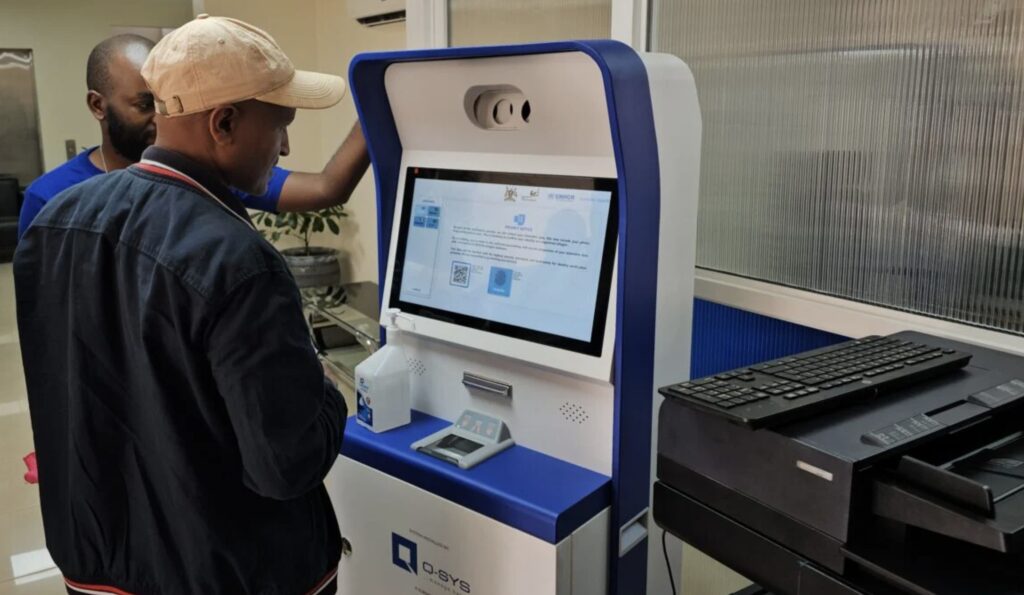
UNHCR’s Regional Bureau for the East and Horn of Africa and the Great Lakes (EHAGL) has begun piloting a new self-service biometric kiosk application called Localized Identification and Self-service Access (LISA).
LISA is designed to enable refugees to verify their presence in their country of asylum independently and at their convenience. The new application aims to cut down wait times and lower administrative costs through self service, and boost data accuracy from digital integration. After successful user testing in Kampala, Uganda, UNHCR plans a wider rollout later this year.
Traditionally, verifying a refugee’s presence has cost about $10 per person and demanded significant staff time. In resource-constrained settings, these exercises often take days or weeks, delaying critical data updates and hampering planning. By contrast, each LISA kiosk can handle verification activities on demand.
The LISA kiosks use a simple touchscreen interface with which refugees verify their identity via fingerprint or face biometrics, review their registered information, and, if there are any discrepancies, request an in-person appointment. Because no personal data is stored on the machine itself, the system complies with UNHCR’s strict data-protection standards.
What once could take up to six hours in waiting and processing can now be completed in just minutes, at a time chosen by the individual. The UNHCR says LISA improves biometric enrolment rates, which currently sit between 60 to 80 percent in some regions, and helps eliminate duplicate records. Each kiosk costs around $6,000.
After a successful round of user testing in Kampala, Uganda, LISA is scheduled for a pilot launch in late 2025. Refugees who tested the system noted it was easy to use, particularly by literate testers, and expressed enthusiasm in using it for future verifications, reported UNHCR. Uganda was selected for its sizable refugee population and its supportive environment for digital innovation.
Feedback from the Kampala trials is guiding refinements ahead of the broader rollout. As LISA requires only electricity and an internet connection, kiosks can be deployed in UNHCR offices, partner sites, government facilities or community centers, demonstrating flexibility for global rollout.
LISA is interoperable with UNHCR’s registration systems and will eventually serve as one of several access points to UNHCR’s broader Digital Gateway initiative, which envisions secure, self-managed digital services for forcibly displaced people.
Related Posts
-
 September 10, 2024
 -
 May 21, 2025
 -
 February 4, 2025
 -
 March 26, 2025
 -
 November 19, 2024
 -
 November 4, 2024
Article Topics
biometric enrollment | biometrics | digital identity | kiosk | Localized Identification and Self-service Access (LISA) | refugee registration | self-service | UNHCR

Comments