
Sole source contract to Bi2 expands ICE’s use of biometric surveillance
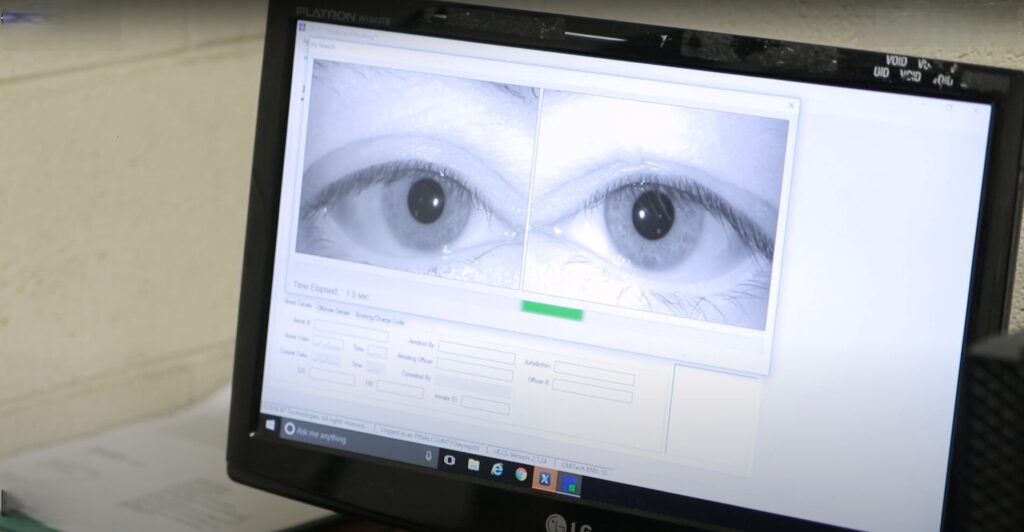
U.S. Immigration and Customs Enforcement (ICE) is moving to fold iris recognition into everyday enforcement, announcing plans to buy access to Bi2 Technologies’ (Bi2) Inmate Identification and Recognition System (IRIS) and its Mobile Offender Recognition and Information System (MORIS) through a non-competitive, sole-source award.
Procurement records show the agency signaled its intent on August 6, followed with a combined synopsis/solicitation and, ultimately, a sole source award justification last week to Bi2 Technologies, LLC.
Market-intelligence trackers that mirror federal feeds list the contract as a definitive award to ICE’s Enforcement and Removal Operations with a ceiling reported up to roughly $4.6 million and a one-year period of performance.
ICE says it “has a requirement for iris biometric recognition technology for offender recognition and access to a biometric information system to allow ICE agents to quickly authenticate the identity of subjects during field operations.”
The justification ties the buy to President Trump’s current immigration directives, citing his January 20 declaration of a national emergency on the southwest border -which ICE incorrectly identified as “Presidential Proclamation 108” – and Executive Orders (EO) 14159 and 14165 as part of a broader push to speed on-scene identity checks and expand mobile biometrics beyond fingerprints and faces.
The EO references on enforcement and border security are reflected on official trackers and agency pages summarizing the January 20, order and subsequent immigration actions.
ICE’s filings assert that Bi2 “holds the only non-federal national web-based biometric network and database specifically tailored for law enforcement,” and that pairing IRIS and MORIS will allow agents to match field captures against nationwide arrest records with “99 percent accuracy.”
The agency also points to sheriffs’ groups as development partners, naming the National Sheriffs’ Association, the Western States Sheriffs’ Association, and the Southwestern Border Sheriffs Coalition, while emphasizing claimed interoperability with existing jail and records systems, state Automated Fingerprint Identification Systems, and offender registries.
These points echo Bi2’s own marketing. The company touts a national, web-based iris repository and positions MORIS as a smartphone-ready tool that works on iOS, Android, and Windows devices to query the IRIS database in real time.
The sheriff-led pipeline matters because it is the core of the database ICE wants to tap. Bi2’s site and third-party coverage highlight a large, distributed booking corpus, while ICE’s justification talks up access that reaches across “multiple jurisdictions in the United States.”
The National Sheriffs’ Association has repeatedly publicized partnerships with Bi2, including programs that put MORIS and IRIS into county jails and patrol environments, and promotional efforts that framed deployments as “no-cost” to border-region sheriffs.
The procurement documents go further, arguing that “this capability is unmatched by any competitor” and that Bi2’s system “ensures redundancy” – if one sensor or modality is unavailable, other biometrics (iris, face, fingerprints) can still return a match. ICE also cites Federal Bureau of Investigation (FBI) certification as a requirement.
It is worth noting that the FBI’s Certified Products List is primarily an image-quality compliance program; it explicitly cautions that listing is not an endorsement and may apply only to particular modalities (e.g., fingerprints) and specifications. ICE’s justification does not publish specific certificate IDs for the iris components.
A central selling point is scale. ICE’s narrative compares multiple reservoirs of biometric and booking data, stating that an agency whose identity ICE redacted had amassed about 2.7 million iris images as of 2023, and that “roughly 100,000 new identities [are] being added every month.”
Bi2 performed 4.2 million “unique offender iris searches” that same year, ICE stated. Bi2 itself claims “over 5 million” bookings are now accessible.
While ICE’s sole source award justification does not name the 2.7 million-image collector, it presents Bi2’s search volume and current reach as evidence that enrolling with IRIS/MORIS would provide “arrest data beyond what is currently available through existing government-only databases.”
Bi2’s website, for its part, advertises 5.1 million bookings, sub-15-second response times, and zero “mistaken” identifications, figures that underscore the scale ICE seeks to leverage even as they reflect vendor-supplied metrics rather than independent validations.
The acquisition lands squarely in the Trump administration’s migration and border-security agenda. Executive Order 14159, Protecting the American People Against Invasion, directs DHS to prioritize registration, detention, and expedited identity checks as part of enforcement.
A January 29 order reinforces the border-security posture. A September 19 proclamation restricting entry of certain H-1B workers underscores the administration’s use of presidential authorities to tighten immigration parameters on multiple fronts.
While these actions differ in scope, they are the policy scaffolding ICE invokes to justify faster identity resolution in the field, which is precisely the use case IRIS and MORIS are meant to serve.
Technically, MORIS is the mobile front end, and IRIS is the back-end repository and booking workflow in jails and prisons. Bi2 says MORIS can authenticate subjects from a smartphone or tablet and immediately retrieve any information previously entered into the IRIS national database.
Company materials depict platform-agnostic apps and peripherals to capture iris, face, and even fingerprints on demand, with claimed liveness checks and near-instant returns.
Independent reporting over the years has described MORIS as a smartphone-based package that marries on-device capture with database queries. More recent local TV coverage and vendor press confirm ongoing sheriff deployments and pilots in 2024–2025.
ICE clearly seems to believe that government-only systems do not yet aggregate the sheriff-to-sheriff iris corpus at national scale, and that a private network offers a shortcut.
In 2023, Bi2 gave sheriffs in 31 U.S. border counties free access to MORIS, and early this year new deployments were still being touted by county agencies, with officials describing IRIS as a way to accelerate bookings and “help deputies out in the field.”
The ICE award effectively extends that ecosystem into federal immigration enforcement, giving agents another way to challenge fake IDs and resolve aliases without hauling a subject back to a processing site.
Bi2’s law-enforcement footprint extends far beyond immigration. For more than a decade, the company has marketed iris capture in local corrections, contributed data to FBI pilots around the Next Generation Identification program, and maintained an exclusive services arrangement with the National Sheriffs’ Association for background checks and jail technologies.
Those partnerships are what make today’s IRIS database valuable to ICE.
None of this though answers the core accountability questions that will likely follow the award. ICE hasn’t published a system privacy impact assessment specific to IRIS/MORIS access and has not identified the unnamed collector behind “2.7 million sets of iris images,” nor do they specify whether ICE will copy any records into Department of Homeland Security systems or merely query a vendor-hosted repository.
Nor do the documents reconcile the different valuations floating in procurement metadata, where some planning entries reference simplified acquisition procedures while award trackers log a multi-million-dollar ceiling, a discrepancy that may reflect how the buy evolved from intent to award.
Until ICE releases fuller contracting documents, the contours are best understood through what’s already public: a non-competitive purchase of licenses to a private iris network that Bi2 and sheriffs have been building for years, and a strategic bet that mobile iris capture will sharpen fast-ID checks at the heart of the administration’s enforcement model.
Related Posts
-
 August 7, 2025
 -
 December 3, 2024
 -
 March 10, 2025
 -
 February 5, 2025
 -
 April 1, 2025
 -
 November 11, 2024
Article Topics
BI2 Technologies | biometrics | GEO Group | ICE - U.S. Immigration and Customs Enforcement | iris biometrics | law enforcement | procurement | U.S. Government

Comments