
Synolo introduces contact fingerprint top for contactless biometric scanner
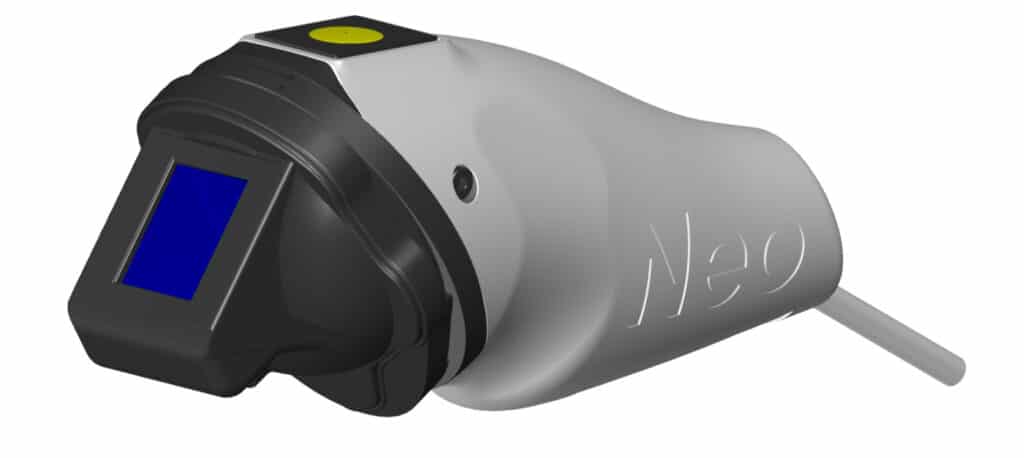
Synolo Biometrics is launching a new aperture, or top attachment, with a prism for its portable platen-free fingerprint biometric scanner so that it can be converted to collect traditional contact-based prints.
Synolo’s Neo fingerprint scanner has previously come with three interchangeable tops: one for newborns, one for children and one for adults. With the introduction of the new top, the company believes it has the only dual-mode fingerprint scanner on the market.
“One feedback from the market that we got on the non-contact is that they were concerned about accurate matching” to reference fingerprint templates collected on contact-based scanners, CEO Greg Scott told Biometric Update in an interview. The company believes the concern to be overblown, but saw value in providing the flexibility to collect both. Some of that value comes from the confidence it gives to customers who want to continue using contact-based scanning until standards for contactless fingerprint and interoperability are in place. Some comes from greater flexibility for different applications.
Synolo’s competition in Brazil’s market for fingerprinting infants, Infant.ID, uses a contact FAP10 scanner.
The paths for processing the biometrics are very different between contact and non-contact fingerprints, CTO Dr. Steve Saggese explains. But once the templates are fed into the back-end technology (supplied by Neurotechnology) for assessment and matching, there is no difference.
A live demonstration during the video call showed better matching scores when the same capture method was used, but cross-comparisons between contact and non-contact fingerprints far surpassed the threshold for confidant matching.
The tops are magnetic, and can be switched in less than 10 seconds to go from non-contact to contact or visa versa, according to the announcement. In the demonstration, it took Saggese significantly less time to change them. The scanner recognizes the aperture in use, and zooms in more or less, accordingly.
The new scanner aperture is being introduced this week at Identity Week America 2025.
Confidence in interoperability soon
Synolo’s scanner is FBI FAP20 PIV-certified for adults’ non-contact fingerprints, and the company eventually plans to have its contact scanning certified as well. The non-contact scans are captured in 3,000 ppi, while the contact fingerprints are collected at 2,500 ppi (averaged, due to the tilted platen), according to Saggese. Both deliver a standard 500 ppi output.
The company has also submitted data to NIST under its CRADA for analysis with the NFRaCT tool.
“Our scores are well above what they need to be,” Saggese says. “Their critical thing is the scale mismatch and how do they spec that.” The goal is to have comparisons of minutiae points captured on contact and non-contact scanners separated by no more than 2 percent, he explains.
Offering a scanner with both capabilities also allows biometric enrollment to be performed for both contact and non-contact fingerprints, to provide greater flexibility in reference templates.
“Pairing a FAP20 contact capability with our set of non-contact tops enables programs to build matched datasets, run side-by-side tests with legacy AFIS/ABIS, and plan migration paths based on evidence,” Saggese says in the company announcement. “We hope these efforts will inform ongoing standards and research work, building on our participation in independent studies such as the NIST CRADA on contactless technologies and CITeR’s longitudinal multi-modal studies.”
The scanner operates in manual or automated capture modes, the latter designed to make it easier to collect good-quality prints from squirmy infants. In auto mode, the scanner takes multiple images per second and the software selects the best candidate images captured over a span of up to 20 seconds. Age correction is then applied for infants and children to bring the template into the range where they will work with an ABIS.
Synolo provides an SDK to its customers so that the scanner can work with any ABIS, Business Development Manager Rafael Lucchesi says.
The Brazilian use case involves fingerprints infants’ mothers as well, to prove their relationship, and the ability to use contact fingerprints ensures that those adult biometrics will be matched accurately regardless of the ABIS used.
While the NEO scanner was developed to address the applications for infant biometrics, the company has received positive feedback for other applications as well, making use of its portability to capture non-contact adult biometrics. The company has been in talks with NIST about how to encourage the community to accept contactless fingerprinting, Saggese says, such as by advancing standards for contactless biometrics.
Synolo announced deals with three new partners to distribute its biometric scanners across Brazil earlier this week. The first production order from the market has been received, and will be filled with contact tops for all of the scanners delivered, Scott says.
Related Posts
-
 December 18, 2024
 -
 April 1, 2025
 -
 December 9, 2024
 -
 September 9, 2025
 -
 October 2, 2024
 -
 February 6, 2025
Article Topics
biometrics | fingerprint biometrics | fingerprint scanners | infant biometrics | interoperability | Synolo

Comments