
South Africa’s MyMzansi DPI blueprint to revolutionize public service culture
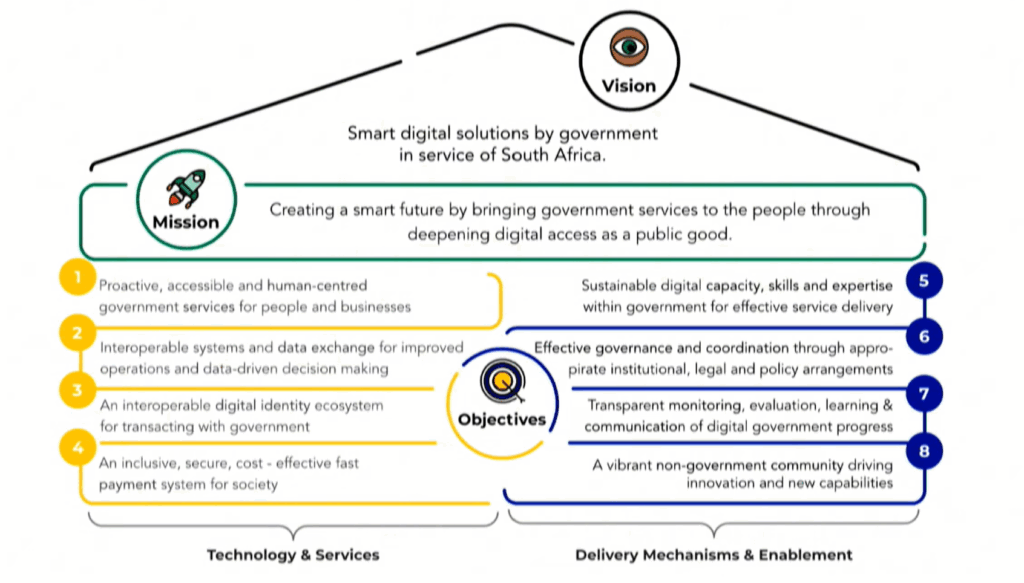
The South African government has expressed optimism that the effective implementation of digital public infrastructure (DPI) under the MyMzansi Digital Transformation Roadmap will substantially change how citizens access public and private sector services.
The roadmap will be implemented under the coordination of a Digital Services Unit (DSU) which was also put in place in may when the initiative was launched.
Richard Gevers, head of Service Design and Delivery at the DSU, told GovInsider recently that the roadmap will change how public services are designed and delivered.
He is quoted as saying that the initiative will put in place a “next-generation government” by making sure that DPI meets the citizens at their point of need.
The MyMzansi roadmap
Per the MyMzansi digital transformation roadmap, the country intends to build and scale solid DPI between 2025 and 2030. This will happen in two phases. The first is set to unfold from 2025 to 2027 and the second will run from that year until 2030 when the country hopes to have one of the most efficient public service delivery systems on the continent.
One of the things the government intends to have in place during the first phase is a single digital identity system which will enable citizens seamlessly access services across platforms. Added to that will be data exchange and digital payments systems, all of which will piloted and okayed for nationwide rollout.
According to the roadmap, the data exchange system will facilitate access to data among government institutions and other entities in real-time, allow access to huge amounts of data for policy and research purposes, as well as for personalized and other services.
The digital payments system, for its part, will make it possible to complete instant financial transactions in a hitch-free manner, while the payment of social protection grants by the South African Social Security Agency (SASSA) will also be streamlined. The KwaZulu-Natal regional office of SASSA was recently praised for its efforts to modernize digital income and grand beneficiary registration processes.
As part of the digital payments component of the DPI, government-to-people (G2P) payments will also be integrated into the Integrated Financial Management System, a government platform designed to automate public sector financial management processes.
Verifiable credentials through digital wallet
In addition, a verified document sharing system and a digital wallet will also be rolled out to enable citizens easily manage and present documents digitally. Through the wallet, citizens can share or receive cryptographically secure digital credentials which are linked to their single digital ID. The ID can be stored in the MyMzansi mobile application.
Meanwhile, other platforms to access services digitally and in a trusted manner will be established and they’ll include a government information portal, the MyMzansi digital government platform, as well as an integrated human resource management system.
While the first phase of the blueprint is about piloting and rolling out the various DPI components, the second will entail scaling and expanding them into many sectors, including education and healthcare.
The roadmap also outlines a mechanism to ensure the DPI is effectively built and scaled up, and this includes coordination through an inter-departmental working group.
Related Posts
-
 September 29, 2025
 -
 February 7, 2025
 -
 May 12, 2025
 -
 July 18, 2025
 -
 December 2, 2024
 -
July 9, 2025
Article Topics
biometrics | data exchange platform | digital government | digital ID | digital public infrastructure | digital wallets | mobile app | MyMzansi | South Africa | verifiable credentials

Comments