
Amadeus’ on-the-move airport biometrics corridor roll out at scale in Indonesia
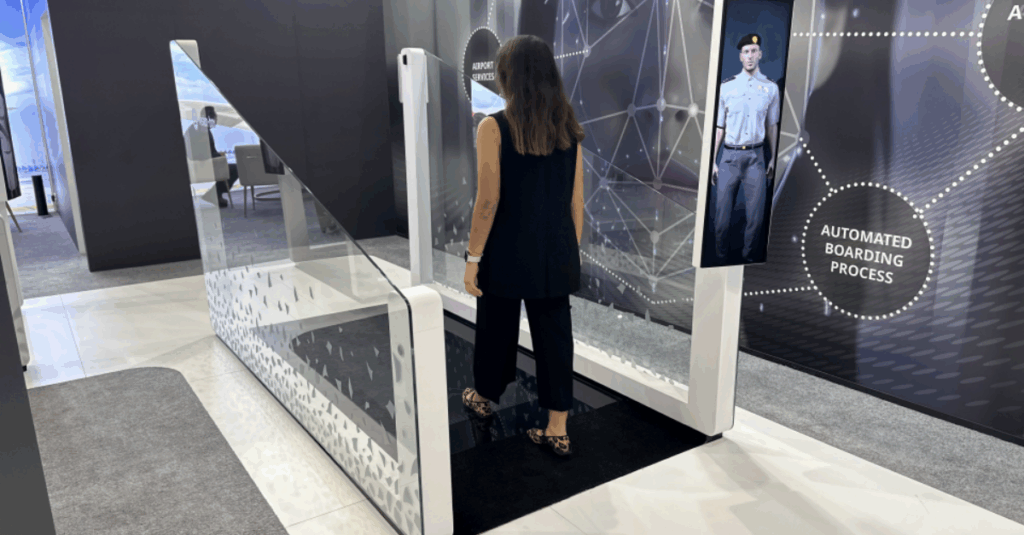
A Seamless Corridor for biometric capture from Amadeus has reached operation at scale in Indonesia at Jakarta and Surabaya airports, a first for the technology.
Seamless Corridors capture biometrics from passengers “in motion” as they walk to their gate, and travelers are not required to present physical documents like a passport.
In an interview with Biometric Update, Amadeus SVP for Border Authorities Jeff Lennon credits the collaborations of Amadeus and Vision-Box prior to its acquisition with governments around the world, including aviation and border authorities but also the U.S. Department of Homeland Security, for helping the technology reach production-readiness.
The deployment of two corridors at Jakarta and another at Surabaya was completed in cooperation with Indonesia’s Directorate General of Immigration, and aligned with the government’s “All Indonesia” digital transformation initiative.
“The Seamless Corridor is the ‘jewel in the crown’ of our end-to-end portfolio for seamless travel, helping to remove friction and queues at the border,” says Amadeus EVP of AirOps Rudy Daniello in the announcement. “In combination with innovations in digital identity and biometrics at key airport service points, it’s finally possible for airlines, airports and governments to provide a truly seamless, secure experience, free from document checks, queues and barriers.”
A stride beyond e-gates
The “on the move” concept predates the corridor design, Lennon says, tracing back to ideas to speed passage through biometric e-gates. Vision-Box began experimenting on capturing quality images of people in motion in 2017, Lennon says. That involved “creating a pipeline of biometric cameras to be able to capture people on the move” and deal with “angles, distortion and different human behaviors.”
The human factor is the most challenging element, he says.
Frontex pilots around 2021 and 2022 in Portugal and Bulgaria helped further develop the technology. Vision-Box built a corridor in Lisbon airport under contract to Frontex, “using what we called back in the day ‘V-Box’ edge cameras.” The Bulgaria pilot allowed the company to further advance the concepts, collecting both face and fingerprint biometrics.
Vision-Box also participated in multiple edition of the Biometrics Rally held by the U.S. DHS, and Lennon notes that the 2022 competition evaluated systems for processing passengers in motion. Vision-Box scored one of the highest accuracy rates in the Rally, Lennon says.
Customers keen to push the boundaries of innovation like the United Arab Emirates encouraged the development of the “Free Flow” biometric corridor, which debuted at the Dubai Airshow in 2023. An experiment with Dubai airport in collaboration with the Emirates’ border police followed, giving Vision-Box “another occasion to really stress-test the solution. Not just from a technological standpoint, because we were pretty confidant about what we were doing and the results we had from the different pilots.”
The ”Free Flow” biometric corridor was then officially launched at PTE 2024, the same month as Amadeus completed its acquisition of Vision-Box.
Scaling Indonesian operations
Vision-Box has been working with Indonesian border authorities since 2016, but its deployments in the country have scaled up since the pandemic, reaching 240 biometric gates between Jakarta and Bali. Bali alone has 68 e-gates in a single row, the largest-such deployment in the world, according to Lennon.
The capacity was still not enough to deal with the traffic influx during the Hajj pilgrimage, which can increase passenger numbers to ten times their normal level. Hajj pilgrims must pre-register, making it a perfect opportunity to test the biometric technology in production. “It’s kind of a frequent traveller program,” Lennon says. “They are pre-vetted by the government.”
Biometric corridors represent a change in how border guards operate, Lennon points out. Managing that change is the main challenge for border authorities, he says. The system is highly tolerant of different circumstances and degrees of cooperativeness on the part of people being matched, Lennon says, but exceptions are inevitable, and managing them is operationally different with the corridor concept, where the guard will be waiting at the end of the space with a tablet to receive any alerts.
Designing for a different process
“The real challenge is about the operational design. The solution itself right now at our level is quite mature. We are able to capture in real-time multiple subjects walking at pace at the same time in the corridor.” How many people is largely a matter of how wide the corridor is.
Machine learning is applied during the face capture process, he explains, along with some 3D capabilities to determine how many people are in the corridor.
Amadeus also draws on its long history working with border control to layer in presentation attack detection (PAD) to block spoof attacks.
Lennon attributes the success of the technologies behind Amadeus’ Seamless Corridor in large part to the focus it and Vision-Box have maintained on the travel industry. He notes that many of the participants in the DHS Rally are focused on biometrics matching for a range of applications, with a variety of training datasets. The company developed advanced systems for biometrics capture before it released its matching engine commercially.
Amadeus’ system can capture images compliant with ISO/IEC standards like 19794 and 39794, but typically accepts more distortion than these standards allow. It remains “extremely stringent” on how many pixels are between the subject’s eyes in captured images.
Amadeus’ cameras analyze the image quality and then capture a single image for comparison when it reaches a specified threshold. Pre-processing works down to the pixel level to compensate for distortions. Lennon emphasizes the importance of template-creation speed for the on-the-move airports use case.
Encouraging adoption
“Adoption is paramount, and to encourage adoption, you need to focus a lot on the experience design at different moments of the journey,” Lennon observes. “How do you activate customers, how do you trigger brains of different cultures, different ages, different demographics?”
Lennon says Amadeus has been running more than 60 flights per week, carrying thousands of people, with an in-the-field identification rate above 98 percent, showing that process has been successful.
As an implementation in a controlled environment with a small gallery of expected travellers, Indonesian airports represent “the perfect terrain for us to experiment with bigger scale deployment in the future.”
Lennon sees pre-screening with remote identity verification as a preliminary step to bringing the corridor concept to scale. Pre-qualified subjects who have submitted quality biometric references ahead of time sets up digitization at the border.
In Manchester, Amadeus’ traditional smart gates are being trialled in contactless mode without the traveler presenting a passport, which is only possible following the “known traveler” process. A similar process is in place in Curacao.
DTC pilots are also starting back up, with Amadeus working with the Dutch government on Phase II, Lennon says. He describes these as a follow-up to the KTDI concept.
For airports playing catch-up on biometric passenger processing, Lennon advises rating the maturity level through consultation to understand where they are at the moment, and whether they are position to leapfrog e-gates and proceed directly to implementing a Seamless Corridor for biometrics capture.
Related Posts
-
 March 10, 2025
 -
 April 7, 2025
 -
 January 29, 2025
 -
 June 11, 2025
 -
 May 12, 2025
 -
 November 28, 2024
Article Topics
ABC gates | airport biometrics | Amadeus | biometrics | border security | contactless corridor | facial recognition | Indonesia | passenger processing | Vision-Box

Comments