
Wicket facial ticketing at Australian Open builds fan trust in biometrics
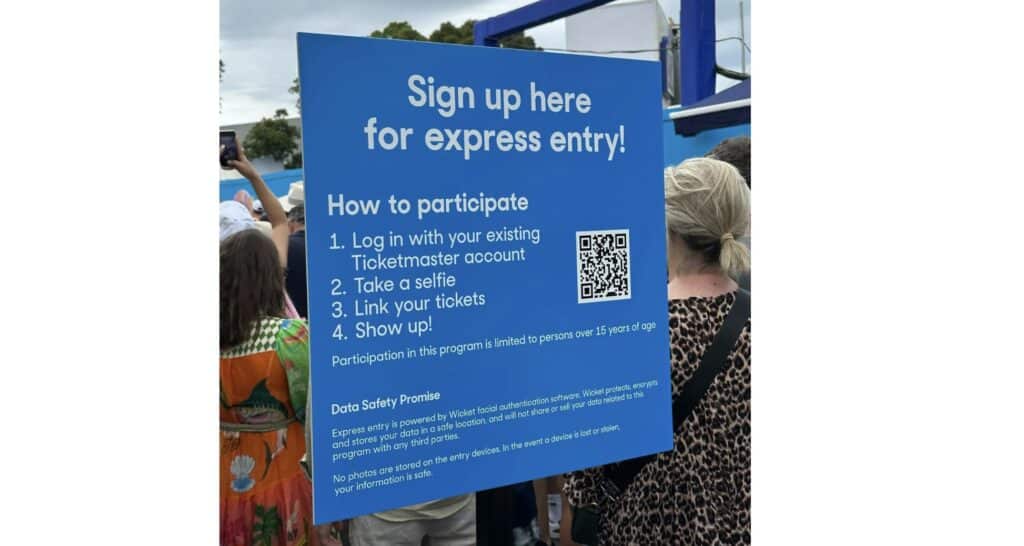
What’s more important: the illusion of privacy, or skipping the line? That’s the question on the line in an analysis from the Financial Review, which focuses on the Australian Open’s deployment of Wicket’s biometric facial ticketing system at Melbourne Park.
The Express Entry system had its first pilot at the Australian Open in 2024. This year, it has widened to general admission, and Tennis Australia says uptake has increased in kind. The organization manages the encrypted cloud services on which Wicket stores the facial biometric templates its system generates, which are then matched against a selfie uploaded to Ticketmaster for fan entry.
While the system has been a hit with fans, Australia’s privacy commissioner Carly Kind says it undercuts consent. “When you’re being asked for the 20th time in a day if you accept terms and conditions, then you’re probably pretty unlikely to spend the 15 minutes reading them. You can’t ask people to be vigilant, particularly in circumstances where the withdrawal of their consent will often mean they miss out on the service or product that they were hoping to get.”
Kind worries that systems like Wicket’s soften the ground for misuse of personal information. Anyone who buys a ticket to the Open must agree to terms and conditions that say the venue may “incorporate facial recognition technology” in order to enhance security and patron safety.
“We see it time and time again that entities violate that principle in other contexts,” Kind says. “I think there is a real risk of it happening in the context of facial recognition as well.”
Attendance at this year’s Australian Open is predicted to exceed 1.2 million people, and the crowds have meant long lineups. Given the profile of the event, one of professional tennis’ four annual Grand Slam tournaments, there is much at stake.
But that’s kind of the point. The Financial Review quotes a fan who was happy to use the more convenient biometric option for entry, because they trust the integrity of the Australian Open brand: “We’d hope an event of this calibre would really take care of our data and our privacy.”
The statement underscores how big deployments that come with big expectations also help build user trust – if done successfully. Wicket, which has processed more than 5 million transactions through its facial authentication platform at customer venues and live events, has also developed its partnership with the National Football League (NFL) and professional golf leagues. Neither the NFL nor the Australian Open are likely to jeopardize their business with a janky business partner who brings a lot of risk to the table.
It’s a long way of saying experience counts. Data does, too, and Wicket claims a fan experience rating of 9.6 out of ten, and says 90 percent of customers want more facial authentication at sporting events. In the end, the fan experience – which already involves assimilating into a large public crowd, meaning privacy isn’t guaranteed, anyway – may be one of the places for biometrics to shine.
Facial authentication is money: SBJ
A recent report from Sports Business Journal says “emerging technology at the gate, biometrics, mobile credentials, RFID ticketing and AI-powered crowd analytics is transforming entry points into business tools.”
“In the last decade, venues have learned that time is money, especially at entry. With frictionless entry, stadiums can reduce gate staffing, reassign personnel to hospitality or premium areas, and increase per-capita spending once fans are inside. Every minute shaved off a line is a minute gained for food, beverage and merchandise sales.”
Data, it says, is “the new turnstile.”
“At the modern stadium the gate is an engine. Each scan, sensor and system contributes to a safer, smarter and more profitable operation.”
Sao Paulo stadium shows what not to do with face biometrics
In the case of Brazilian soccer club Palmeiras, the line between safety and surveillance appears to be permeable. A Reuters report says facial recognition technology used for ticketing at Sao Paulo’s Allianz Parque stadium “has helped the Sao Paulo Public Security Secretariat (SSP) arrest 28 criminals in four games.”
The facial authentication system, reportedly implemented this year through the Muralha Paulista program – an integrated camera network and database for public security – is positioned as biometric ticketing. But it also “allows real-time analysis to detect fans who have bought tickets from touts, the use of false or third-party documents, outstanding arrest warrants, non-compliance with court orders and sanctions.”
In addition to the 28 arrests, the system facilitated banning 42 people not complying with court orders from entering the stadium, and identified 253 missing persons.
SSP Secretary Guilherme Derrite says “this is an action of the police intelligence area with the objective of making the event venue safer and preventing access to people who could compromise public order.”
Related Posts
-
 June 12, 2025
 -
 April 15, 2025
 -
 February 18, 2025
 -
 March 17, 2025
 -
 November 24, 2025
 -
 October 2, 2025
Article Topics
biometric ticketing | biometrics | Express Entry | face biometrics | facial authentication | Wicket

Comments