
Class action challenges DHS’ use of facial recognition against protesters
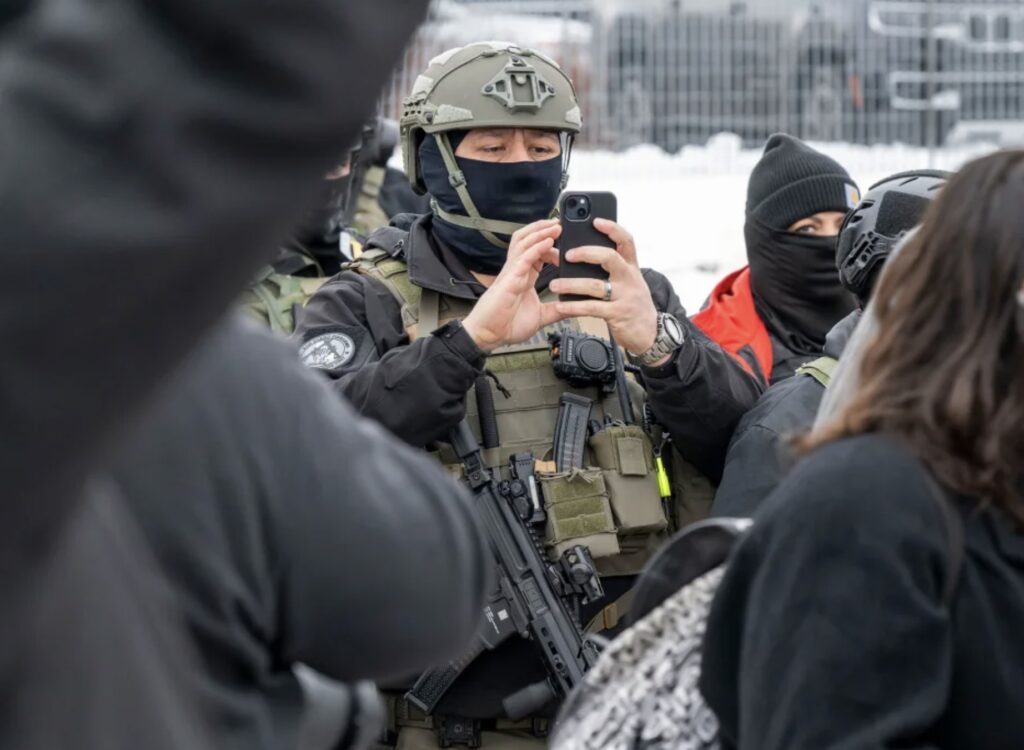
A class action lawsuit filed in the U.S. District Court for the District of Maine accuses Homeland Security Secretary Kristi Noem and senior Department of Homeland Security (DHS) officials of using surveillance technology to intimidate residents who were lawfully observing federal immigration operations.
The suit, brought by Portland residents Elinor Hilton and Colleen Fagan, alleges that DHS agents photographed, scanned, and recorded their biometric data and license plate information after they documented immigration arrests in public spaces.
According to the complaint, agents then warned them they were being entered into a “database” or placed on a “domestic terrorist watchlist” because they were filming.
The case, Hilton v. Noem, was filed February 23 and seeks declaratory and injunctive relief, arguing that the government’s actions amount to unconstitutional retaliation designed to chill protected First Amendment activity.
According to the complaint, the events unfolded in January during what DHS described as an immigration enforcement surge in Maine.
Both plaintiffs say they went to observe and document federal agents conducting arrests in parking lots and residential neighborhoods. They contend they maintained a reasonable distance and did not interfere with law enforcement operations. Instead, they say agents turned their cameras on them.
Fagan alleges that after she began recording, one agent filmed her face at close range while another documented her vehicle and license plate. When she asked why her information was being recorded, she says an agent responded that they had “a nice little database” and told her she was now considered a “domestic terrorist.”
Hilton describes a similar encounter in which agents repeatedly photographed her, discussed identifying her vehicle, and warned she would be placed on a domestic terrorist watchlist. One agent allegedly told her that if she continued showing up to observe operations, they would come to her house later that night.
The lawsuit argues these were not isolated confrontations but part of a broader policy or practice. It alleges that DHS agents are systematically collecting identifying information about people who observe or record immigration enforcement activity and entering that information into government databases or watchlists.
That claim lands amid national reporting that Immigration and Customs Enforcement (ICE) has been tracking protesters in an internal database. In February, Reuters reported that two ICE officials confirmed that the agency has been compiling names, photographs, license plates, locations, and descriptions of conduct that “provoked suspicion” in an internal system.
The reporting described a months-long effort to monitor patterns among individuals who follow or document ICE activity, and it noted that the agency has increasingly relied on the federal statute that criminalizes assaulting, resisting, or impeding federal officers to pursue cases tied to immigration operations.
The Maine complaint mirrors those accounts, alleging that agents used smartphone-based tools capable of facial recognition and license plate scanning to identify observers in the field.
DHS components including Immigration and Customs Enforcement (ICE) and Customs and Border Protection (CBP) began deploying a mobile facial recognition application known as Mobile Fortify in 2025. Public reporting has described the tool as allowing agents to take a photograph with a smartphone and search large government image databases for matches.
Civil liberties groups, including the Electronic Frontier Foundation and the Electronic Privacy Information Center, have raised concerns that the technology enables street-level identification without meaningful consent and that data may be retained for years.
Members of Congress have also sought answers about Mobile Fortify’s rollout and whether DHS completed required privacy impact analyses before expanding its use.
Those oversight questions now intersect directly with the allegations in Maine, where the plaintiffs argue that facial recognition and related tools were turned against U.S. residents engaged in constitutionally protected activity.
The complaint situates the alleged intimidation within a broader shift in rhetoric from DHS leadership. It cites public statements in which senior officials characterized videotaping immigration agents as dangerous or criminal and described some protesters as domestic terrorists.
The plaintiffs argue that this language, combined with the alleged creation or use of internal watchlists, reflects an agency posture that treats observation and documentation as security threats rather than protected speech.
The lawsuit also highlights reported friction between DHS public denials and external reporting about protest-related tracking. DHS officials have denied maintaining a formal domestic terrorist database for observers.
But the complaint points to press reports and statements from federal officials suggesting that protest-related data collection systems do exist.
The plaintiffs argue that either such databases are real, as agents suggested during their encounters, or agents are falsely invoking them as a tactic to chill speech. In either scenario, they contend, the result is unconstitutional retaliation.
Beyond the legal theory, the plaintiffs describe concrete personal consequences. Hilton says she did not stay at her home the night she was threatened and has since altered her routines, including avoiding driving her own car when observing operations and parking blocks away from her residence.
Fagan says she has stopped engaging in similar protest activity and fears potential travel restrictions or professional repercussions stemming from being labeled a domestic terrorist.
The plaintiffs seek class certification for similarly situated individuals and a court order barring DHS from collecting or maintaining personal information about people solely because they are observing or recording immigration enforcement activities.
The case now places a federal judge in Maine at the center of an expanding national debate over how far immigration authorities can go in using surveillance technologies against those who monitor them.
At issue is not only the scope of DHS’s data collection infrastructure, but whether labeling observers as domestic terrorists and warning them of watchlists crosses a constitutional line between enforcement and intimidation.
Related Posts
-
 March 17, 2025
 -
 November 24, 2025
 -
 October 2, 2025
 -
 June 19, 2025
 -
 February 3, 2026
 -
 November 27, 2025
Article Topics
biometric identification | biometrics | CBP | data collection | DHS | facial recognition | ICE - U.S. Immigration and Customs Enforcement | lawsuits | Mobile Fortify | United States

Comments