
Korea’s Winning.i looking to bring its dual authentication tool to global markets
Seoul-based biometric authentication startup Winning.i has been selected for Korea’s Super Gap Startup 1000+ Project. The program run by the Ministry of SMEs and Startups offers intensive support to deep tech startups deemed to have high growth potential.
A post on the Venture Square blog says Winning.i was selected for development of a multi-biometric customer verification service platform, based on “legacy fingerprint DB compatibility technology.”
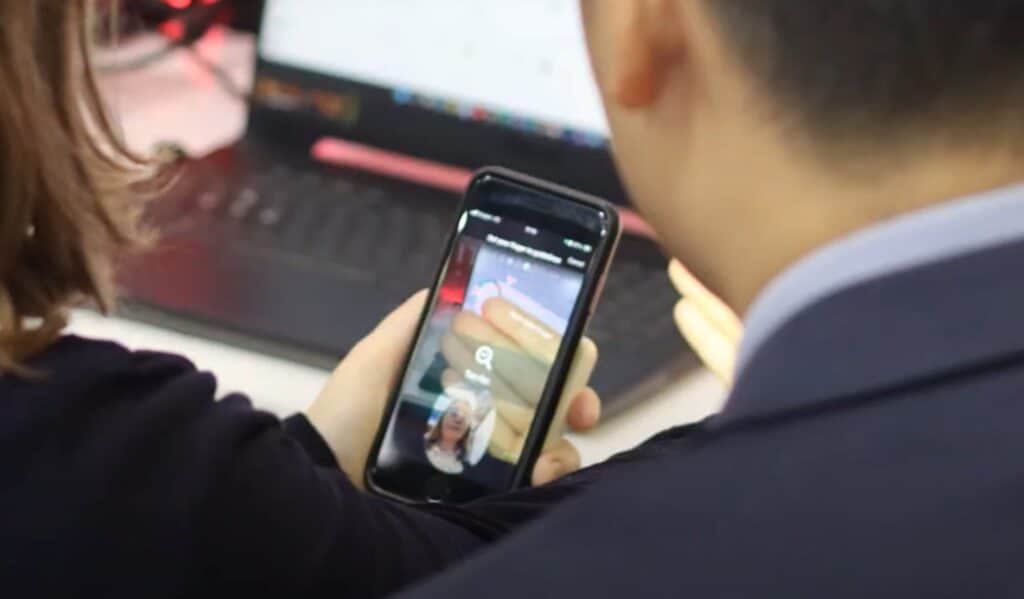
“The core technology is a multimodal authentication technology that can simultaneously recognize a user’s fingerprint and face without contact using only a high-resolution smartphone camera.” Winning.i claims this so-called “one shot, dual authentication” technology as an industry-first – “the first contactless biometric authentication solution that enables simultaneous facial and fingerprint recognition using both the front and rear cameras of a smartphone.”
According to a report from Maeil Business Newspaper, among the more than 400 firms the Super Gap Startup 1000+ Project has supported, two – artificial intelligence (AI) company Revelion and semiconductor design company Padu – have achieved unicorn status, achieving a valuation of one trillion won (US$728M). Fifty one more are “preliminary unicorns” with an enterprise value of more than 100 billion won (US$73M).
More than 180 startups, including Winning.i, have been selected for super-gap projects this year.
Oh Young-joo, Minister of SMEs and Startups, says, “super-gap start-ups are the only government projects that, once selected, will provide intensive support for commercialization and R&D funds for up to five years. We will continue to support various policies to help K-Deep Tech start-ups become global unicorns.”
According to the Korea Times, Winning.i’s product has already secured domestic and international patents and certifications, and has implementations across various financial services such as electronic signatures and digital identity verification. In accelerating its expansion into global markets, the firm hopes to extend to use cases in public services and healthcare.
The firm, helmed by CEO Chung Woo-young, has been active since 2015. He says that with the new development, “whether it is an iPhone or a Galaxy phone, users only need to install one app to authenticate both face and fingerprint at the same time. This is the biggest difference compared to existing technologies.”
The firm already has a relationship in Canada, and is prioritizing the North American market in its quest for global growth. It is reportedly in talks to sign a contract with a U.S. consulting firm that works with emergency medical institutions in Kansas. Chung calls North America “the benchmark not only for biometric recognition but for all technologies.”
The Middle East and North Africa are also attractive markets offering tech sophistication and purchasing power, and the firm is hoping to establish a sales office or joint venture in the UAE.
Winning.i authentication passes iBeta PAD Level 1
A new letter of confirmation from iBeta Quality Assurance will help Winning.i’s case internationally. The firm has passed iBeta’s Presentation Attack Detection (PAD) evaluation in accordance with ISO/IEC 30107-3, becoming the first Korean company to pass the iBeta PAD Level 1 testing for liveness detection in contactless fingerprint recognition technology.
A notice from iBeta says testing was conducted last September with Winning.i’s Aerox SignLoc v1.64 contactless fingerprint application, installed on a Samsung Galaxy S24 Ultra running Android 14. The lab conducted passive liveness detection testing on the tool from 29 August to 19 September 2024. Testing involved enrolling six subjects and having them authenticate five times successfully. The test time for each PAD test per attack was limited to eight hours.
“Testing was conducted in accordance with the contract for a level of spoofing technique that only utilized simple, readily available methods to create artefacts of the genuine biometric for use in the presentation attack,” says the notice. “The subjects for the test effort were cooperative – meaning that they were willing and able to provide any and all biometric samples, including high-quality fingerprint images and molds.”
A total of 360 presentation attacks were attempted, representing six different types of attack. Per the notice, “iBeta was not able to gain unauthorized access with the PAs, yielding an overall Presentation Attack (PA) success rate of 0 percent, which then equates to the Imposter Attack Presentation Accept Rate (IAPAR) of 0 percent with the AeroxSignLoc v1.64 application.”
According to CEO Chung, preparing for the test took six months – and that the firm’s readiness is reflected in the results. “Spoof attack prevention has become an essential and core technology, especially with recent advances in deepfake technology. By extracting various data from high-resolution color fingerprint images, we have proven through the iBeta certification that 100 percent spoof prevention is achievable.”
Chung says securing a stable revenue base is the most important task for Winning.i if it is to achieve its goal of going public on the Kosdaq by 2029. In addition to its dual modality authentication app, it is also developing a non-face-to-face identity verification service for foreigners, which it expects to launch in 2026.
“This service works by matching facial and fingerprint data of foreign residents in real time with biometric records held by the Ministry of Justice,” Chung says. “Our primary target is the approximately 800,000 foreign nationals residing in Korea. We expect it will take one to two years to expand the service to more financial institutions and public sector clients.”
Related Posts
-
 August 11, 2024
 -
 September 11, 2024
 -
 January 31, 2025
 -
 September 17, 2024
 -
 October 1, 2024
 -
February 27, 2025
Article Topics
accelerator program | biometric authentication | biometric liveness detection | contactless biometrics | face biometrics | fingerprint biometrics | multimodal biometrics | presentation attack detection | WINNING.I

Comments