
India pledges support for Myanmar digital ID pilot
Myanmar is pushing ahead with its digital ID system with formal partnerships even as its military government faces criticism for surveillance and repression.
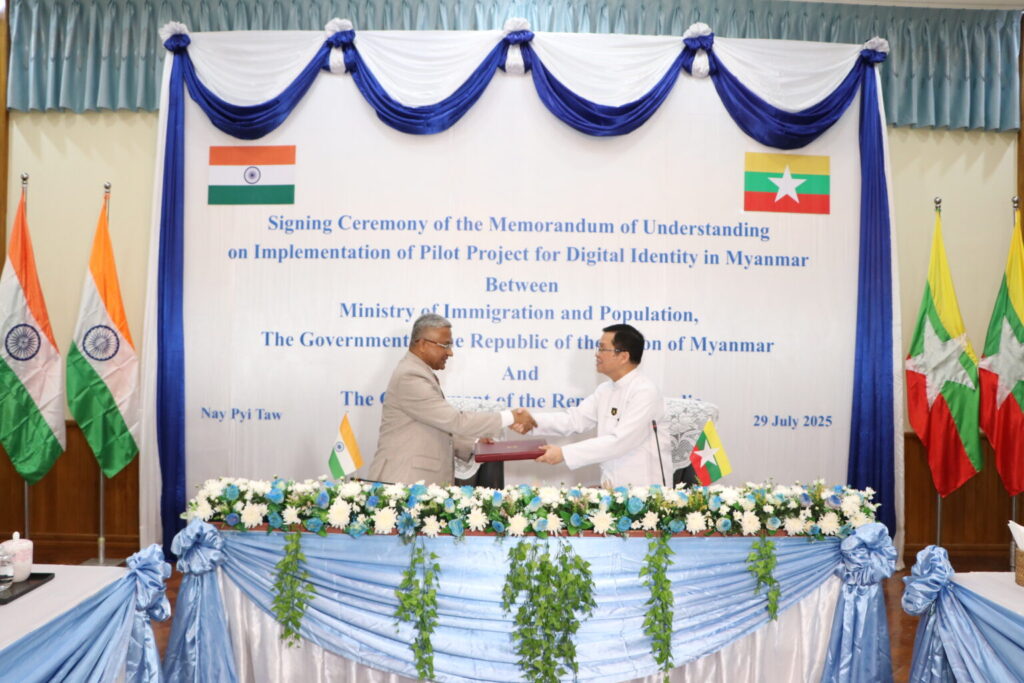
Myanmar and India have formalized their partnership on the pilot phase of Myanmar’s Digital Identity Programme with a Memorandum of Understanding signed in Naypyidaw.
Union Minister for Immigration and Population U Myint Kyaing and Indian Ambassador Abhay Thakur attended the agreement, which commits India to share technological knowhow, regulatory practices and operational expertise.
The MoU establishes expert consultations, implementation support and resource-sharing to lay the groundwork for Myanmar’s Digital Identity Pilot Project. Minister Kyaing underscored that a foundational electronic ID system is central to Myanmar’s digital government framework.
He praised India’s pledge of essential IT assistance, strategic guidance, human resource development and policy expertise. Ambassador Thakur reaffirmed Delhi’s commitment to ongoing technical exchanges and the value of India’s operational experience in guiding implementation strategies.
Previously, a Burmese delegation travelled to Bangalore to tour the Unique Identification Authority of India (UIDAI) Technology Centre. Deputy Director-General Tanusree Deb Barma demonstrated how the Aadhaar system powers current operations, manages data input and continually refines record verification processes.
Last year, at the International Institute of Information Technology Bangalore (IIIT-B), institute leaders highlighted their partnership with Myanmar’s University of Information Technology and showcased India’s Modular Open-Source Identity Platform (MOSIP) deployments abroad. Representatives from India’s National Institute of Smart Government (NISG) joined the meeting, and also discussed the implementation of a digital ID modeled on Aadhaar in a subsequent discussion with Kyaing.
NISG is managing an RFP for Sri Lanka’s national digital identity system issued in June.
Digital ID under a repressive government
Myanmar has seen armed conflict with insurgency groups, dissent over the military government’s rule, and crackdowns on opposition political parties and activists. While the country is split between pro-democracy and ethnic rebel groups and the military junta — which has limited control beyond major cities — the government has intermittently shut down internet access, deployed firewall systems and blocked parts of the internet in what critics call a “digital iron curtain” and a “digital dictatorship.”
In addition, it has been alleged the junta has made the electronic ID a tool for coercion and repression. Wai Phyo Mint, a digital rights advocate and policy analyst at Access Now, claims the project has been “weaponized” against thousands of civil servants who joined the Civil Disobedience Movement. Mint says those who tried to escape the country under false identities, after arrest warrants were issued, were unable to do so as the new system cross-references biometric data across passports, SIM cards and financial records.
Early last year, young Burmese attempted to flee following a military conscription law, which led to a surge in passport applications. The junta then made e-ID a requirement to acquire a passport and border passes.
In response to such claims, the Ministry of Immigration and Population has said the digital ID system is not designed for surveillance but aims to securely manage personal information and to verify citizens’ identities for official use. The ministry says the implementation of a digital ID platform will streamline applications such as bank account openings, healthcare and licensing access.
While the UK, EU and Canada have imposed sanctions targeting Myanmar’s military regime, it has received support from the governments of China, Russia, and, to a lesser extent, India. Mint has called for companies in China and India to halt technology transfer and in particular the supply of biometric systems and censorship technology that could enable surveillance and repression.
Human Rights Myanmar has claimed “discriminatory surveillance practices” such as data retention, SIM registration, VPN blocks and facial recognition in a submission to the UN High Commissioner.
Related Posts
-
 May 22, 2025
 -
 February 26, 2025
 -
November 20, 2024
-
 January 6, 2025
 -
 February 28, 2025
 -
 January 2, 2025
Article Topics
Aadhaar | biometrics | digital ID | digital identity | India | MOSIP (Modular Open Source Identity Platform) | Myanmar | National Institute for Smart Government (NISG)

Comments