
Philippines president stresses practical benefits of digital transformation
At the Manila Tech Summit, Philippines president Ferdinand R. Marcos Jr spoke on the practical benefits of digital transformation for citizens.
The Philippines is pursuing digital public infrastructure, digital economy, and hosted MOSIP Connect 2025 in Manila in March, where officials talked through their challenges and successes in bringing about digitalization.
“For Filipinos, digital technology means shorter queues [and] faster transactions,” Marcos said. “It means ease in paying bills, renewing licenses, and accessing government services.”
The president highlighted the National Fiber Backbone (NFB) to provide 17 million Filipinos faster and more reliable internet access. The NFB is due for completion by 2028, spanning the archipelagic country. And the Philippine Identification System, including the Digital National ID, was named as a way to make financial services more accessible.
Marcos drew attention to the Free Wi-Fi for All program, which provides internet connection to all schools, complemented by the Bayanihan SIM Project, enabling students and teachers to access digital tools.
However, the president warned of the risks that come with the digital age and the need to be vigilant against fraud and scams. Southeast Asia is a region seeing acute surges in these crimes with lawmakers and institutions trying various ways to tackle the problem.
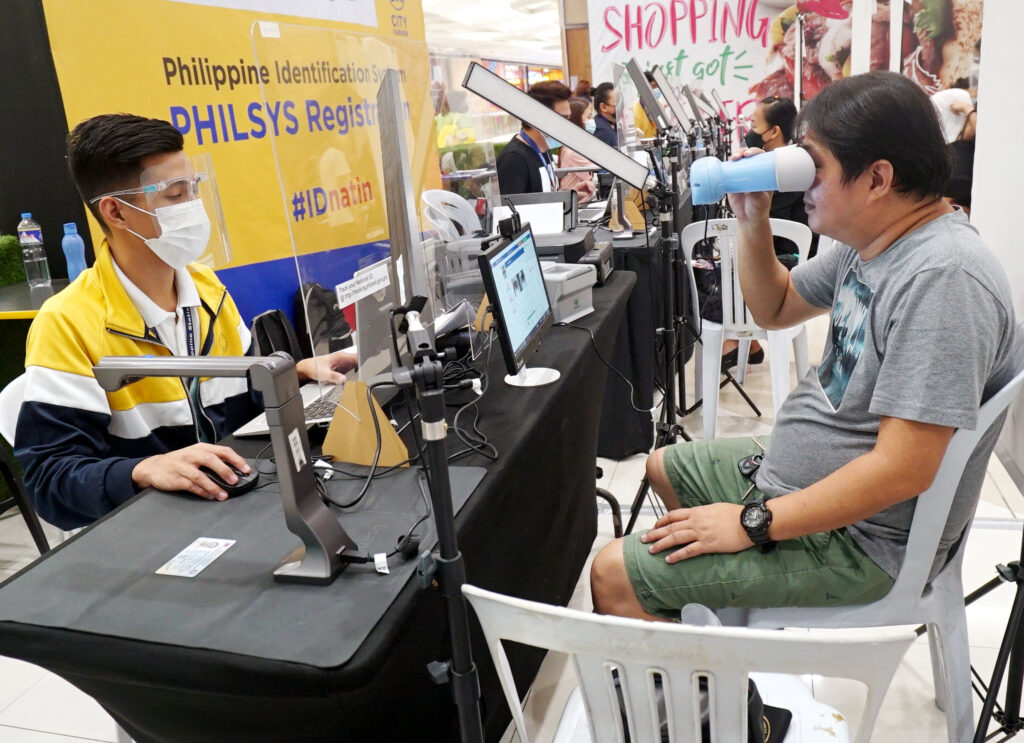
As the country’s leader champions digital transformation, other public offices are encouraging uptake of the new systems. The Philippine Statistics Authority (PSA) has urged the use of the Digital National ID especially as so many people use smartphones.
Those living in the National Capital Region (NCR), a highly populated administrative region that includes the capital of Manila and other urban centers such as Quezon City, show especially high rates of smartphone ownership.
“With many smartphone owners in NCR, more Filipinos can easily and conveniently access valid and sufficient proof of identity, such as the Digital National ID,” said PSA undersecretary Claire Dennis S. Mapa, National Statistician and Civil Registrar.
Mapa called on those to “seize the opportunity” to have a valid proof of identity on their smartphones. The Digital National ID is available via the eGovePH app after download. Users need to create an account to access the digital ID, which includes a biometric liveness test (a live selfie).
The Digital National ID is recognized for civil registry applications for birth, death, and marriage certificates. It also serves as a valid document for processing delayed birth registrations.
Digital ID holders can use their credentials to verify accounts on mobile financial platforms such as GCash and Asia United Bank’s HelloMoney app, enabling full access to their services.
Throughout August, holders of the National ID — including the digital version — were eligible for free rides every Wednesday on Metro Rail Transit Line 3 (MRT-3) and Light Rail Transit Line 2 (LRT-2), between 9-11am and 6–8pm. The exception was August 6 when the LRT-2 promotion was paused. On that same day, 25,173 National ID holders took advantage of the free MRT-3 rides, Philsys reports.
The PSA also called on local government units (LGUs) to integrate the Digital National ID into their civil registration services, aligning with the country’s broader digital transformation agenda.
During the 4th National Convention on Civil Registration and Vital Statistics (NCCRVS), nearly 1,000 attendees, which included local civil registrars and LGU representatives from across the Philippines, were briefed on the functionalities and benefits of the Digital National ID.
“Let’s make this part of the conversation, whether they are applying for late registration or securing certified true copies of their civil registry document,” Feedback and Grievance Division Officer-in-Charge Nicole Dane L. Navea, told attendees.
“We encourage you to guide your clients in [the step-by-step] process, especially when they come to your offices.”
As of July 13, a total of 88,236,337 Digital National IDs are available to access through the eGovPH app.
Related Posts
-
 September 19, 2024
 -
 July 14, 2025
 -
 March 11, 2025
 -
 June 19, 2025
 -
 March 6, 2025
 -
 September 13, 2024
Article Topics
civil registration | digital ID | financial inclusion | government services | national ID | PhilID | Philippines | Philippines Statistics Authority

Comments