
RealSense integrates AI cameras with Nvidia’s platforms
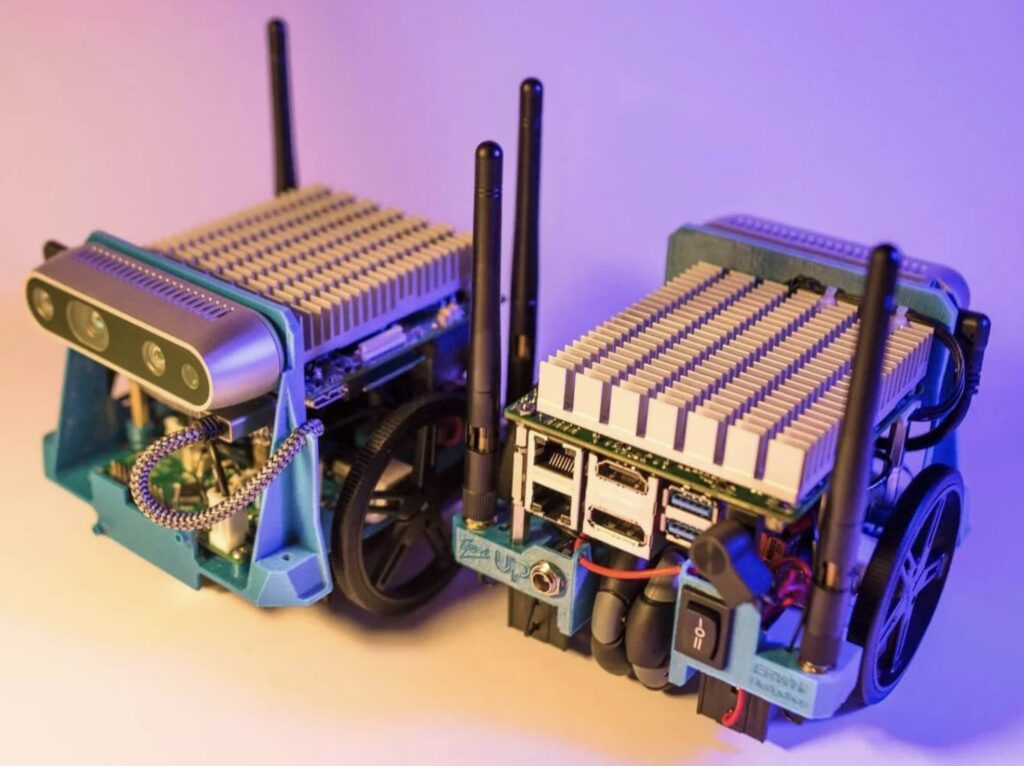
Computer vision technology firm RealSense plans to integrate its depth-sensing AI cameras with Nvidia’s robotics platforms, allowing developers to enhance the perception performance of their robots.
Through the strategic collaboration, the Intel spin-off plans to combine its products with Nvidia Jetson Thor Series for robot run-time computing, Nvidia Isaac Sim for digital twins and Nvidia Holoscan Sensor Bridge for ultra-low-latency sensor streaming.
“By providing native integration and performance optimizations with NVIDIA Thor and Holoscan Sensor Bridge, we are accelerating the mainstream adoption of physical AI,” says Nadav Orbach, CEO of RealSense.
The company’s depth cameras and vision technology is used in autonomous mobile robots, humanoids, access control, industrial automation, healthcare and more. RealSense has also been expanding its biometrics offerings and has recently received US$50 million in early-stage funding to help it achieve its goals.
The spun-out company is headquartered in California, U.S., with manufacturing operations in Asia, including Thailand. The firm has more than 3,000 active customers “and pretty high growth year over year,” according to Orbach.
RealSense’s new integrations to help developers
With the new integrations, RealSense wants to allow developers to stream native true depth and image data into NVIDIA Isaac Sim, which will help them accelerate development from prototype to deployment, the firm says in a release.
It also allows developers to use system architectures optimized for NVIDIA Jetson Thor to ensure maximum performance for robotics and physical AI applications. Additionally, the technology integrates RealSense depth perception capabilities with the NVIDIA Holoscan Sensor Bridge to achieve real-time sensor fusion and ultra-low-latency data streaming.
NVIDIA Holoscan Sensor Bridge streaming along with an on-camera neural network for improved image post-processing, will be integrated in the firm’s latest RealSense D555 depth camera. The camera features a v5 Vision Processor and integrated Power over Ethernet capability. The technology delivers high-fidelity perception data suitable for humanoid robots and other robotic applications.
“Powered by the NVIDIABlackwell GPU and featuring 128GB of memory, Jetson Thor delivers up to 2070 FP4 teraflops of AI compute to effortlessly run the latest generative AI models – all within a 130-watt power envelope. Compared with its predecessor, NVIDIA Jetson Orin, Jetson Thor delivers up to 7.5x higher AI compute and 3.5x greater energy efficiency,” says the company.
Integrating Nvidia Jetson Thor’s AI compute with RealSense’s perception technology, on the other hand, will allow robotics developers to “shorten time to market, discover new applications and scale safely into production,” the firm adds.
Related Posts
-
 July 11, 2025
 -
 December 13, 2024
 -
January 7, 2025
-
March 17, 2025
-
 October 16, 2024
 -
 January 17, 2025
Article Topics
biometrics | depth camera | facial recognition | Nvidia | RealSense | robots | vision AI

Comments