
Germany presents proof-of-concept for quantum-secure ID card
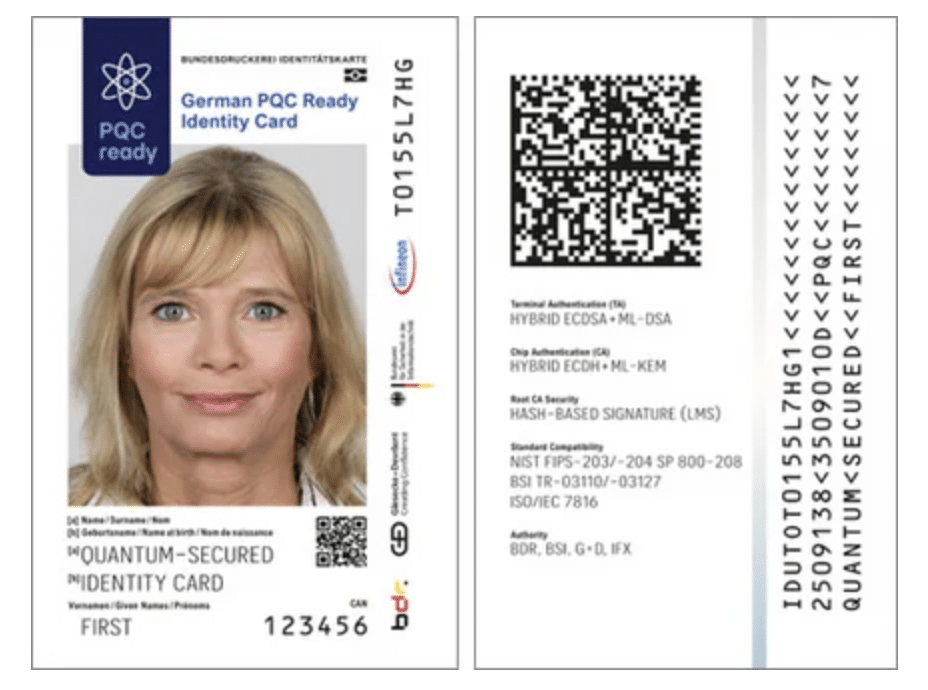
Germany has made its first moves to protect identity documents from quantum computer attacks, which threaten to break modern encryption and compromise sensitive data stored in IDs.
State-owned technology enterprise Bundesdruckerei Gruppe has completed a proof-of-concept for a national ID card that combines classical and post-quantum cryptography. The Berlin-based firm, which produces documents and devices for secure identification, collaborated on the project with security technology provider Giesecke+Devrient (G+D) and the German Federal Office for Information Security (BSI), G+D said in an announcement on Monday.
“Bundesdruckerei and G+D are the first in Germany to demonstrate that highly secure, quantum-resistant cryptography, covering both encryption and authentication, can be implemented on ID chips,” says Dr. Kim Nguyen, senior vice president of Innovation at Bundesdruckerei.
The project aimed to protect both the hardware and software of the country’s future ID cards.
The proof-of-concept involved chips produced by German semiconductor manufacturer Infineon, featuring a new design that supports Post-Quantum Cryptography (PQC) algorithms.
The PQC software was deployed into ID chips by G+D, which has previously worked in German government-funded projects related to quantum cryptography, such as Aquorypt and Quoryptan.
The move is part of an EU roadmap to adopt Post-Quantum Cryptography (PQC) in critical and high-risk applications by 2030. The roadmap was issued in June and warns that it is “impossible to precisely predict” when quantum computers will be powerful enough to compromise the cryptography currently in use.
“Equipping ID card chips with post-quantum cryptography is essential, as we must assume that by 2030, quantum computers will be capable of breaking today’s cryptographic algorithms,” says BSI President Claudia Plattner. “By then, governments must be ready to issue quantum-secure ID cards.”
Earlier this year, the EU also kicked off the PQC4eMRTD initiative, which aims to protect electronic passports against the threat of quantum computing attacks. The project involves a number of public and private organizations, including Thales and Infineon.
Germany plans to transition to quantum-secure ID cards in two stages. During the first stage, personal data will be protected with a quantum-resistant digital signature scheme, while the second stage predicts a full transition to quantum-secure technology.
In 2022, Bundesdruckerei also developed the world’s first electronic passport demonstrator that meets post-quantum security standards. The project included Infineon and the Fraunhofer Institute, one of Europe’s largest applied research organizations.
Related Posts
-
 January 29, 2025
 -
 March 3, 2025
 -
 November 20, 2024
 -
 April 17, 2025
 -
 March 6, 2025
 -
 March 6, 2025
Article Topics
Bundesdruckerei GmbH | digital ID | Giesecke & Devrient (G+D) | identity document | post-quantum cryptography

Comments