
Hungarian border police explores contactless fingerprint scanning
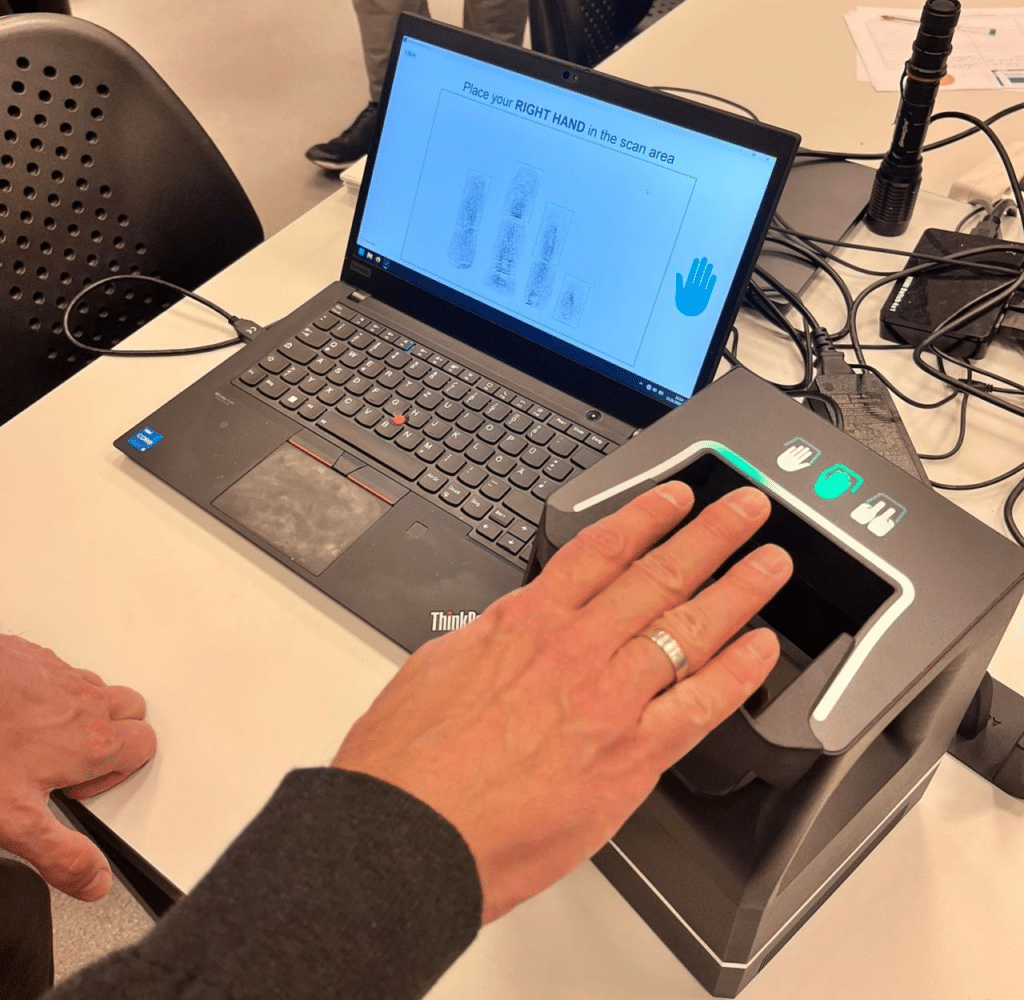
Hungarian border police are exploring the use of contactless biometric technology made by German startup IDloop in border control and law enforcement.
The research initiative between the company and Hungary’s Border Policing Innovation Program (HIP) will focus on how contactless fingerprint scanning can be applied in real-world environments, including for 3D data processing, rolled fingerprints and palm capture.
IDloop presented the technology at a forum organized by HIP in January, showcasing its 3D contactless fingerprint scanner and software platform designed for high-accuracy biometric enrollment and verification, CFS flats.
The product was first introduced in 2024 and is the world’s first 3D contactless fingerprint scanner certified by the FBI, according to the firm. The project was brought to market with the help of a European Commission grant of 10 million euros (US$10.6 million). Aside from border control, CFS flats can be used in biometric enrollment for ID documents and forensic applications.
IDloop is also collaborating on security projects with the German Federal Office for Information Security (Bundesamt für Sicherheit in der Informationstechnik, BSI).
Hungary is also investing more funds into surveilling its borders. The police have earmarked nearly 4.8 billion Hungarian forints (US$15.1 million) for reconnaissance devices and systems to monitor its Schengen external borders with Serbia and Ukraine. This includes fixed and mobile electro-optical surveillance systems.
The funding comes from a non-reimbursable grant from the European Commission’s Border Management and Visa Policy Instrument (BMVI), Hungary Today reports.
Related Posts
-
 April 1, 2025
 -
 September 9, 2025
 -
 December 5, 2025
 -
 December 9, 2025
 -
 June 4, 2025
 -
 December 1, 2025
Article Topics
3D contactless fingerprint scanner | biometric identification | border security | contactless biometrics | fingerprint biometrics | fingerprint scanners | Hungary | IDloop

Comments