
SITA urges digital identity, AI coordination as aviation faces ‘significant pressures’
SITA’s most recent report mentions the elephant in the room regarding the industry, as the conflict in the Middle East wreaks havoc on global aviation.
More than ever, airlines and airports are being urged to close the gap when it comes to data coordination to fully unlock the efficiencies that can be enabled by technology and build foundations that will “outlast the current disruption.”
“We are publishing this research at a moment when the industry is under significant pressures,” said David Lavorel, SITA CEO.
The executive reveals that across every area measured in the Air Transport IT Insights 2025 report, there arose a common constraint. Where data doesn’t flow freely across systems and partners, investment is unable to fully deliver what it was designed to unlock.
“That constraint carries a higher cost today, but also a clear opportunity to emerge stronger,” he said.
Airlines and airports are significantly raising their IT spending as they race to build more resilient, data‑driven operations. Airlines invested $36 billion in 2025 — 3.6 percent of revenue — while airports lifted their IT spend to $14.8 billion, or 7.3 percent of revenue. More than 80 percent of both groups now view data‑driven decision making as a strategic priority.
The report found operational reliability is closely linked to financial issues, with flight delays alone costing the industry $30 billion annually. Nearly half of airlines (46 percent) are upgrading flight operations systems to unify data across aircraft, crew, passenger and scheduling platforms.
However, almost the same proportion (49 percent) point to fragmented data being the biggest barrier to early disruption management.
The implementation of the EU’s biometric EES for border control, which involves extensive data-sharing, led to significant delays this week, despite widespread suspension of the biometrics element.
Lack of coordination limits digital identity scale
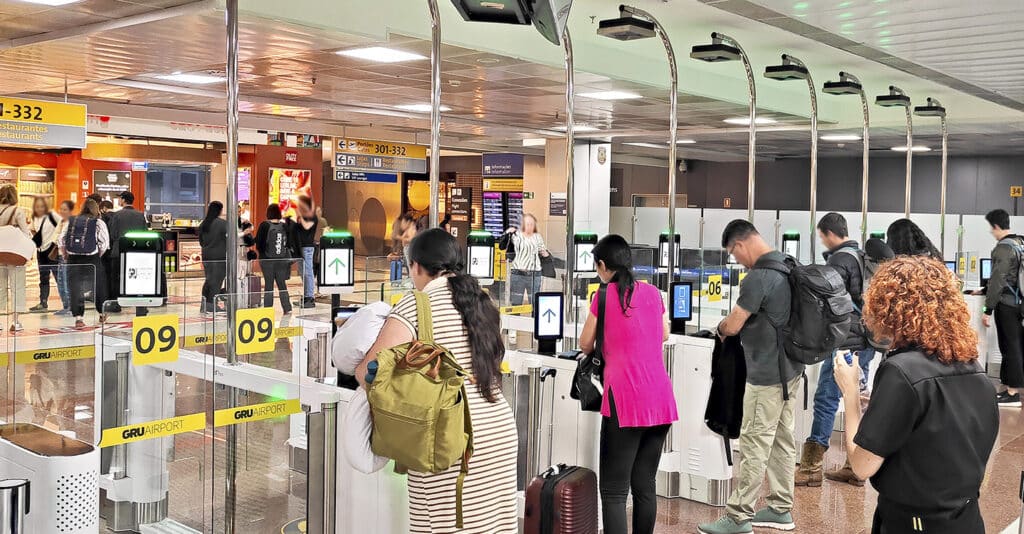
Digital identity is scaling quickly, with 64 percent of airlines planning to issue their own digital credentials, which is double 2024’s figure, and biometric border controls are expected to reach 83 percent of airports by 2028.
But coordination remains the limiting factor as 57 percent of airlines say airport cooperation is vital for digital identity to scale. The International Air Transport Association (IATA) recently concluded that fully contactless international travel is already achievable, enabled by biometrics, if governments begin issuing and accepting digital passports at scale.
AI adoption is accelerating, but its impact is constrained by data integration. Among airlines, 63 percent now use AI in operations control to coordinate decisions across aircraft assignment, crew availability and disruption recovery.
Generative AI is the top investment priority for the next year. Yet AI is used least in areas that require consistent, multi‑partner data as only 17 percent of airlines use it to monitor turnaround activity in real time. However, airports are closing that gap, with 53 percent now applying it to aircraft turnaround, an increase from 36 percent in 2024.
“Aviation is deploying AI with real ambition,” said Lavorel. “But the survey is clear: the primary barrier to maximizing that investment is the lack of data integration across the operation. The technology is there. The data infrastructure to connect it often is not.”
Cybersecurity has become a top concern as more systems are interconnected. Cybersecurity is ranked the primary IT focus by 71 percent of airports, and nearly two‑thirds (64 percent) are using AI to detect anomalies earlier.
Sustainability is a big focus for passengers worldwide. A global survey from October 2025 by SITA revealed that travelers want faster, smarter and greener journeys. The desire for digital convenience and sustainability was especially pronounced among millennials and Gen Z passengers.
However, SITA logs the same pattern in sustainability with airlines advancing in areas they control directly, such as fleet renewal and selective SAF sourcing, while emissions tracking, which requires shared data across operators, remains below 20 percent adoption.
Across AI, cybersecurity, digital identity and sustainability, the report finds a consistent pattern: progress is fastest where data flows freely across systems and partners, and slowest where it does not.
Related Posts
-
 July 29, 2025
 -
 October 27, 2025
 -
 March 25, 2026
 -
 June 30, 2025
 -
 August 4, 2025
 -
 November 12, 2025
Article Topics
AI | airport biometrics | digital identity | digital travel | SITA

Comments