
China creates digital ID for humanoid robots
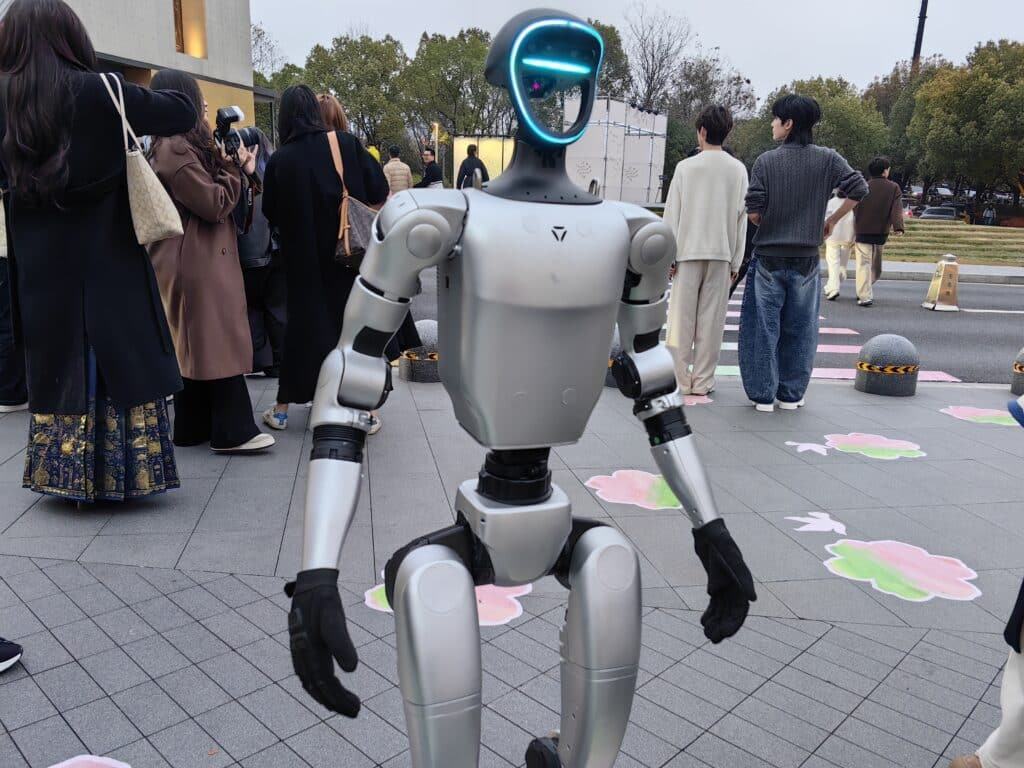
China is telling its humanoid robots to take a number. The country plans to assign a unique numerical code to every AI-equipped bipedal humanoid manufactured in the country before it leaves the factory floor. A report in the South China Morning Post says the initiative is “like a national ID but for robots.”
The “Humanoid Full Lifecycle Management Service Platform” will enable tracking of the robots through their full lifecycle, from production through to recycling. The agency overseeing the initiative – the Humanoid Robotics and Embodied Intelligence Standardization (HEIS) committee, operating under China’s Ministry of Industry and Information Technology, out of the Hubei Humanoid Robot Innovation Center in Wuhan – says tracking is to monitor for risks to ensure safety, oversight and proper governance of robots designed to behave like humans.
Each ID code is 29 numbers long, and contains four parts. A two-digit national code tracks cross-border shipments and sales. A four-digit code identifies the Chinese firm that manufactured the robot. A six-digit product model code identifies the robot type. And a 17-digit serial code distinguishes individual units.
More than 28,000 robots across 200 models have already been assigned the digital ID.
Robot cops, runners already in action
China is accelerating its development of humanoid robots, as it aims to leverage its vast industrial supply chain. According to a recent report in the Guardian, there are now roughly 140 Chinese firms hoping to build humanoids. The southeastern city of Hangzhou already has 15 robot traffic police patrolling the streets. China’s robots have already become internet sensations, going viral as they variously dance, fight and fall over.
The government is racing to keep up with standards, guidelines and coordination with industry to support growth in the sector. Freshly issued guidelines cover lifecycle management and instructions for using the mandatory numerical ID. They apply to stakeholders including manufacturers, service providers, sellers, users and recycle facilities.
But the relentless pace of the AI industry has brought us to the juncture of guidelines and sanctions – which is to say, where practical and technical concerns meet legal, ethical and philosophical ones. As SCMP notes, a humanoid robot developed by a Huawei subsidiary recently broke a record running the E-Town Humanoid Robot Half-Marathon, finishing the race faster than any human has ever run the same distance in history. The world of The Jetsons is no longer a cartoon fantasy: global shipments of humanoid robots reached some 17,000 units in 2025, with a market valued at $424 million. Robot maids are on the doorstep.
As we continue to assign agency to machines, what will be decided as the optimal limits for that agency? In building an army of humanoid robots, are we in fact building digital slaves? What can we or should we ask these entities to do for us, or be for us? If we equip them with superhuman skills, could they possibly use those skills to inflict harm, should they opt not to be numbered, tracked and recycled? More acutely, is it a good idea for humans to apply that particular control architecture at all, when it has proven to translate so easily to populations of real people?
Robot digital ID ‘institutional spine on which standardization can be built’
These are the questions now facing Chinese authorities, and the world at large. An article from Six Degrees of Robotics, published on LinkedIn, notes that the monitoring goes far beyond what is recorded in the ID code, extending to include “maintenance logs, application scenarios, intelligence level, and even real-time telemetry such as joint wear, battery status, and operational accuracy.” The ID enables rapid fault diagnosis, liability determination, and fast maintenance when a robot malfunctions.
China’s initiative is one of the first attempts to build a national governance infrastructure for embodied AI systems before they reach mass deployment. It points to a new framing for robots, treating “each robot as a discrete regulated entity with a persistent identity, much as financial regulators treat legal persons or as aviation authorities treat individual aircraft tail numbers.”
Eighty five percent of the 17000 humanoid robots shipped in 2025 came from China, and AI robotics firms are exploding. Regulation, however, is still taking shape. Meanwhile, the industry fragments, adopting incompatible technical standards, isolating operators and providing, as Six Degrees of Robotics says, “no unified norms for traceability, safety supervision, or data circulation.”
China’s digital ID for humanoid robots attempts to solve the problem, formalizing official numbering against national standards. “That means manufacturers seeking legitimate market access will need to participate in the registry – and participation creates a continuous data relationship between the state and the machine itself.”
“The ID system is positioned as the institutional spine on which standardization can be built. For an industry expected to integrate deeply into manufacturing, commercial services, and eventually domestic settings, the absence of such a spine is precisely what makes consumer-facing deployment legally and politically risky.”
Can the state continuously regulate your friend Tidbit?
For most people in the world, it would still be shocking to see a humanoid robot walking the streets. But we may have seen variants in hospitals, at restaurants or on social media. China is at the forefront of a push to integrate them into human life en masse, which raises complex questions for regulators globally.
Imagine a humanoid robot, perhaps with the name Tidbit. Tidbit brings you breakfast in bed every morning, and reads you a poem. Is Tidbit a product, like a coffee maker, suggesting regulation ended at point of sale? Or is it a “persistent regulated entity?” China’s ID scheme would claim regulatory jurisdiction for Tidbit’s full operational lifetime. “That has clear advantages for accident investigation and liability attribution – and clear implications for ownership, privacy, and the boundary between state oversight and private property.”
Who gets the data a robot generates, and where can it go? What happens across borders? Foreign countries are unlikely to adopt a digital ID scheme for robots that concedes continuous access to the Chinese state. But contrasting or competing identification models will create an even more tangled regulatory jungle.
The project unfolding in China “sketches the outline of a governance architecture that treats humanoid robots less like appliances and more like regulated participants in economic life,” says the post. “Whether other jurisdictions follow, resist, or develop alternatives, the policy questions it surfaces – about identity, traceability, data rights, and cross-border recognition – are arriving faster than most regulatory bodies are prepared for.”
This is perhaps the most common refrain to issue from the world of AI transformation: this is all happening fast – probably faster than we can control. By the time we understand the gravity of the questions being raised, some may be answered by matter of fact. For while it is tempting to write off human-robot wars as the product of science fiction, there is a reason people have felt compelled to write those stories, and to lay bare the profound implications our decisions will have on the near future.
Related Posts
-
 September 16, 2025
 -
 June 6, 2025
 -
 October 2, 2025
 -
 April 8, 2026
 -
 June 4, 2025
 -
 October 20, 2025

Comments