
Nothin’ like a G-Knot: finger vein crypto wallet mixes hard science with soft lines
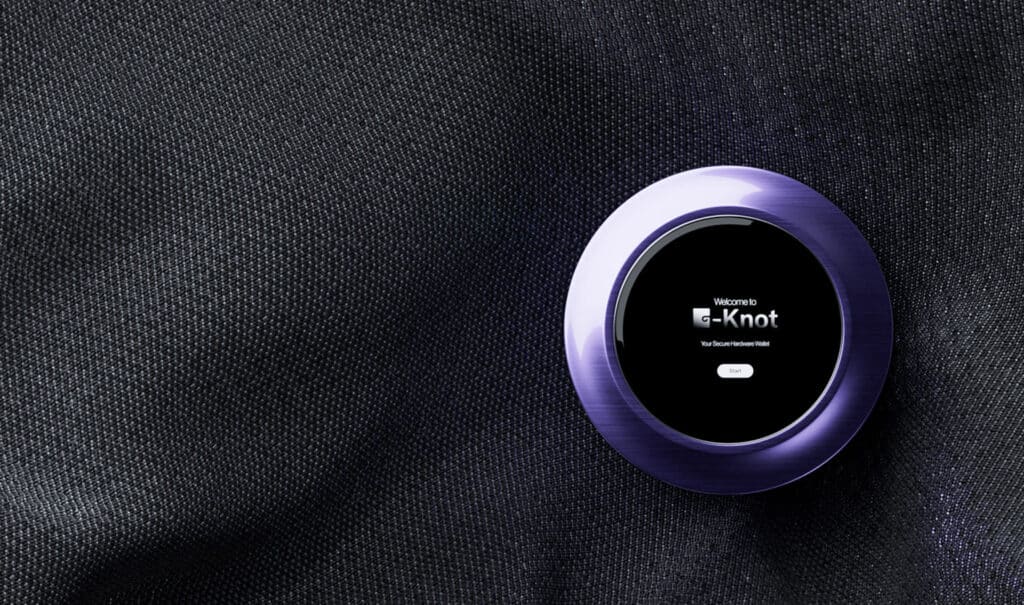
Let’s be frank: most biometric security hardware is not especially handsome. Facial scanners and fingerprint readers tend to skew toward practical, not to say clunky aesthetics. On the other end of the spectrum, an iris-scanning orb is, fundamentally, a deeply silly design concept.
G-Knot’s CEO Wes Kaplan says the firm designed its cold crypto wallet to look like a hockey puck – which is accurate if you assume Transformers play hockey. The sleek but hearty little disc uses fingerprint vein biometrics, subdermal near-infrared imaging and CCD cameras to derive security keys without the need for passwords or seed phrases. Its secret weapon is the P2N2 authentication module algorithm developed by South Korean firm eTunnel.
Kaplan explains further: “it uses some of our patented technology, which generates private keys from your unique vascular finger vein patterns and helps ensure anti-spoofing via blood flow detection.”
The wallet is compact, but G-Knot is thinking big. The company ultimately sees itself playing in the identity space; Kaplan says “the wallet’s just the start” of a planned connected ecosystem revolving around the G-Knot crypto token. In this, it positions itself adjacent to World and other blockchain-adjacent identity networks with a native token.
The look is part of that large-scale thinking.
“The idea is that your user experience should be amazing. And part of that is aesthetics, right? What we’ve tried to create is not just something that changes the game in terms of self-custody and institutional custody. We’re designing a lifestyle brand as well.”
There is, however, plenty under the hood. Check out the full episode to hear Wes Kaplan break down the science of illuminating finger veins and using charged coupled device cameras with optical filters to capture the absorption patterns of deoxygenated hemoglobin – and more.
Listen now: Spotify, Apple, YouTube, Podbean
Runtime: 00:23:55
Related Posts
-
 July 8, 2025
 -
 July 10, 2025
 -
 October 14, 2025
 -
 November 3, 2025
 -
 February 26, 2025
 -
 March 28, 2025
Article Topics
access control | biometric authentication | biometrics | crypto wallet | eTunnel Inc. | finger vein | G-Knot | vein biometrics

Comments