
Lodestar launches biometric 9mm handgun into skeptical market
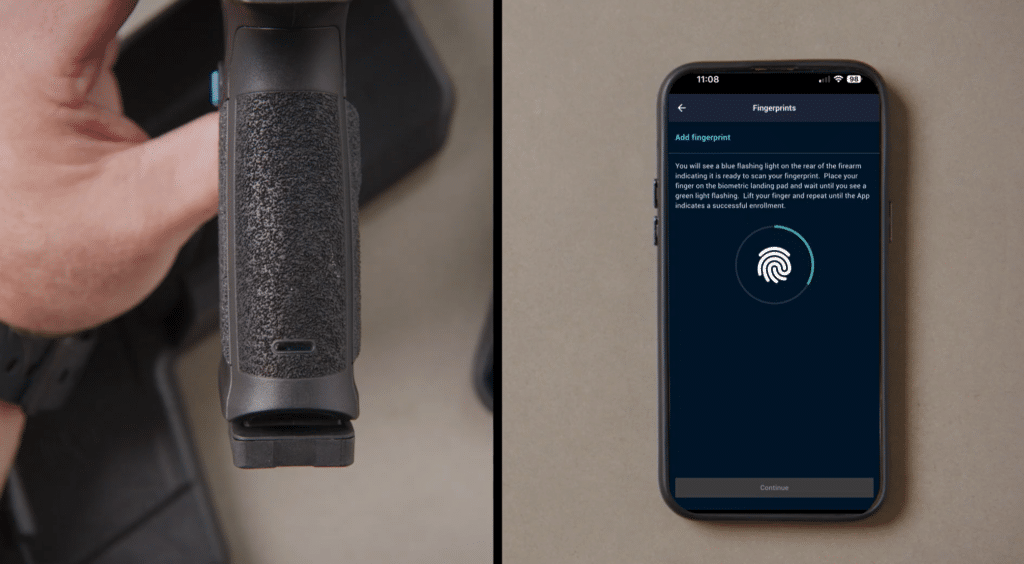
Chattanooga, Tennessee-based Lodestar Technology has rolled out a new biometric-enabled 9mm handgun, the LNK9. The question hanging over the launch is not whether the technology can be built, but whether enough American gun enthusiasts will want it to buy it.
The MSRP is set at $979.99, which is competitive with higher-end handguns.
The LNK9 is a “user-authorized” pistol that uses fingerprint recognition embedded in the grip, PIN-pad access, local biometric storage, Bluetooth-based owner management, and support for as many as 50 authorized fingerprints.
The company says the gun is designed so access control stays with the owner, not a remote network. That positioning reflects the central problem smart-gun makers have faced for years.
The technology has always been promoted as a way to prevent unauthorized use by children, thieves, or other unintended users, but in the U.S. firearms market, it has also long been treated with suspicion by gun rights advocates who see it as either unreliable, politically loaded, or both.
Lodestar is clearly trying to blunt that resistance by stressing that the LNK9 does not rely on cloud authentication or remote disablement. In other words, the company is not just selling a gun, it is selling reassurance to a customer base that has historically distrusted electronics on defensive firearms.
In early 2022, what was then named LodeStar Works, as well as gun manufacturer SmartGunz, tried to move the concept away from the failed experiments of the past and toward something more commercially viable.
They marketed their guns as personalized firearms that could keep children from firing guns they found in the home, and to reduce harm from the hundreds of thousands of guns lost or stolen each year.
By March 2024, the category saw a more concrete step when Biofire said it would begin shipping what it described as the first biometric smart gun made in the U.S. It was a notable milestone, but it did not settle the larger commercial question.
At the time, the company still faced resistance from gun rights groups and skeptics who viewed smart guns as unreliable or as a potential backdoor to firearm regulation. The same concerns now shadow Lodestar’s launch, even if Lodestar is pursuing a somewhat different feature mix and price point.
What is holding back adoption is a mix of technology risk, culture, regulation, and market psychology.
A smart gun has to do more than function most of the time. In the minds of many gun owners, especially those who buy for self-defense, it has to work instantly under stress, with wet or dirty hands, after long periods of nonuse, and without introducing failure points that a conventional handgun does not have.
This fear of unreliability, combined with concern that smart guns could become a wedge for government mandates, remained one of the biggest reasons the concept struggled to gain traction.
That skepticism is not just anecdotal. A Johns Hopkins survey found that while 79 percent of gun owners supported licensed dealers offering both traditional and personalized firearms, only 18 percent said they were likely to buy a personalized gun when considering the additional cost.
The same research found that 70 percent had concerns about whether the technology would work when needed, and more than half worried about price.
Those findings help explain why smart guns generate a level of public policy interest and media attention that far exceeds their actual commercial footprint.
American gun culture also makes success difficult in a way that goes beyond ordinary product adoption. This is not a market where buyers are simply comparing features the way they would with phones or home electronics.
In much of the firearms world, simplicity is itself a feature, and electronics are often seen as something that can fail at the worst possible moment.
That does not mean there is no market for a product like the LNK9. It means the likely buyer is not the median American gun owner, but a narrower group that is especially concerned about unauthorized access in the home, theft, family sharing, or keeping children from using a firearm they should not touch.
Smart guns are more likely to succeed as a niche rather than as a mass-market category, at least in the near term. They may appeal to safety conscious households, newer gun owners, and some buyers willing to accept added complexity in exchange for access control.
But they are unlikely to displace standard handguns across the broader U.S. market anytime soon. That is especially true because the culture of gun ownership remains enormous.
Gallup says 30 percent of Americans reported personally owning a gun in 2025, while the National Shooting Sports Foundation (NSSF) says more than 8.1 million handguns were made available to the U.S. market in 2023 alone.
The state policy landscape is also narrower than the politics around smart guns might suggest. Only Maryland, Massachusetts, and New Jersey have laws that directly address personalized or smart-gun technology.
New Jersey is the most politically significant because its current law requires licensed retailers to make at least one such model available for purchase and to post information about it.
Maryland law defines “personalized handgun” and incorporates the concept into its handgun roster framework. A handgun roster is basically a state-maintained list of handgun models that are approved for commercial sale in that state.
Massachusetts has also moved in this area, and its approved firearms roster includes a “Smart Gun” listing dated February 14, 2025.
California matters too, though in a somewhat different way. The state attorney general’s handgun roster and approved safety device listings show that Biofire’s smart gun has obtained California approval as both a certified handgun and an integrated biometric lock device.
That is not the same thing as California having a dedicated smart-gun mandate, but it does show that the regulatory path for biometric firearms can be cleared in one of the country’s most restrictive handgun markets.
One reason manufacturers have long been wary of the category is that state policy has historically looked less like a market opportunity than a regulatory trap.
New Jersey’s earlier smart-gun law became notorious because it was widely understood to risk forcing the broader handgun market toward personalized firearm requirements once a qualifying product became available.
That law was later changed, but its legacy remains one of the main reasons the firearms industry has treated smart-gun innovation as politically dangerous, even when companies insist they oppose mandates.
As for the actual market size, that is where the picture becomes less precise. There is no widely accepted, public, hard-data count for U.S. smart-gun unit sales because this remains a very small and immature category.
The broad handgun market is large and well documented, with NSSF putting 2023 U.S. handgun availability at 8.1 million units. But the addressable market for a biometric or user-authorized pistol is clearly far smaller than that total.
If smart guns captured even 1 percent of that handgun market, that would imply roughly 81,765 units, which at Lodestar’s MSRP would translate to around $80 million in retail value.
That estimate aligns roughly with one market research figure that placed the U.S. smart-guns market at $87.8 million in 2024, though such third-party estimates should be treated cautiously.
So, the actual commercial opportunity for the LNK9 is probably best understood as a small but potentially durable slice of a huge handgun market, not as a product poised to remake American firearms buying.
Until smart-gun makers can clear the hurdle that biometric-enabled guns are trustworthy guns, the category is likely to remain a specialized corner of the handgun market rather than a transformational new standard.
Related Posts
-
 April 1, 2025
 -
 December 16, 2025
 -
 June 3, 2025
 -
December 12, 2025
-
 September 9, 2025
 -
February 19, 2026
Article Topics
biometrics | fingerprint biometrics | fingerprint recognition | fingerprint sensors | Lodestar | smart gun

Comments