
NYPD faces federal lawsuit over alleged unconstitutional citywide surveillance
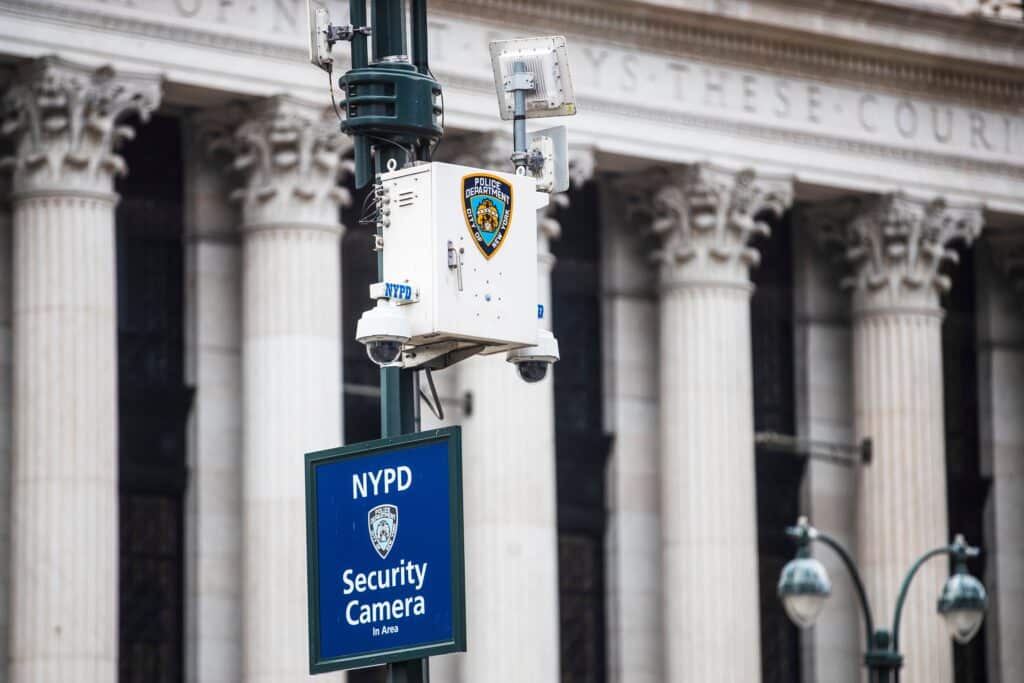
A new federal lawsuit accuses the New York City Police Department (NYPD) of operating an unconstitutional mass surveillance system that tracks residents and visitors across the five boroughs.
The 29-page complaint, filed October 27 in the Southern District of New York, alleges that the NYPD’s Domain Awareness System (DAS) fuses cameras, sensors, license-plate readers, biometric databases, and social-media monitoring into an integrated network that surveils millions of people without warrants or adequate oversight.
The plaintiffs, Brooklyn residents Pamela Wridt and Robert Sauve, argue that the system violates their First and Fourth Amendment rights by turning everyday life in New York into a continuous police search.
The suit, backed by the Surveillance Technology Oversight Project and the law firm Emery Celli Brinckerhoff Abady Ward & Maazel LLP, seeks to halt warrantless use of DAS and compel the city to adopt clear limits on data storage and access.
According to the complaint, the Domain Awareness System – developed by NYPD in partnership with Microsoft and expanded since about 2012 – consolidates more than a dozen surveillance technologies into a single interface.
The plaintiffs say it links video cameras, automated license-plate readers, drones, ShotSpotter gunshot detectors, biometric and facial-recognition systems, and social-media analytics, allowing officers to track individuals across space and time.
Wridt and Sauve claim the system’s reach extends directly into their home. Two NYPD cameras mounted outside their Bedford-Stuyvesant residence, they allege, are aimed through their living-room and bedroom windows.
The complaint describes DAS as a centralized platform integrating thousands of stationary and mobile cameras operated by both the NYPD and its private-sector partners. It cites public disclosures showing that video feeds flow into the system from other city agencies and private businesses, including housing-authority cameras.
Drones and helicopters, the plaintiffs say, supply additional live and archived footage of public areas. Police can view these feeds in real time or retrieve stored video for roughly 30 days, according to NYPD policy documents referenced in the lawsuit.
Automated license-plate readers record vehicles as they pass through checkpoints, capturing location, time, and images of drivers and passengers. The complaint asserts that NYPD pairs its database with records from private contractor Vigilant Solutions, which adds more than a million new plate scans each day, and alleges that plate data may be retained for years regardless of whether suspicion exists.
Those claims have not been independently verified.
The plaintiffs also allege that NYPD’s ShotSpotter gunshot-detection microphones can pick up nearby conversations, including those occurring inside homes. The city has spent tens of millions of dollars on the system, though the lawsuit cites audit findings suggesting that a large share of alerts are false positives.
Another section of the complaint describes the department’s collection of biometric information, including fingerprints, facial images, and DNA. It points to an NYPD DNA database containing tens of thousands of profiles, some drawn from individuals never convicted of crimes.
Wridt and Sauve claim that New Yorkers unknowingly contribute personal identifiers to this database through licensing or benefit programs, unaware that the information can be accessed for policing purposes.
The plaintiffs further allege that NYPD employs advanced analytic tools within DAS to connect disparate data points linking camera footage, location histories, and social-media activity to create detailed digital dossiers on individuals.
According to the complaint, the system’s pattern-recognition software can follow a person across multiple cameras based on features such as clothing color or gait.
The lawsuit also highlights alleged social-media surveillance. Officers, it says, use undercover accounts to monitor online groups and scrape posts, photos, and messages from platforms including Facebook, Instagram, and TikTok.
Those records are then cross-referenced with other datasets such as license-plate or facial-recognition results to map the political and social connections of city residents.
In addition, the complaint contends that NYPD shares personal data gathered through DAS with state and federal agencies, including the Department of Homeland Security, after which the department “loses control” of how the information is used.
The plaintiffs cite testimony indicating that local surveillance data has previously been shared with U.S. Immigration and Customs Enforcement, including a protester’s sealed arrest record, to illustrate how city information can end up in federal hands despite sanctuary-city policies.
The plaintiffs warn that this kind of sharing could expose New Yorkers to out-of-state prosecutions or other legal actions as federal systems integrate local data through private contractors such as Palantir.
Their legal arguments rest on two constitutional claims. Under the Fourth Amendment, they assert that the Domain Awareness System constitutes an “indiscriminate search” conducted without warrants or individualized suspicion, capturing “the privacies of life.”
Under the First Amendment, they argue that constant monitoring chills free expression and association, discouraging people from attending protests, religious services, or community meetings.
The lawsuit asks the court to declare NYPD’s practices unconstitutional and to restrict the use of DAS unless officers first obtain warrants. It seeks an injunction requiring the department to establish written policies governing data access and sharing, to maintain audit logs to prevent abuse, and to adopt a time limit for retaining surveillance data.
The plaintiffs also request compensatory damages for emotional distress and loss of enjoyment of their property.
City officials have not yet filed a response. NYPD has long defended the Domain Awareness System as a critical public-safety tool for counterterrorism and crime prevention. Mayor Eric Adams and Police Commissioner Jessica Tisch have praised its effectiveness, describing it as an example of technological innovation in policing.
The plaintiffs counter that despite billions of dollars invested over more than a decade, there is no publicly available evidence showing that DAS has measurably reduced crime. They argue instead that it has created a climate of constant observation that erodes constitutional freedoms in the nation’s largest city.
Related Posts
-
 April 12, 2025
 -
 March 31, 2025
 -
 December 4, 2024
 -
October 3, 2025
-
 April 12, 2025
 -
 October 13, 2025
Article Topics
biometric identification | biometrics | data privacy | facial recognition | lawsuits | Microsoft | NYPD | police | video surveillance | Vigilant Solutions

Comments