
DHS has turned college football games into surveillance test beds
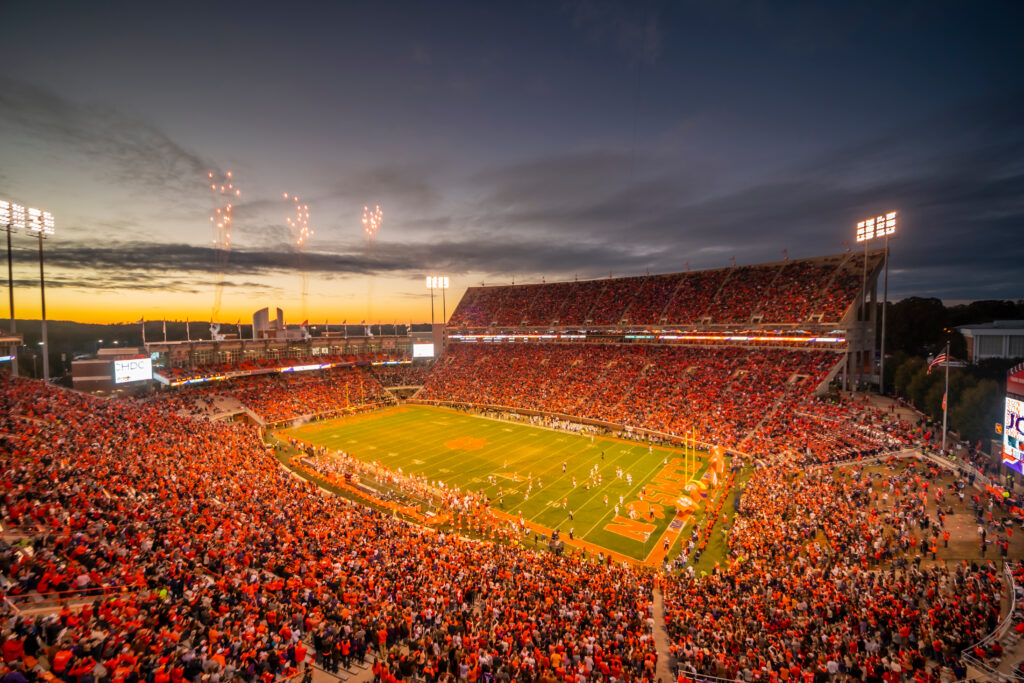
The Department of Homeland Security (DHS) has quietly turned college football into test beds for a federated surveillance stack built around its Homeland Security Information Network (HSIN).
DHS has for years promoted and facilitated the use of HSIN for college football game operations, and HSIN’s feature set at these events includes live video, mobile streaming, and, in at least one case, drone-detection and camera integration, all pointing to an increasingly sensor-rich environment.
Public records and DHS publications describe HSIN as the department’s official system for “trusted sharing” of sensitive but unclassified information across federal, state, local, tribal, territorial, and even private-sector partners.
In practice, that has meant live camera feeds piped into shared “situation rooms,” chat and file exchange among many agencies at once, and a common operating picture that extends well beyond a single campus police department.
New reporting by FOIAball this week reconstructed how the system works on game day. Drawing on event action plans and campus materials, HSIN stood at the center of security operations at multiple college venues, including Ole Miss home games against Georgia and Mississippi State in November 2024.
Documents listed at least eleven on-site agencies and referenced HSIN “SitRoom/Connect” for multi-agency coordination, an arrangement that illustrates both the power and reach of the platform when tens of thousands of fans assemble.
HSIN’s college football footprint is not new, though. In a January 2016 issue of DHS’s own HSIN Advocate newsletter, the department wrote that HSIN “was used during every Ohio State University home game” during the 2015 season and supported other Ohio campuses and even Major League Soccer.
The same newsletter highlighted the College Football Playoff (CFB) National Championship in January 2016 where Phoenix police and Arizona’s fusion center “turned to HSIN,” applying lessons learned from that year’s Super Bowl to refine the interagency playbook.
By 2019, DHS was publicly touting more sophisticated workflows. In a September 2019 HSIN Advocate, the Georgia Tech Police Department described using “HSIN Connect to share live video streams” from fixed cameras and mobile phones with public safety partners on game days, emphasizing how the mobile app could send “multiple, simultaneous live video streams back to our Operations Center.”
The same issue of the newsletter also noted that police departments in Georgia, Mississippi, Illinois, and Ohio had integrated HSIN into their football operations, proof that what began as a national-event tool was filtering into regular campus security.
Recent federal publications show the stack growing more sensor-rich. In DHS’s 2023 CIO Annual Report, the department cited a University of Central Florida (UCF) football trial where “HSIN Connect facilitated quick sharing of weather radar, drone detection system information, and security camera feeds,” suggesting the platform now ingests a mix of venue video, local airspace awareness tools, and environmental data in real time.
At the policy level, DHS and its beleaguered Computer Infrastructure and Security Agency (CISA) have worked for years to normalize this kind of multi-party coordination at sports venues.
CISA’s Security and Resiliency Guide’s “Sports Leagues and Venues Annex” explains the counter-IED and incident management practices expected of stadium operators and their public safety partners, repeatedly pointing to shared situational awareness, information exchange, and unified command structures.
None of this guidance mandates HSIN specifically, but it foregrounds the kind of “whole-of-venue” surveillance and coordination that HSIN is designed to provide.
The civil liberties questions get sharper when looking at how HSIN interacts with biometric searches. The system is not a facial recognition platform, but federal auditors and agency testimony have confirmed that HSIN exposes a “Multi-State Facial Recognition Community of Interest” where authorized users can request indirect facial recognition searches by pushing probe photos to state and local partners, including fusion centers.
The Government Accountability Office documented this in 2021, writing that DHS “owns the Homeland Security Information Network … [which] has a form for authorized users to request indirect facial recognition searches through state and local entities,” and that Customs and Border Protection and Immigration and Customs Enforcement personnel leveraged those pathways in FY 2020.
The Department of Justice reiterated the same point in written testimony to the U.S. Commission on Civil Rights in 2024, noting that the U.S. Marshals Service has access to HSIN and its indirect facial recognition request workflow.
That means a camera-rich game day environment plugged into HSIN can – at least in some circumstances – be only one step removed from a face search handled by a partner system.
The Commission’s 2024 report on federal facial recognition did not name college football, but it underscored the broader risk of unregulated federal use, accuracy and bias concerns, unclear retention, and the difficulty citizens face in discovering when facial recognition technology was used.
When combined with HSIN’s role as an interagency bus for live video and stills, those findings raise obvious questions about downstream identity resolution at mass gathering venues.
DHS’s public facing description of HSIN emphasizes security and collaboration. It is the “official system” for sensitive information sharing and, as such, a natural hub whenever multiple jurisdictions converge on a single mission space, it has said.
In stadium contexts, that convergence is unusually dense: campus police, city police, sheriffs, state police, highway patrol, fusion centers, emergency managers, private venue security, sometimes National Guard civil support teams, and DHS components themselves.
HSIN gives them a shared chat, files, dashboards, and live feeds. The capability can be lifesaving in a crisis, but it can also normalize routine mass surveillance at ordinary civic events.
What is opaque is governance. The Ole Miss materials surfaced by FOIAball show who was in the room and that HSIN was the chosen collaboration layer, but they don’t answer core privacy questions like which camera networks were ingested, whether any private sector cameras were federated, which data were retained after the final whistle, how long chat logs and uploaded imagery persist, or whether any game day imagery was later used for off-venue investigations.
In UCF’s case, DHS acknowledges drone detection and camera fusion, but does not elaborate on retention, audit trails, or post-event access. Without campus policies, MOUs, or HSIN community charters in hand, fans have little visibility into how their images might travel once captured inside or just outside a stadium.
CISA’s guidance to sports venues helps frame a safety rationale for counter-IED sweeps, suspicious item reporting, emergency egress, and other threat agnostic preparedness, but those documents do not settle the question of proportionality once you have persistent video, a federalized distribution layer, and a nearby route to face searches via state partners.
A steady cadence of DHS reporting and newsletters shows how quickly practices can migrate from elite, one-off events to weekly fixtures. What HSIN enabled for the 2015 Super Bowl or 2016 CFP title game soon appeared in regular season college play in multiple states and then evolved into multi-sensor fusion at a single campus by 2023.
While HSIN is not itself a face-matching system, documented federal practice allows HSIN users to route images to partner facial recognition systems, raising a material risk that game day imagery can feed identity searches through indirect channels.
What remains unsettled is oversight. The Commission on Civil Rights has already recommended stronger federal guardrails around facial recognition. Whether the same clarity will be applied to HSIN-enabled mass gathering operations is, for the moment, an open question.
Related Posts
-
 January 13, 2025
 -
 November 4, 2025
 -
 October 30, 2025
 -
 July 17, 2025
 -
 March 31, 2025
 -
 November 9, 2025
Article Topics
biometrics | DHS | facial recognition | Homeland Security Information Network (HSIN) | law enforcement | United States | video surveillance

The novelty isn’t the surveillance itself; many stadiums are capable of implementing these solutions without DHS. The novelty is the facilitation of cross-agency coordination. This becomes complex because different jurisdictions have different regulations regarding video analytics and facial recognition.