
Yoti Verified Calls aims to help businesses defend against surge in injection attacks
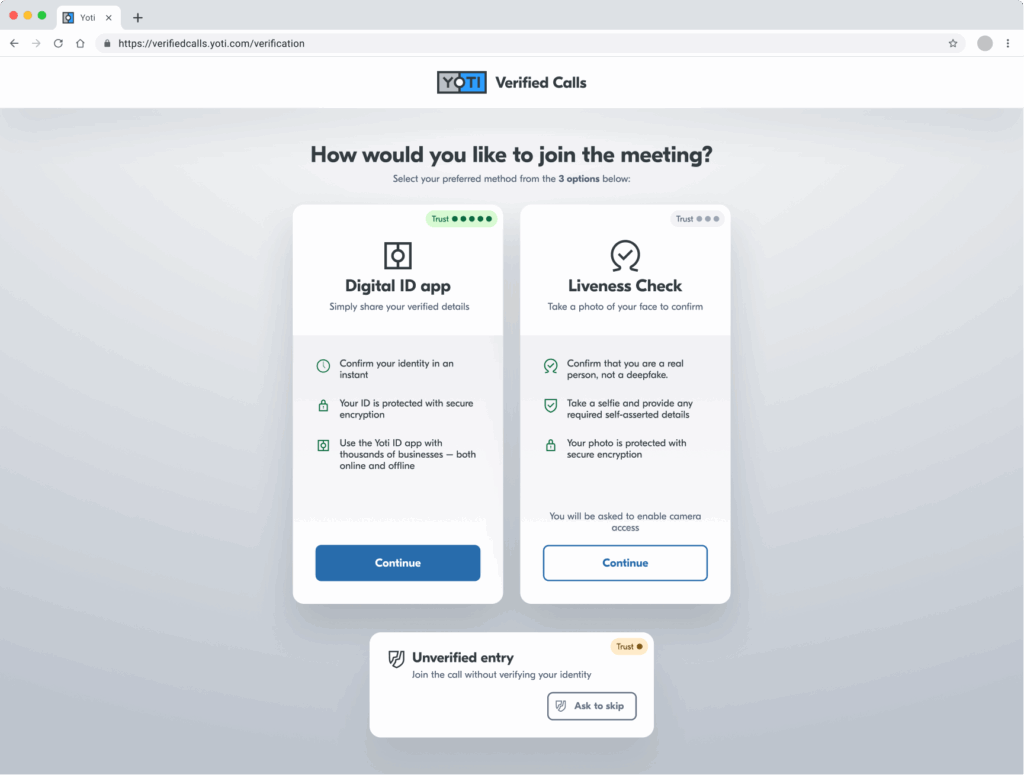
Yoti has launched Yoti Verified Calls, a tool designed to clamp down on impersonation fraud by detecting and stopping injection attacks during video calls.
“Businesses are under siege from sophisticated fraud operations,” says Robin Tombs, CEO of Yoti, in a release. The company’s data shows an increase in injection attacks, which target remote verification services by hijacking live camera feeds with pre-recorded or synthetic images or videos, from a daily average of 1,000 in February 2024 to over 6,000 attacks in January 2025.
“Whether it’s impersonating staff to gain system access or deepfake-driven scams, it’s critical to ensure only authorised attendees are able to access video calls,” Tombs says.
Yoti Verified Calls allows retailers to verify employees, suppliers or partners before and during video sessions. ID checks can be applied at any stage in the process. Yoti gives the example of verification for shift work or random spot checks, “particularly useful in sectors with high volumes of staff.”
Per its listing on Zoom Marketplace, at the beginning of a Yoti Verified Call an individual will be asked to prove their identity using one of four different verification options. “Further checks can be made throughout the call to ensure no AI has been used to spoof the call, and a notification will be made to users if someone tries to swap devices, or ‘inject’ another device into the call.”
“This new security layer is essential as retailers modernise operations, manage remote teams, and collaborate across digital platforms,” says Tombs. “It’s all about safeguarding your business from increasingly sophisticated fraud and cyber attacks – from a privacy perspective, brand image and critically, preventing potentially significant financial losses.”
Synthetic bosses can lead to big losses
Yoti’s blog has a detailed breakdown of the deepfake problem, which traces the evolution of deepfake tech from the Generative Adversarial Network (GAN) model to the diffusion model – and from curiosity to potent threat.
“At first, deepfakes were mostly seen online, through doctored celebrity videos or political misinformation clips. However, their reach has expanded dramatically. What started as an internet gimmick has quickly evolved into a real threat for businesses.” Impersonations, account takeovers, employee fraud and synthetic identities all heighten the risk for organizations that rely on remote communications, making deepfake detection a critical layer in the security stack.
Speaking on the UKTN podcast, Tombs talks about Yoti Verified Calls, and also breaks down the firm’s facial age estimation product, offers insights on the regulatory landscape, and the accumulating use cases for biometric identity verification in the era of digital identity.
Tombs also addresses the burning question of how private-sector IDV firms fit into the government’s current plan for a UK digital identity scheme – the answer to which, he confirms, is not yet clear.
Related Posts
-
 October 8, 2025
 -
 June 23, 2025
 -
 October 17, 2025
 -
 May 19, 2025
 -
 August 18, 2025
 -
 January 31, 2025
Article Topics
deepfake detection | fraud prevention | identity verification | Yoti | Zoom

Comments