
Senators press DHS to abandon biometric smart glasses plan for immigration officers
A group of Democratic senators led by Edward Markey of Massachusetts and Jeff Merkley of Oregon is demanding that the Department of Homeland Security (DHS) abandon a proposed effort to develop smart glasses for immigration officers.
The lawmakers warned in letter to DHS Secretary Markwayne Mullin that the technology could give federal agents a covert, real-time biometric identification tool capable of scanning people in public without their knowledge or consent.
The letter does not merely ask for guardrails to be put on the technology. It calls for DHS to abandon the plan entirely.
Short of that, the senators are demanding documentation showing whether the department has assessed the constitutional, privacy, civil rights, and data protection consequences of giving immigration officers wearable facial recognition tools.
The lawmakers take aim at the $7.5 million DHS is asking for in its fiscal year 2027 budget request to develop new technologies and analytics tools for Immigration and Customs Enforcement (ICE) and Customs and Border Protection (CBP).
This includes smart glasses that would provide agents with “real-time access to information and biometric identification capabilities in the field.”
The senators argue that the proposal would mark a significant expansion of DHS’ surveillance capabilities at a time when the Trump administration has already faced mounting scrutiny over its use of facial recognition, mobile biometric applications, license plate readers, drones, social media monitoring, and predictive analytics in immigration and protest-related contexts.
“DHS’s proposed smart glasses could allow its agents to identify individuals, including U.S. citizens, in real time by covertly collecting their biometric information – for example, through a facial scan – without their knowledge or consent,” the senators wrote. “DHS should immediately abandon any plans it has to develop this technology.”
At issue is not simply the use of a wearable device, but the combination of body-worn cameras, facial recognition, database access, and immigration enforcement authority.
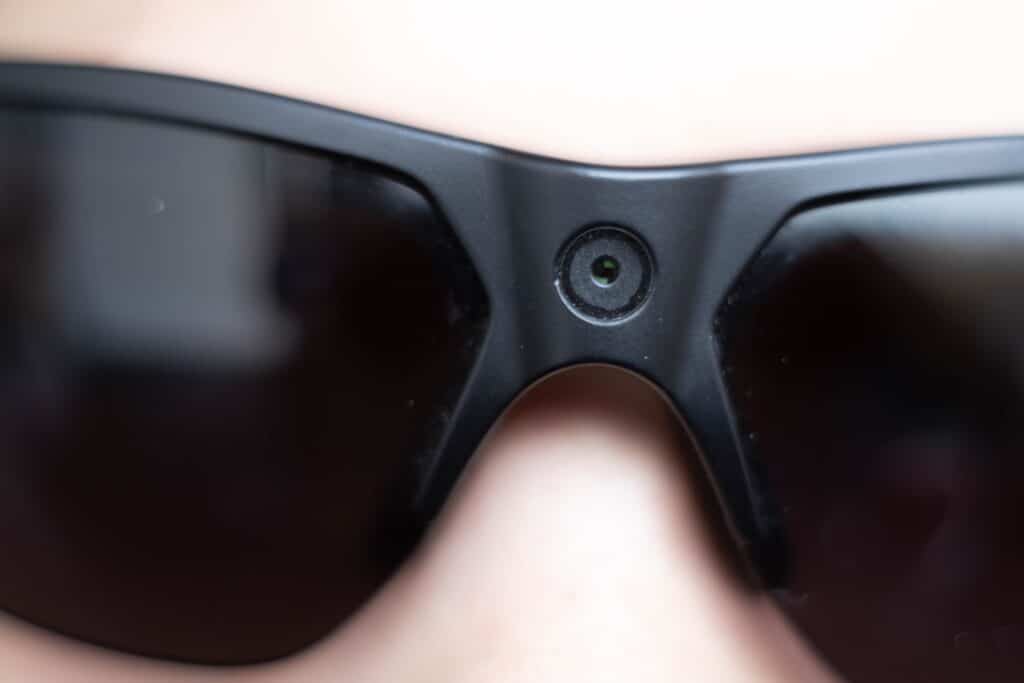
Smart glasses can be designed to look like ordinary eyewear while containing small cameras capable of capturing images of people in the officer’s field of view.
If connected to biometric identification systems, the senators warn, the devices could allow officers to scan large numbers of people in public spaces and compare their faces against government or other databases.
The letter says such a system could allow ICE and CBP officers to “capture thousands of images of faces each day” without the subjects’ knowledge or consent and could create a tool for quickly and quietly identifying members of the public.
The senators also note that DHS has not guaranteed that any data collected through the proposed devices would be limited to immigration enforcement.
That concern goes to the center of the senators’ objection. Facial recognition and other biometric systems do not merely observe public activity. They can convert public presence into identifiable, searchable data.
Once captured, a person’s image can potentially be retained, compared, shared, or used later in investigations that go beyond the original purpose for which the technology was deployed.
The senators warn that the technology could be used to support wrongful arrests, detentions, or deportations, including of U.S. citizens, lawful residents, and immigrants. They also raise the possibility that officers could use the glasses to identify protesters, journalists, activists, or government critics.
“An ICE officer could use smart glasses to identify and later target peaceful protesters, even exploiting that information to create a database of President Trump’s political opponents,” the letter states. “A CBP officer wearing smart glasses in the field could covertly scan thousands of faces a day, cross referencing them against social media and government databases to flag journalists, activists, or critics for detention.”
The senators frame the proposal as part of a broader surveillance pattern under DHS. They cite reports that ICE has used biometric tools and other surveillance techniques in encounters with people documenting immigration enforcement activity or protesting ICE operations.
In one incident cited in the letter, an ICE officer allegedly recorded a protester in Portland, Maine, and told her that her information would be placed in a “domestic terrorist” database.
In another, an ICE agent allegedly photographed a Minneapolis woman who was documenting ICE activity in her neighborhood and then recited personal information to her, including her address.
For the senators, those examples show how biometric identification systems can become tools of intimidation when used in politically sensitive contexts. The letter argues that smart glasses would make that kind of identification faster, more discreet, and easier to deploy in ordinary public settings.
“Every person in the United States has the right to move through daily life without fear that the federal government is tracking, scanning, and cataloguing their every step,” the senators wrote.
The letter also criticizes DHS for what the senators describe as a pattern of expanding surveillance programs while refusing to provide meaningful responses to congressional oversight.
The senators say they have previously sought information about ICE’s Mobile Fortify facial recognition application, CBP’s use of license plate readers, DHS’s use of predictive algorithms, social media monitoring, and the deployment of Predator drones to monitor protesters.
According to the letter, DHS and its subcomponents have not provided meaningful responses to those inquiries.
Markey has been one of the Senate’s most active critics of DHS biometric surveillance. In February, he joined several other lawmakers in introducing the ICE Out of Our Faces Act, legislation that would bar ICE and CBP from acquiring or using facial recognition technology and other biometric identification systems.
The smart glasses letter continues that line of oversight. It asks DHS to provide written answers by June 4 on the civil rights and privacy implications of the proposal, the department’s data collection and retention practices, and any third-party vendors or partners involved in developing, testing, or deploying the technology.
The senators specifically ask DHS to identify any privacy assessments, civil rights evaluations, Privacy Threshold Analyses, Privacy Impact Assessments, or third-party audits connected to smart glasses.
They also ask whether DHS has studied how the technology could affect bystanders and non-targets, whether it could chill First Amendment activity, and whether it carries risks of misidentification, disparate impact, or discriminatory outcomes.
The questions also focus on consent and data handling.
The senators asked DHS to describe what categories of biometric data would be collected, what legal authorities would support that collection, how the department would provide notice and obtain consent from people whose data is captured, how long the data would be retained, whether people could request deletion of their biometric information, and how DHS would comply with state biometric privacy laws.
The vendor question could prove especially significant. Wearable biometric identification systems typically require more than a device. They can involve camera hardware, facial recognition algorithms, mobile connectivity, cloud infrastructure, identity databases, watchlists, and data-sharing arrangements.
The senators are asking DHS to disclose any third parties involved and explain the scope and terms of those engagements.
The proposal comes amid a broader national debate over the use of biometric surveillance in immigration enforcement. Civil liberties groups have long warned that facial recognition and mobile biometric tools can expand government identification powers far beyond traditional law enforcement encounters.
For DHS, the budget language presents the smart glasses effort as a technology development project aimed at providing agents with real-time access to information and biometric identification capabilities.
For the senators, that same language confirms the danger: a mobile, covert identification system that could transform public spaces into searchable biometric environments.
The dispute is likely to become part of a larger fight over DHS surveillance authorities, immigration enforcement technology, and the role of Congress in overseeing rapidly expanding biometric systems.
Related Posts
-
 April 21, 2026
 -
 June 23, 2025
 -
 March 16, 2026
 -
 February 17, 2026
 -
 November 4, 2025
 -
May 11, 2026
Article Topics
biometric matching | biometrics | CBP | DHS | facial recognition | ICE - U.S. Immigration and Customs Enforcement | real-time biometrics | smart glasses | video surveillance | wearables

Comments