
Leaked records and smart glasses expose DHS surveillance drift
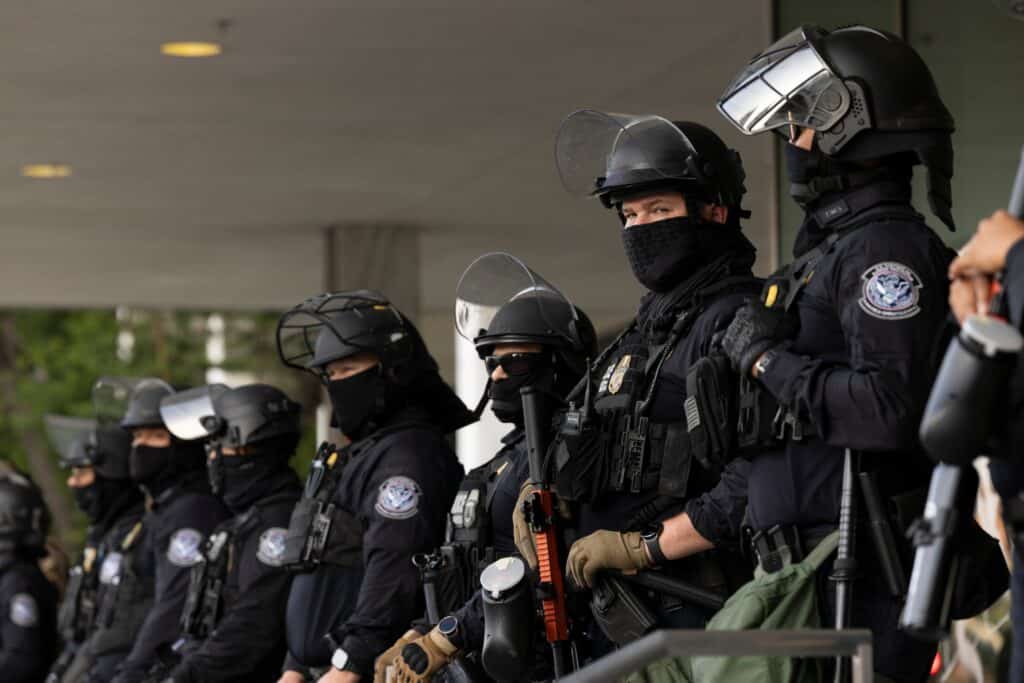
The Department of Homeland Security (DHS) is no longer just testing surveillance technology at the edges. It has built a formal pipeline for bringing new tools into the department, even as reporting suggests agents in the field are already using consumer AI devices in ways that raise fresh oversight concerns.
That pipeline runs through the Office of Industry Partnerships (OIP), a unit inside DHS’s Science and Technology Directorate that works with outside companies seeking research and development business with the department.
DHS’s own privacy assessment says the OIP Portal is the online system through which companies submit proposals for Broad Agency Announcements and other research and development opportunities. Put simply, it is a key entry point for private firms pitching new technologies to DHS.
Leaked OIP material first reported by The Guardian shows more than 1,400 funded contracts worth $845 million and a pool of more than 6,800 companies that had bid on projects through the office.
The projects described included smartphone based biometric collection tools, AI systems designed to analyze airport camera feeds, and a platform intended to ingest 911 call data and generate geospatial heat maps and incident predictions.
By itself that reporting would already be notable. But it becomes more revealing when viewed in the context of DHS’s own public disclosures.
The department’s AI use case inventory shows that Customs and Border Protection (CBP) and Transportation Security Administration (TSA) already have operational or pre-deployment systems involving video analysis, biometric processing, facial matching, and checkpoint monitoring.
CBP’s listed use cases include biometric and image analysis functions, while TSA’s inventory includes Automated Field Data Collection. Rather than describing a disconnected wish list, the leaked OIP material appears to show DHS trying to expand capabilities that already exist in some form across the department.
The smartphone biometrics work illustrates the point. The leaked records described projects meant to let agents use phones with related hardware to capture fingerprints, iris images, facial images, and contactless fingerprints. That fits the broader direction already visible in DHS’s own disclosures about biometric intake and identity processing.
The significance is not that every leaked contract matches a currently deployed system. It is that DHS is continuing to invest in making biometric collection more mobile, more flexible, and easier to deploy in the field.
The airport monitoring projects point in the same direction. The leaked records described systems designed to analyze CCTV near TSA checkpoints, track people, catalog visible characteristics, and generate automated alerts.
TSA’s own published inventory shows that checkpoint video analysis and related AI enabled operational tools are already part of the agency’s landscape. That makes the OIP material look less like a leap into unfamiliar territory and more like an extension of an existing surveillance model.
The predictive element may be the most politically sensitive. The leaked material described a platform intended to ingest 911 call data from around the country, build heat maps, and predict incident trends.
At the same time, DHS’s public AI guardrails say the department should not use AI for unlawful or improper large-scale monitoring, surveillance, or tracking of individuals.
That tension sits near the center of the story. The department’s published rules sound cautious, but the technologies moving through its innovation pipeline suggest a broader surveillance ambition.
The Independent, meanwhile, reported that Border Patrol and Immigration and Customs Enforcement (ICE) agents in six states have been seen wearing personal Meta AI smart glasses during immigration operations.
In some cases, agents appeared to use the glasses to record or photograph members of the public. The devices can take photos, record video, connect to the internet, and use voice-controlled AI to analyze what the wearer is seeing.
Viewed on its own, the smart glasses episode might seem like a separate controversy. But in context, it looks more like the operational edge of the same trend. On one side is an institutional pipeline for pulling more advanced biometric and video analysis tools into DHS. On the other is the apparent use of consumer AI eyewear by agents in the field. One is formal and bureaucratic. The other is improvised and immediate. Together they suggest a department in which surveillance capacity is expanding from both directions at once.
DHS said it does not have a contract with Meta for the glasses. It also said agents may wear personal sunglasses but are not authorized to record with personal devices.
That matters because CBP’s own Incident Driven Video Recording System directive says personally owned devices may not be used in place of official recording systems to document law enforcement encounters.
The distinction is important. Official body worn camera systems come with rules governing activation, storage, retention, and evidentiary handling. Personal AI glasses do not offer the same public assurance.
If agents can capture images or video on privately owned wearable devices that also connect to Internet-based AI services, there is far less visibility into where that data goes, how long it is kept, whether it is shared, and whether it could be combined with other government systems.
In a department that already acknowledges a growing set of AI enabled image analysis and biometric tools across its components, that is not a minor policy gap.
In three instances in Illinois, California, and North Carolina last year, agents appeared to have used Meta glasses to record or photograph people.
In other locations, including New Jersey, Louisiana, and Minnesota, agents were seen wearing the glasses, which appeared to be recording, as indicated by a white LED above the lens indicates when the glasses are recording or taking a photo.
In a January 2025 report, the DHS Office of Inspector General said the department had taken steps to develop and govern AI but issued 20 recommendations for further improvement, all of which DHS said it concurred with.
The report did not address either of these episodes directly, but it reinforced the larger point. DHS governance has not fully caught up with the speed and breadth of the technologies its components are developing, acquiring, and using.
The significance of all this is that it narrows the gap between experimentation and deployment.
For years, debates over DHS surveillance often revolved around pilot programs, prospective use cases, or abstract capability claims. What is visible now is more concrete.
DHS has an official intake system for outside firms pitching research and development technologies, and it has a public inventory showing that AI enabled surveillance related systems already exist inside major components. And agents have been reported using consumer AI eyewear during live enforcement activity.
None of this proves every project in the leaked OIP material will become an operational system. It also does not prove that every agent seen wearing Meta glasses was violating policy. But the pattern is increasingly difficult to dismiss.
DHS has built a formal apparatus for drawing surveillance technology in from the private sector, while field personnel appear willing to adopt new forms of visual capture even outside the department’s official recording architecture.
Against that backdrop, the smart glasses episode looks less like an oddity than a warning about the direction of DHS surveillance culture.
Related Posts
-
 March 2, 2026
 -
 June 23, 2025
 -
 November 13, 2025
 -
 March 31, 2025
 -
 February 13, 2026
 -
 April 12, 2025
Article Topics
biometrics | CBP | DHS | procurement | surveillance | U.S. Government | video analytics

Comments